 Birch Bay Siding
 A Business Decision, Not a Sales Pitch
Homeowners in Birch Bay sometimes ask us why we don't offer a menu of siding options the way some contractors do. It's a fair question, and it deserves an honest answer rather than a marketing one. Years of installing and repairing siding along this stretch of Whatcom County coastline taught us something simple: the products that perform well in a showroom or in a drier inland climate don't always hold up the same way three blocks from Semiahmoo Bay. Salt air, wind-driven rain, and a moss season that can run half the year put real stress on a wall assembly. At some point we stopped trying to make every product work in this climate and started only installing the one that was engineered to handle it. That product is James Hardie fiber cement siding.
This page explains the reasoning, not just the conclusion. We'll walk through what Birch Bay's climate actually does to siding, why the common alternatives struggle here in specific and predictable ways, and what Hardie's engineering does differently. Our goal isn't to talk you out of asking questions elsewhere — it's to make sure whoever you hire, you understand what you're buying.
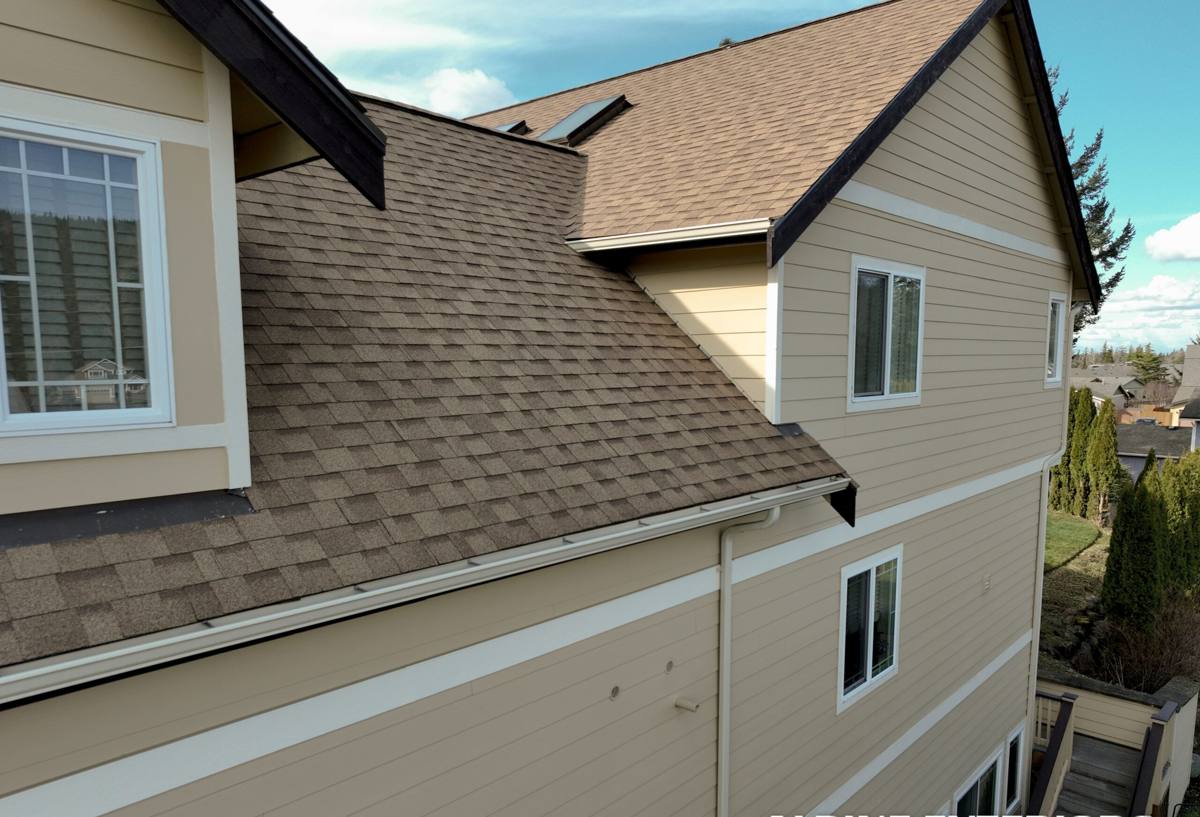
What Birch Bay's Climate Actually Does to a Wall
Birch Bay sits directly on the water, and that changes the math on exterior materials in ways that inland Whatcom County homes don't deal with. Three factors compound here:
Salt Air and Airborne Moisture
Homes within a mile or two of the water take on a constant low-level exposure to salt-laden air. Salt is hygroscopic — it pulls moisture out of the air and holds it against a surface longer than plain rain would. Over years, that accelerates corrosion of fasteners and trim, and it keeps porous or seam-heavy siding materials damp more often than a dry-climate installation would ever see.
Driving, Wind-Driven Rain
Rain here rarely falls straight down. Storms off the Strait of Georgia push rain sideways into walls, which means water finds its way into laps, seams, and fastener penetrations that a vertical-rain climate would never test. Siding systems that rely on tight tolerances or careful field caulking to stay watertight are more exposed in a driving-rain environment than their spec sheets suggest.
Long Moss and Mildew Season
Cool, damp, low-sun conditions for much of the year mean organic growth — moss, algae, mildew — gets a long runway on any surface that holds moisture or has an absorbent, organic substrate. Some siding materials feed that growth; others simply don't give it anything to hold onto.
None of this makes Birch Bay an extreme climate. It's a manageable one, but only for materials actually built for coastal, marine-layer conditions. That's the filter every product below gets run through.
Why We Don't Install Vinyl Siding
Vinyl is inexpensive, widely available, and easy to install fast, which is exactly why so many homes have it. It's not a bad product for what it is. But it has two structural weaknesses that matter more here than in a drier, calmer climate:
- Thermal movement: vinyl panels expand and contract significantly with temperature swings, and they rely on loose-nail installation to allow that movement. In wind-driven rain, that same looseness is what lets water track behind the panel.
- Impact and wind resistance: vinyl is thin and brittle in cold weather. Coastal wind gusts and wind-borne debris can crack or blow panels off in ways that thicker, denser materials resist.
Vinyl also can't be painted to a durable factory standard, so color fade and chalking show up faster under UV and salt exposure, and once it fades, your only real fix is replacement, not refinishing.
Why We Don't Install LP SmartSide
LP SmartSide is an engineered wood product — strand-based wood fiber treated with resins and zinc borate for decay resistance. It performs reasonably well in moderate climates when installed and maintained exactly to spec. Our concern in a marine environment is what happens when installation isn't perfect or maintenance lapses, because it's still wood at its core.
Wood-based products depend on an intact factory coating and sealed edges to keep moisture out. Any cut edge, fastener hole, or joint that isn't field-sealed correctly becomes a point where a wood-fiber substrate can begin to swell or delaminate. In a climate with near-constant airborne moisture and a long wet season, that margin for error is thinner than we're comfortable building a business around.
Why We Don't Install Cemplank or Allura
Cemplank and Allura are also fiber cement, which tells you we're not against the category — we install fiber cement exclusively. The distinction we draw is about factory finish quality, product engineering for climate zones, and the depth of the manufacturer support behind the warranty. James Hardie was the company that pioneered fiber cement siding in the U.S. and has put the most engineering into climate-specific product lines (more on that below) and into ColorPlus, its factory-applied finish process. When we standardize on one manufacturer, we want the one with the longest track record and the strongest backing — not because competitors are bad products, but because "good enough" isn't the standard we hold ourselves to.
Why We Don't Install Primed Spruce or Cedar
Cedar has real appeal — it's a genuinely beautiful, traditional Pacific Northwest material, and we understand why homeowners are drawn to it. But solid wood siding, primed or not, requires an ongoing maintenance commitment that most homeowners underestimate: periodic refinishing, careful caulk maintenance, and vigilant attention to any spot where paint fails and bare wood is exposed. In Birch Bay's damp, moss-friendly climate, an exposed or under-maintained cedar wall is an invitation for rot and organic growth. We've simply seen too many cedar installations fail from deferred maintenance rather than bad workmanship, and we'd rather not sell a product whose success depends on a homeowner's ability to keep up a maintenance schedule indefinitely.
What James Hardie Does Differently
Non-Combustible, Dense Fiber Cement
Hardie board is roughly 90% Portland cement, sand, and cellulose fiber. It doesn't burn, it doesn't rot, and it isn't food for insects. It's also dense enough to resist impact and hold up under sustained wind loads far better than vinyl or foam-backed products.
Climate-Engineered HZ5 Product Line
Hardie manufactures its siding in different formulations tuned to different climate zones — the HZ5 line is engineered for the wetter, freeze-thaw-prone Pacific Northwest specifically, rather than a one-size-fits-all national formulation. That's a meaningful difference from products that use the same board everywhere in the country.
ColorPlus Factory Finish
Rather than relying on field-applied paint, Hardie's ColorPlus finish is baked on in a controlled factory environment, which produces a more even, UV- and fade-resistant finish than most job-site painting can match, and it carries its own finish warranty separate from the substrate warranty.
Warranty Structure
Hardie backs its fiber cement products with a long, transferable limited warranty on the substrate, plus a separate ColorPlus finish warranty. Transferability matters to resale value — a future buyer inherits real, manufacturer-backed coverage, not just a contractor's word.
Product and Cost Comparison
| Material | Typical Lifespan | Coastal/Moisture Performance | Maintenance Burden |
|---|---|---|---|
| James Hardie fiber cement | 30-50+ years with correct install | Engineered for wet, coastal climates (HZ5) | Low — occasional wash, no repainting for years |
| Vinyl | 15-25 years | Prone to wind/impact damage, seam leakage | Low, but not repaintable when faded |
| LP SmartSide | 20-30 years if sealed perfectly | Vulnerable at unsealed cuts/joints | Moderate — coating and caulk upkeep |
| Cedar/primed spruce | Highly variable, 10-30 years | Poor if maintenance lapses | High — regular refinishing required |
Hardie generally costs more upfront than vinyl and comparably to or somewhat more than engineered wood, but the lifecycle math changes when you factor in repainting cycles, warranty coverage, and replacement intervals.
What Correct Installation Actually Involves
Hardie's own warranty is conditioned on installation to their published specifications — this is one of the most overlooked parts of the product. Correct installation in a climate like Birch Bay's includes:
- Proper weather-resistive barrier and rainscreen or drainage plane behind the siding
- Correct fastener type, spacing, and embedment depth
- Minimum clearance from grade, decks, and roof lines to keep board edges out of standing moisture
- Factory-mitered or properly sealed joints and butt seams
- Correct caulking at penetrations, trim, and terminations using Hardie-compatible sealants
A homeowner evaluating any contractor's Hardie bid should ask specifically how each of these is handled — it's the difference between a 30-50 year installation and a much shorter one, regardless of the product on the truck.
The Honest Trade-Off
We won't pretend Hardie is the cheapest option on the market, because it isn't. If upfront price is the only factor, vinyl will win that comparison every time. What we're telling homeowners is that in Birch Bay's specific combination of salt air, driving rain, and a long moss season, the products that look competitive on price tend to show their weaknesses within the first decade — fading, seam failure, moisture intrusion, or maintenance homeowners didn't sign up for. We'd rather install one product correctly and stand behind it than offer five options and hope the cheaper ones hold up.
If you're weighing a siding replacement in Birch Bay or anywhere else in Whatcom County, we're happy to walk your home, look at your specific exposure, and give you a straightforward estimate for James Hardie siding — no pressure, and no pitch for a product we wouldn't put on our own homes.