 Birch Bay Siding
 The Question Every Birch Bay Homeowner Eventually Asks
If you've priced out a re-side in Birch Bay, you've run into the same fork in the road nearly everyone here does: vinyl siding or James Hardie fiber cement. Both are legitimate, widely used products. Both show up on homes up and down Semiahmoo Bay and Whatcom County. But they behave very differently once they're actually exposed to the marine environment we live in — salt-laden air off the Strait of Georgia, wind-driven winter rain, and the long, damp moss season that hangs on from October through May. This page lays out the honest differences so you can make the call with real information, not marketing copy.
We'll say upfront where we land: our company installs James Hardie fiber cement exclusively. We don't install vinyl, and we'll explain why below. But that doesn't mean vinyl is a bad product — it means we've made a professional judgment about what holds up best on homes in this specific climate, and we think you deserve to see the reasoning, not just the conclusion.
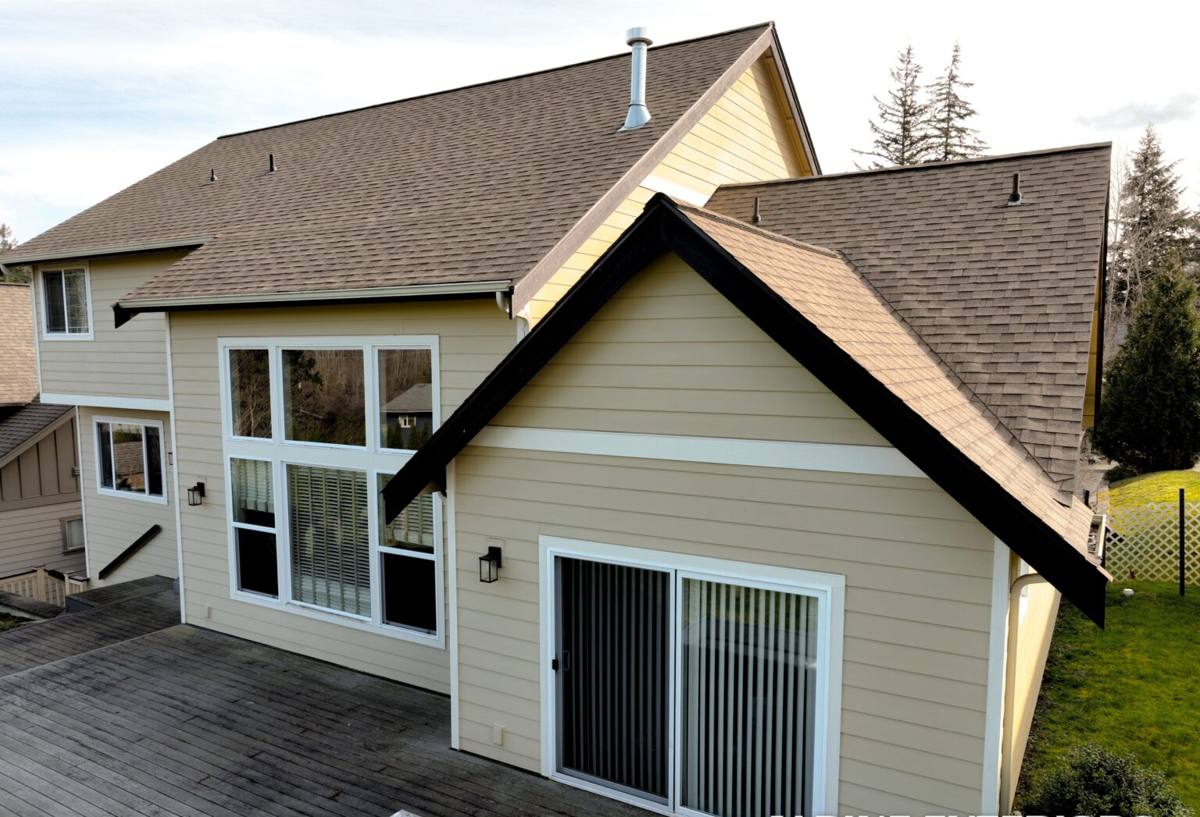
Vinyl Siding: What It Gets Right
Vinyl earned its market share honestly. It's lightweight, relatively inexpensive to manufacture and install, and it doesn't rust or rot in the way raw wood does. For budget-sensitive projects, it's often the lowest up-front cost option on the table, and a well-installed vinyl job can look clean for a number of years. It's also low-maintenance in the sense that it never needs painting — the color is baked into the material itself.
Where vinyl runs into trouble isn't the material's basic chemistry — it's how that chemistry responds to sustained coastal exposure over decades, which is exactly the environment Birch Bay sits in.
Where Vinyl Struggles in a Coastal Whatcom County Climate
Salt Air and UV Together
Vinyl is a PVC product, and PVC fades and becomes brittle with prolonged UV exposure. Combine that with the salt air rolling in off the water — which accelerates the breakdown of surface coatings on a lot of exterior materials — and you get vinyl that chalks, fades unevenly (worse on south and west-facing walls), and becomes noticeably more brittle within 10-15 years. Brittle vinyl cracks more easily from hail, thrown debris, or even an errant ladder, and cracked panels are a repair-and-replace hassle rather than a spot-patch.
Driving Rain and Water Management
Vinyl siding isn't a sealed water barrier — it's designed to shed the bulk of the water while relying on the house wrap and flashing behind it to manage what gets through the overlapping panels. That's a fine system in a moderate climate. In Birch Bay's driving, wind-blown winter rain, water gets pushed harder into those laps and channels than the product was originally designed to handle in milder regions, which puts more pressure on the house wrap doing the real waterproofing work. If that underlying assembly isn't detailed well, moisture problems show up behind the siding long before they're visible on the surface.
The Long Moss Season
Vinyl's slightly textured, low-gloss surface and the shaded, damp conditions under eaves and on north-facing walls give moss and algae a foothold, especially through our long wet season. It's cosmetic, but it means regular washing to keep panels looking clean, and pressure washing vinyl too aggressively can crack panels or force water up under the laps.
Thermal Movement
Vinyl expands and contracts substantially with temperature swings, which is why it has to be installed "hung," not nailed tight, to allow for movement. Get that installation detail wrong — and it's a common mistake — and panels buckle, warp, or pop loose in a hard wind, which the Strait delivers plenty of.
James Hardie Fiber Cement: What It's Actually Made Of
James Hardie siding is a fiber cement product — a mix of Portland cement, sand, and cellulose fibers, cured into a rigid board. It's non-combustible, doesn't support moss and algae growth the way vinyl's surface does, and holds its shape and color far more consistently through decades of coastal weather. It's also considerably heavier and more rigid than vinyl, which matters when 40-50 mph gusts are pushing on your walls.
Climate-Engineered HZ Product Lines
James Hardie engineers its HZ10 product line specifically for wetter, harsher climates like ours in the Pacific Northwest — denser formulation aimed at better moisture and freeze-thaw resistance than their standard HZ5 line built for milder regions. For a Whatcom County home taking direct salt spray and driving rain off the water, that's not a marginal spec difference — it's the reason the HZ line exists at all.
ColorPlus Factory Finish
Rather than field-painted, most Hardie siding installed today uses the ColorPlus finish — a multi-coat, baked-on finish applied at the factory under controlled conditions, which adheres and weathers more evenly than most job-site paint applications. It comes backed by its own dedicated finish warranty, separate from the substrate warranty on the board itself.
Side-by-Side: Vinyl vs. James Hardie
| Factor | Vinyl Siding | James Hardie Fiber Cement |
|---|---|---|
| Material | PVC plastic | Cement, sand, cellulose fiber |
| Combustibility | Melts/deforms under heat | Non-combustible |
| UV/salt air fade resistance | Fades and chalks over time | ColorPlus finish holds color far longer |
| Impact resistance | Cracks, especially as it ages/becomes brittle | Resists impact well; can chip if struck hard |
| Moss/algae resistance | Textured surface holds growth | Denser surface, less prone to growth |
| Wind performance | Lighter, can flex or pop loose if under-installed | Heavier, rigid, holds tight to the wall |
| Maintenance | Periodic washing; no painting | Periodic washing; repaint only if finish is field-applied |
| Typical lifespan (Northwest coastal) | 15-25 years before fading/cracking becomes an issue | 30-50+ years with correct install and upkeep |
| Upfront cost | Lower | Higher |
Installation Sensitivity: Why the Installer Matters as Much as the Product
Both products can fail early — not because the material is bad, but because they were installed wrong. Vinyl needs correct nailing (hung loose, not tight) to allow thermal movement. Hardie needs correct fastening, gapping at butt joints, proper flashing at penetrations, and factory-cut or properly sealed field cuts to keep water out of the cut edge, which is the one part of the board not protected by the factory finish. A poorly installed Hardie job can underperform a well-installed vinyl job, and vice versa. This is why who installs your siding matters at least as much as which siding you choose — ask any contractor how they detail cut edges, butt joints, and flashing before you sign anything.
Warranty Structure: What You're Actually Covered For
Vinyl warranties are typically prorated — full coverage in the early years, declining coverage as the product ages, and they're frequently non-transferable to a new owner, which matters if you plan to sell. James Hardie's warranty on the substrate is a long-term, transferable warranty when the product is installed to Hardie's specifications, with the ColorPlus finish carrying its own separate finish warranty. Read the fine print on any siding warranty — "lifetime" language often means the lifetime of the original owner's residence in the home, not an unconditional forever guarantee, and workmanship (versus material) coverage is a separate matter entirely, tied to your installer, not the manufacturer.
Cost Over Time, Not Just at Install
Vinyl's lower purchase price is real, and for a homeowner planning to sell within a few years, that math can make sense. But if you're planning to stay in the home, the comparison should include replacement cycle: a vinyl job that needs full replacement at 18-20 years due to fading and cracking, versus a Hardie job with a much longer service life, changes the effective cost-per-year even though the upfront numbers favor vinyl. Add in that faded, brittle vinyl is difficult to touch up (colors are notoriously hard to match once discontinued or weathered), while Hardie's baked-on finish keeps its factory color much longer, and the total picture shifts further.
Why We Standardized on James Hardie
We made a call, as a company, to only install James Hardie. Not because vinyl doesn't have a place in the market, but because we didn't want to keep watching homes in this exact climate — salt air, driving rain, that long moss season — wear through vinyl's weak points years before it should, and then get called back for repairs we knew were coming from day one. Hardie's HZ10 line, the ColorPlus finish, and the non-combustible substrate line up with what actually holds up on Birch Bay and Whatcom County homes long-term. That's the entire reason behind the decision — it's a standard, not a sales pitch.
Questions Worth Asking Before You Choose a Siding Contractor
- Do you install more than one siding brand, and if so, why did you choose the ones you offer?
- How do you detail cut edges and butt joints to keep water out?
- What does your warranty cover for workmanship, separate from the manufacturer's material warranty?
- Can you walk me through how the product performs in salt air and driving coastal rain specifically?
- What's the realistic maintenance schedule for the product you're recommending?
If you're weighing vinyl against James Hardie for a home in Birch Bay, we're happy to walk your property, look at your exposure to wind and salt air, and give you a straightforward, no-pressure estimate for a Hardie install — no hard sell, just an honest look at what your home actually needs.