 Birch Bay Siding
 Why Cedar Keeps Coming Up
If you've been pricing out siding options for a home in Birch Bay, cedar has probably crossed your mind. It's a Pacific Northwest classic — warm, natural-looking, and tied to the same forests that built half the houses in Whatcom County. Real estate listings still use "cedar siding" as a selling point, and it's easy to see why: freshly installed cedar is genuinely gorgeous, and there's a long regional history of it holding up on older homes.
We get asked about cedar siding often enough that it's worth addressing directly. This page isn't here to talk you out of liking the look of cedar — it's here to walk through what actually happens to that wood once it's on a wall a few hundred feet from Semiahmoo Bay or Birch Bay's own shoreline, year after year, through our wet winters and mossy shoulder seasons. We install James Hardie fiber cement exclusively, and cedar is one of the main reasons why. Here's the honest version of that story.
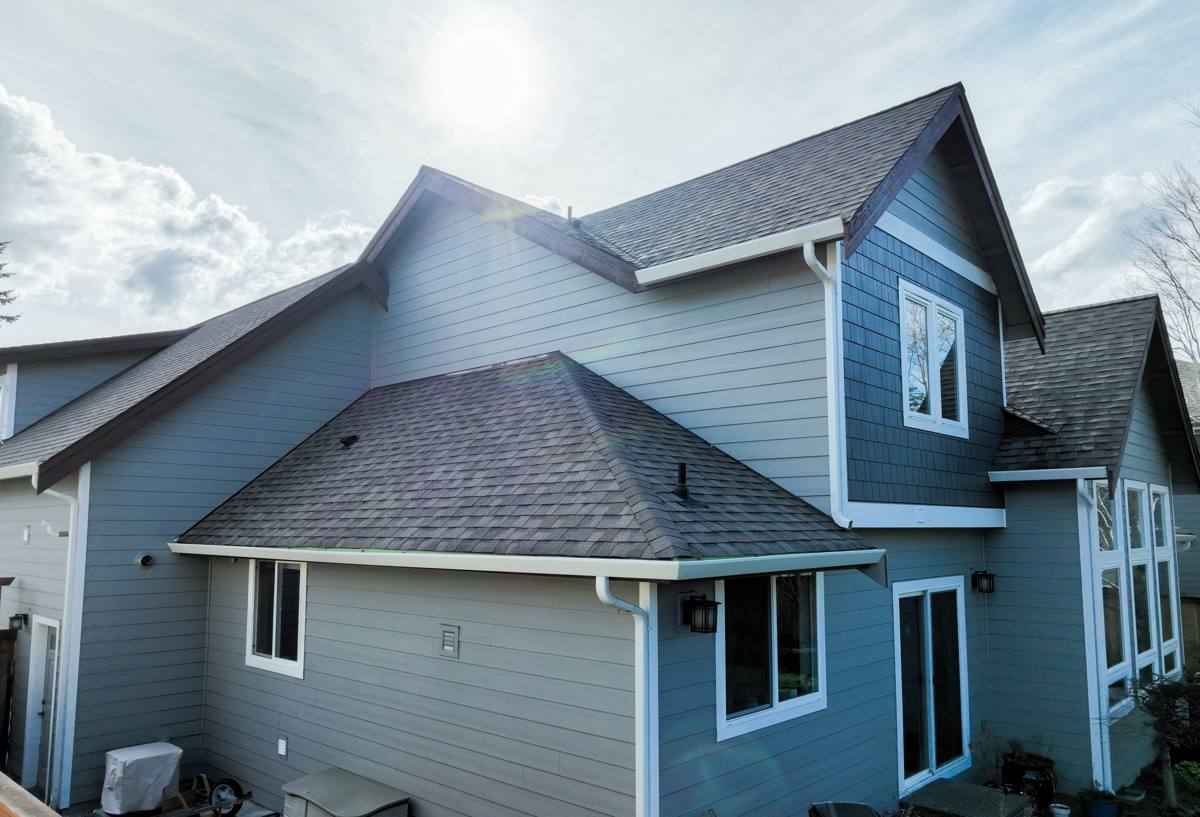
What Cedar Actually Gets Right
Before getting into the trade-offs, it's worth being straight about what cedar does well, because none of it is marketing spin.
Appearance and Character
Cedar has a grain, warmth, and texture that manufactured products spend a lot of engineering trying to replicate. Vertical grain clear cedar in particular has a look that's hard to argue with. It ages into a range of tones depending on how it's finished, and it's genuinely a beautiful building material.
Workability
Cedar is light, easy to mill, and forgiving to work with on-site, which is part of why it became the default siding choice across the Pacific Northwest for decades. It cuts cleanly and takes stain or paint well when it's properly prepped.
Natural Insulating Properties
Wood has better natural insulating value than most other siding materials of comparable thickness, and cedar specifically resists insect damage better than many softwoods thanks to natural oils in the wood.
None of that is in dispute. The problem isn't what cedar is when it goes up. The problem is what happens to it over the following 10, 15, and 20 years in this specific climate.
The Birch Bay Climate Problem
Birch Bay sits right on the water, and that proximity to salt water changes the math on exterior materials in ways that inland Whatcom County homes don't deal with as severely.
Salt Air
Airborne salt is corrosive and hygroscopic — it pulls moisture out of the air and holds it against surfaces longer than they'd otherwise stay wet. On wood siding, that means finishes break down faster, fasteners corrode sooner, and the wood itself stays damp longer after a storm than it would a few miles inland. Metal fasteners and flashing detailing that would be fine in Bellingham can show corrosion issues on a waterfront Birch Bay home years earlier.
Driving Rain
Storms coming off the Strait of Georgia don't just drop rain straight down — wind-driven rain hits siding at an angle, working into laps, seams, and end grain in a way vertical rain doesn't. Wood is most vulnerable exactly where it's most likely to get hit: cut ends, board edges, and butt joints.
Moss and Algae Season
Whatcom County's long, mild, wet stretch from fall through spring is close to ideal growing conditions for moss and algae. North-facing walls, shaded elevations under trees, and anywhere siding stays damp for extended periods are prone to green and black staining. On cedar, that's not just cosmetic — moss and algae hold moisture against the wood surface, which accelerates the exact decay processes you're trying to avoid.
Moisture, Movement, and Maintenance
Wood is a natural material, which means it moves. It swells when it absorbs moisture and shrinks as it dries out, cycle after cycle, season after season. Over years, that movement shows up as cupping, checking (surface cracks), and eventually splitting, especially on flatter-sawn boards or lower-grade material.
To slow that process, cedar siding needs a real maintenance schedule, not a one-time coat of stain at installation:
- Re-staining or re-sealing every 3 to 5 years, sometimes sooner on sun- and salt-exposed elevations
- Regular washing to keep moss, algae, and organic debris from sitting on the surface
- Caulk inspection and renewal around joints, trim, and penetrations
- Prompt repair or replacement of any board showing checking, cupping, or soft spots before rot spreads to neighboring boards
- Careful attention to end grain at every cut, since that's where moisture intrusion starts fastest
Skip that schedule for a few years — which happens to almost every homeowner at some point — and cedar starts losing ground faster than it can be caught back up. Once moisture gets past a failed finish and into the wood fiber, especially in a spot that doesn't dry out quickly because of shade or salt-laden air, rot can set in at fastener penetrations, board ends, and behind trim before it's visible from the ground.
Fire Risk and Insurance Reality
Western Washington doesn't get the wildfire headlines that Eastern Washington does, but insurers have been paying closer attention to combustible exterior materials statewide, and that trend isn't reversing. Cedar, like any wood siding, is a combustible material. Fiber cement is not.
For most Birch Bay homeowners, this isn't the single deciding factor — it's one more piece of the picture. But it's worth knowing that some insurers now offer better terms for non-combustible siding, and that gap in underwriting treatment has been widening, not narrowing.
Cost Over the Life of the Siding
The sticker price comparison between cedar and fiber cement can look closer than it actually is, because cedar's real cost shows up over time, not on day one.
| Factor | Cedar Siding | James Hardie Fiber Cement |
|---|---|---|
| Initial material cost | Moderate to high (higher for clear grades) | Moderate |
| Refinishing cycle | Every 3-5 years | ColorPlus factory finish — no repainting for typical warranty period |
| Moisture/rot vulnerability | Higher, especially at end grain and joints | Engineered to resist moisture, rot, and pest damage |
| Combustibility | Combustible | Non-combustible core |
| Typical warranty | Varies by installer; material itself carries limited protection | Long-term, transferable manufacturer warranty |
| Salt air / coastal durability | Requires more frequent upkeep near water | HZ5 product line engineered for moisture-prone climates |
The refinishing line is the one that catches people off guard. Stain, labor, and prep work every few years adds up over a 20-year window to a real, recurring cost that a lot of homeowners don't budget for when they're comparing sticker prices at the start.
Cedar Grades and What You're Actually Buying
Not all cedar siding is the same, and grade matters more than most homeowners realize when they're shopping by price.
Clear Grades
Free of knots, clear vertical-grain cedar is the premium option — better dimensional stability, fewer weak points for moisture entry, and a more uniform appearance. It's also the most expensive, and even clear cedar isn't immune to the maintenance schedule above.
Knotty Grades
Lower-cost cedar siding contains more knots, which are natural weak points. Knots can loosen, fall out, or become entry points for moisture over time, and they're more likely to show tannin bleed-through if not properly primed and finished.
The trade-off is straightforward: paying up for clear grade cedar reduces some of these risks but doesn't eliminate the fundamental issue — you're still maintaining a natural wood product in a marine climate.
Before You Choose Cedar: A Checklist
If you're still weighing cedar for a Birch Bay home, these are the honest questions to work through first:
- Am I prepared to re-stain or re-seal on a 3-5 year schedule, including the cost and hassle of scheduling that work?
- Which elevations of my home get the most shade, wind-driven rain, or salt exposure, and am I okay with those needing extra attention?
- Have I priced out 15-20 years of maintenance, not just the installed cost today?
- Does my insurance carrier treat combustible siding differently in their pricing or coverage terms?
- Am I choosing cedar because I love the look specifically, or because I haven't seen how close fiber cement finishes can get to it?
Why We Install James Hardie Instead
We made the decision years ago to install only James Hardie fiber cement siding, and cedar's climate performance in a place like Birch Bay is a big part of that decision. Hardie's HZ5 product line is engineered specifically for moisture-prone, high-humidity climates like ours — it's not a generic siding product retrofitted for the Pacific Northwest, it's built for it.
The ColorPlus factory finish process bakes color onto the board under controlled conditions, which holds up dramatically better against sun, salt air, and moisture than a field-applied stain ever will, and it removes the recurring refinishing cost entirely for a long stretch of the product's life. Fiber cement's core material doesn't swell, cup, or check the way wood does, and it doesn't feed moss and algae growth the way organic wood fiber can. It's non-combustible, and it carries a strong transferable warranty when installed to manufacturer spec.
We're not going to tell you cedar is a bad material — it isn't. It's a beautiful, time-tested Pacific Northwest siding choice that plenty of homes have carried well for decades with disciplined maintenance. But "disciplined maintenance for decades" is the operative phrase, and in a coastal Whatcom County climate with salt air, driving rain, and a long moss season, that's a bigger ask than most homeowners realize when they're standing in a showroom looking at a clean, freshly milled sample board. We'd rather put a product on your home that's engineered to handle Birch Bay's climate with far less of that burden on you.
If you're weighing cedar against fiber cement for your home, we're happy to walk the property with you, look at your specific exposure and elevations, and give you a straight answer — no pressure, no sales script. Reach out for a free estimate and we'll talk through what actually makes sense for your house.