 Birch Bay Siding
 Ferndale and Birch Bay: A Different Kind of Pacific Northwest Weather
Homes in Ferndale and the surrounding Birch Bay area sit close enough to the water that the weather here isn't quite the same as inland Whatcom County. You get the marine layer, the salt-tinged air off the bay, and long stretches of the year where the ground barely dries out between storms. It's a beautiful place to live, but it's also a demanding place to own a house. Exterior materials that hold up fine in a drier climate start to show their age fast out here, and the homes that age the most gracefully are almost always the ones where the siding, roofing, and trim were chosen and installed with this specific climate in mind.
We work throughout Whatcom County, and Ferndale and Birch Bay are areas we know well. The weather pattern isn't identical from one street to the next — a home tucked into trees a few blocks off the water behaves differently than one sitting exposed to the wind coming across the bay — but the underlying stressors are the same, and they're worth understanding before you make any decision about your exterior.
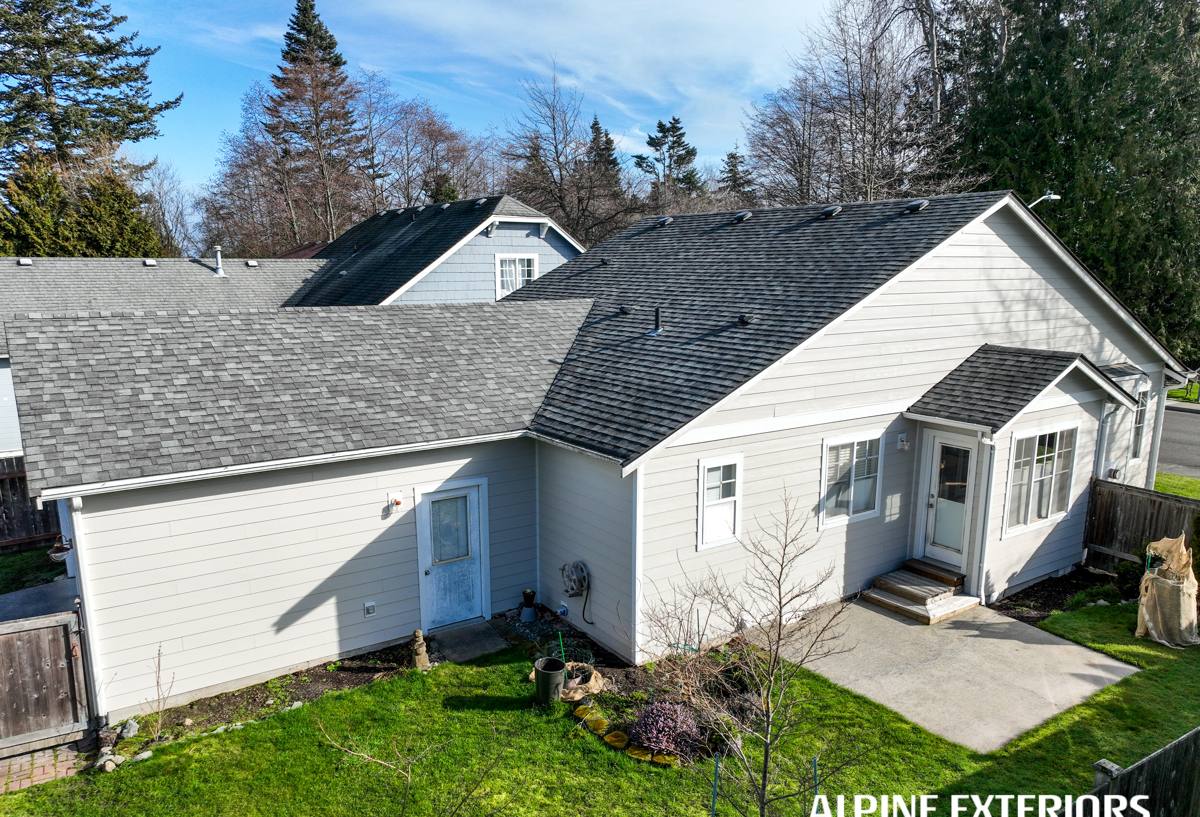
What Salt Air, Driving Rain, and Moss Actually Do to a House
Salt Air and Coastal Corrosion
Salt-laden air doesn't just affect boats and dock hardware. It accelerates corrosion on exposed fasteners, flashing, and metal trim, and it can be harder on painted and coated surfaces than people expect. Over years, homes closer to Birch Bay tend to show more fading, chalking, and hardware corrosion than similar homes further inland. This is one of the reasons material choice matters so much here — some products handle a marine-influenced environment far better than others.
Wind-Driven Rain and Water Intrusion
Whatcom County gets a lot of rain, but the rain that does the real damage in this area is the sideways kind — wind-driven rain that gets pushed up under laps, into seams, and behind poorly flashed penetrations. A siding system that's only designed to shed water straight down isn't enough here. What matters more is how the whole assembly — siding, house wrap, flashing, window and door details — handles water that's actively being pushed sideways and upward by wind off the water.
The Long Moss Season
Between the moisture and the shade many Ferndale and Birch Bay lots get from mature trees, moss and algae growth is a near-constant battle on north-facing walls, rooflines, and anywhere airflow and sun exposure are limited. Moss holds moisture against a surface far longer than open air would, which is a slow but steady problem for any material that isn't dimensionally stable or that can absorb water into its substrate. It's also just a maintenance headache — nobody wants to be pressure-washing siding every year to keep it looking clean.
Why We Install Only James Hardie Fiber Cement Siding Here
We made a deliberate decision years ago to standardize on James Hardie fiber cement siding and not offer vinyl, LP SmartSide, or other engineered wood or composite products. That's not a marketing position — it's a practical one, shaped by exactly the kind of weather Ferndale and Birch Bay deal with.
Fiber cement is non-combustible, dimensionally stable, and doesn't absorb and swell with moisture the way wood-based products can. James Hardie's ColorPlus finish is baked on at the factory under controlled conditions, which gives it better fade and adhesion performance than field-applied paint, and it holds up well against the UV and salt exposure common in coastal Whatcom County. Hardie also engineers specific product lines (their "HZ" designations) for different climate zones, including wetter, cooler regions like ours — the product itself is built with this weather in mind, not just marketed for it.
We're not going to tell you other siding products are junk — vinyl and engineered wood both have legitimate uses and plenty of homes are sided in them without issue. But for the moisture load, wind exposure, and moss pressure this area sees, we've found fiber cement gives homeowners the best long-term outcome with the least maintenance, and that's the standard we hold our own work to.
Siding, Roofing, Windows, and Decks: One Weather-Tight System
Siding doesn't work in isolation. Water intrusion problems on Ferndale and Birch Bay homes are frequently traced back to the places where different systems meet — where siding meets a window, where a roofline meets a wall, where a deck ledger attaches to the house. We handle siding, roofing, windows, and decks, and treating those as one connected weather-tight system rather than four separate projects is a real advantage when your home is dealing with driving rain and constant moisture.
When we replace siding, we're looking at your flashing details, your window and door transitions, and your roof-to-wall connections at the same time — not just cladding the walls and moving on. That's especially important on a home exposed to wind off the water, where a small gap or missed flashing detail becomes a real problem much faster than it would somewhere drier.
Roofing
Roof-wall intersections, valleys, and penetrations are common failure points in wind-driven rain. Proper roofing work protects the top of the wall assembly your siding depends on.
Windows
Window flashing and integration with the siding's water-resistive barrier is one of the most common places we find prior water damage on older homes in this area.
Decks
Deck ledger attachments and any siding cut around a deck need careful flashing — a poorly detailed ledger board is a classic source of hidden rot in wet climates.
What Correct Installation Looks Like in Whatcom County
James Hardie siding performs the way it's designed to only when it's installed correctly, and installation quality matters more here than in a drier climate because there's less margin for error. Proper installation in this area means attention to a few specific things:
- Correct water-resistive barrier and house wrap, lapped and taped to actually shed water rather than trap it
- Proper flashing at every window, door, and penetration, integrated with the house wrap in the right shingle-lap order
- Adequate clearance between siding and grade, decks, roof lines, and other horizontal surfaces where water tends to collect
- Correct fastening per Hardie's specifications, including fastener type and placement suited to coastal, salt-air conditions
- Proper joint and butt-seam treatment, caulked and detailed per manufacturer specs to prevent water tracking behind the boards
- Field-cut edges primed or sealed so moisture can't wick into the cut cement board
Skipping any of these doesn't usually cause a visible problem right away — it shows up two, five, or ten years later as staining, rot in the sheathing behind the siding, or paint failure. That's why installation quality is at least as important as the product itself.
Comparing Siding Materials for Coastal Whatcom County Homes
| Material | Moisture Behavior | Coastal/Salt Air Durability | Maintenance in This Climate |
|---|---|---|---|
| James Hardie Fiber Cement | Dimensionally stable, doesn't swell or rot | Strong; factory finish resists fade and chalking | Occasional wash; repaint not required for many years |
| Vinyl | Doesn't absorb water, but can warp with heat/cold cycling | Can become brittle and fade faster under UV and salt exposure over time | Low, but limited repair options if damaged |
| LP SmartSide / Engineered Wood | Wood-based substrate; vulnerable if moisture reaches cut edges or seams | Moderate; performance depends heavily on installation and sealing | Requires more diligent edge sealing and inspection |
| Cedar / Primed Wood | Absorbs moisture readily; prone to swelling and rot without upkeep | Struggles most in prolonged wet, mossy conditions | High; regular refinishing and moss treatment needed |
A Homeowner's Seasonal Maintenance Checklist
Even the best-installed siding benefits from some basic upkeep in a climate like this. A short annual routine goes a long way:
- Rinse siding and trim once or twice a year, especially shaded and north-facing walls prone to moss and algae
- Keep gutters clean and check that downspouts direct water well away from the foundation and siding base
- Trim back vegetation and tree limbs that keep walls shaded and damp
- Walk the exterior after major windstorms and check caulking around windows, doors, and trim for cracks or gaps
- Look at deck ledger and roof-wall intersections yearly — these are the first places hidden leaks tend to show up
- Address any soft spots, staining, or bubbling paint promptly rather than waiting for the next dry season
What Influences Your Project Cost
| Factor | Why It Matters |
|---|---|
| Home size and wall complexity | More corners, gables, and trim details mean more labor and material |
| Existing exterior condition | Rot or water damage found once old siding is removed adds repair scope |
| Siding profile and color | Lap width, shingle-style panels, and ColorPlus finish options vary in cost |
| Site exposure | Higher wind/salt exposure sites may call for extra flashing and detailing |
| Scope beyond siding | Bundling roofing, window, or deck work can affect overall project sequencing and pricing |
Why a Local Crew Matters in Ferndale and Birch Bay
A lot of exterior problems we see on homes in this area trace back to work that was done by a crew unfamiliar with how this climate actually behaves — details that would be fine in a drier part of the state but that don't hold up against sustained wind-driven rain and a long moss season. Knowing which walls in this area take the worst weather, how local wind patterns push rain, and what kind of moisture load the ground around Birch Bay tends to hold onto isn't something you get from a general specification sheet. It comes from working on houses in this specific area, season after season.
We're not asking you to take our word for it sight unseen. We're happy to walk your property, look at your specific exposure, and give you a straight answer about what your home actually needs — not a generic recommendation.
If you're weighing a siding, roofing, window, or deck project on a home in Ferndale or Birch Bay, we're glad to come take a look and put together a free, no-pressure estimate based on what your house is actually dealing with.