 Birch Bay Siding
 Why Moisture Is the Real Enemy of Siding on the Coast
Most siding doesn't fail because it gets old. It fails because water gets behind it and stays there. In Birch Bay, that's not a rare event — it's the default condition for a big chunk of the year. Between the marine air coming off the Strait of Georgia, the driving rain that Whatcom County sees from fall through spring, and a moss season that can run six months or longer under tree cover, siding here is under near-constant moisture pressure. The question isn't whether your siding will get wet. It's whether it can dry out again before rot sets in.
This page is about understanding that process — how water gets in, what it does once it's there, and how to tell the difference between a cosmetic problem and a structural one.
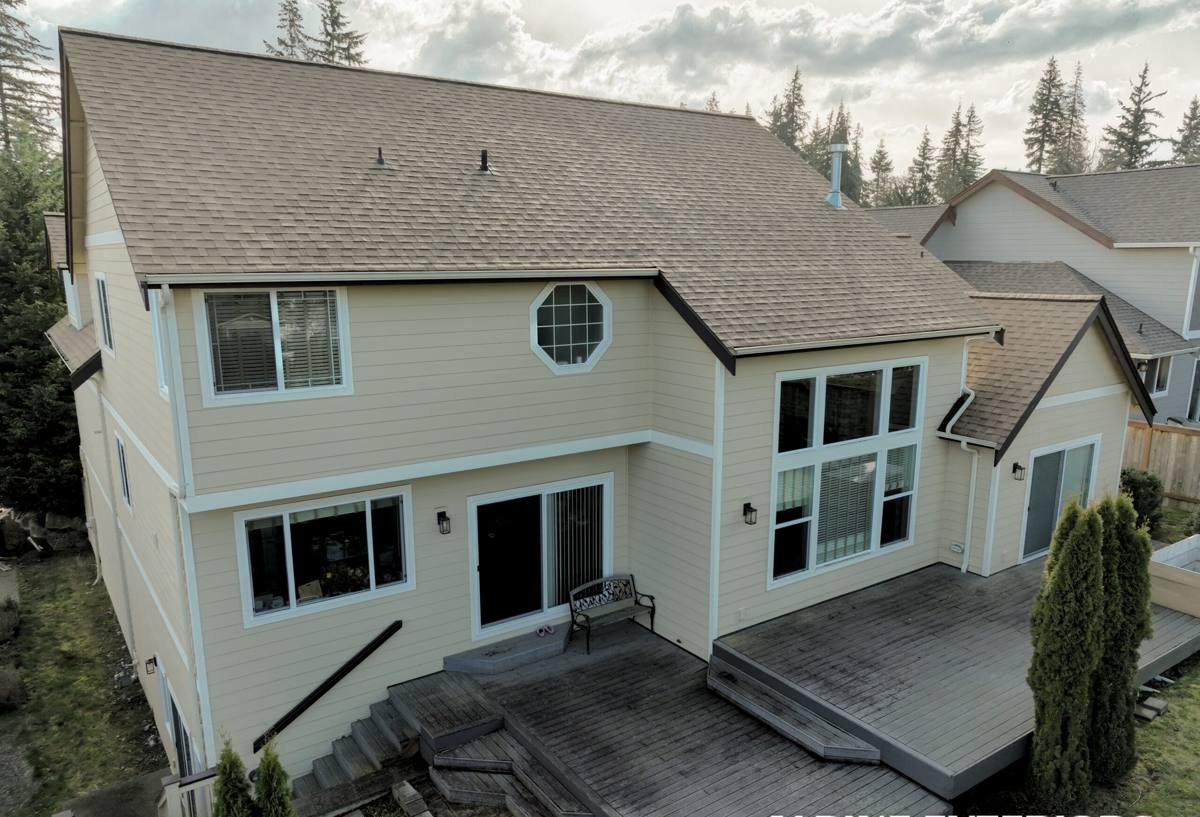
How Water Actually Gets Behind Siding
Siding itself is a rain-shedding layer, not a waterproof membrane. It's designed to work with a weather-resistive barrier (house wrap) and flashing underneath it. Problems start when that system has a gap — and gaps are common, especially on homes that weren't detailed for a wet coastal climate in the first place.
Common entry points
- Failed or missing caulk at trim joints, window and door edges, and butt seams
- Nail holes and fastener penetrations that were driven too deep or at the wrong angle
- Missing or poorly lapped flashing above windows, doors, and horizontal trim
- Siding installed tight to the ground, a deck, or a roofline with no drainage gap
- Kick-out flashing missing where a roof edge meets a sidewall
Once water gets past the siding face, it travels behind the cladding and follows gravity down the wall assembly. It doesn't have to enter right where the damage shows up — a leak at a second-story window can rot sheathing a floor below.
What Happens Once Water Is Trapped
Wood-based materials — solid wood, primed spruce trim, OSB-based siding products, and the wood sheathing behind almost every wall — all share the same vulnerability: they're organic material, and organic material rots when it stays wet. The process is gradual. Fibers swell, paint or finish starts to fail from the inside out, and fungal decay begins working through the wood's structure. By the time you see visible cupping, soft spots, or paint bubbling on the surface, the damage underneath is usually further along than it looks.
Fiber cement behaves differently. It's made from cement, sand, and cellulose fibers — an inorganic material that doesn't rot and doesn't provide food for fungus. It can still absorb and hold moisture at a cut edge or a damaged factory finish, which is why edge sealing and proper installation still matter. But the material itself isn't decaying the way wood-based products can.
How Common Siding Materials Handle Moisture
| Material | Moisture behavior | Maintenance burden | Coastal fit |
|---|---|---|---|
| Solid wood / cedar | Absorbs water, expands and contracts, decays if finish fails | High — refinishing on a recurring cycle | Struggles without disciplined upkeep |
| Primed spruce/pine trim | Wood substrate under a thin factory primer; end grain and cut edges absorb readily | High — repaint and caulk maintenance | Poor match for constant marine moisture |
| Engineered wood (OSB-based) | Wood strand core; performs well when the finish stays intact, vulnerable if water reaches the core | Moderate — finish and edge care | Installation detailing matters a lot here |
| Vinyl | Doesn't rot itself, but doesn't stop water either — relies entirely on the barrier behind it | Low surface maintenance | Can trap moisture behind it in wet climates |
| Fiber cement | Non-organic, doesn't rot; factory finish resists moisture at the face | Low — no repainting cycle when factory-finished | Built for wet, salt-exposed climates |
The Salt Air Factor
Birch Bay's proximity to saltwater adds a layer most inland Whatcom County homes don't deal with. Salt-laden air accelerates corrosion of fasteners, flashing, and any exposed metal in the wall assembly. Corroded fasteners loosen their grip on siding and trim, opening tiny gaps that let water in even when the siding material itself is sound. Salt also holds moisture in the air near the surface longer than dry inland air would, slowing the drying cycle between rain events. That combination — more corrosion, slower drying — is part of why materials and fastener choices that work fine forty miles inland can underperform right along the water.
Moss, Algae, and the Long Wet Season
Whatcom County's tree cover and marine humidity make it prime territory for moss and algae growth on north-facing walls, shaded siding, and anywhere airflow is limited. Moss isn't just cosmetic. It holds water against the siding surface far longer than open air would, keeping that section of wall wet through dry spells that would otherwise let everything else on the house recover. Over a full moss season, that's a lot of extra cumulative moisture exposure concentrated on the same few square feet of wall.
Moss growth is also a symptom worth reading. If moss is establishing itself heavily in one spot, that area is staying wetter than the rest of the house — which is exactly the kind of localized moisture problem that leads to rot underneath, whether the siding is wood, engineered wood, or something else.
Warning Signs of Hidden Moisture Damage
Rot usually announces itself quietly before it becomes an obvious problem. Walk your home's exterior a couple of times a year — especially after the wet season — and look for these signs.
- Paint that's bubbling, peeling, or alligatoring in a localized area rather than uniformly
- Siding boards that feel soft, spongy, or give slightly when pressed
- Visible cupping, buckling, or separation at seams and joints
- Dark staining or streaking below trim, window sills, or butt joints
- A musty smell near an exterior wall from the inside of the house
- Heavy moss or algae concentrated in one section rather than spread evenly
- Fastener heads that are rust-streaked or backing out of the surface
Any one of these on its own might be minor. Two or three in the same area is a strong signal that there's an active moisture problem behind the surface, not just on it.
Repair, Patch, or Replace?
Not every moisture issue means a full re-side. A localized failure — one bad caulk joint, a missing piece of flashing, a section of trim — can often be corrected on its own if it's caught early and the underlying sheathing hasn't been compromised. The harder call is when damage has spread across multiple areas or when it's clear the original installation didn't account for this climate at all: no drainage gap, missing flashing details, or a material that's now failing broadly rather than in one isolated spot.
In those cases, patching becomes a cycle — fix one area, watch another one show up a season later — rather than a real solution. That's usually the point where a full assessment of the wall assembly, not just the siding face, is worth doing before spending more money on repairs that won't hold.
What Correct Installation Does to Prevent This
A lot of moisture damage traces back not to the siding material at all, but to how it was installed. Detailing that matters in a climate like this includes a continuous, properly lapped weather-resistive barrier; flashing integrated above every window, door, and horizontal trim piece; kick-out flashing wherever a roofline meets a wall; a drainage gap at the bottom of the wall and anywhere siding meets a hard surface; and fasteners driven correctly, not overdriven, into solid backing. None of that is unique to any one siding material — it's just harder to skip when the crew treats it as non-negotiable rather than optional.
This is also where we've made our own call as a contractor: we install James Hardie fiber cement siding, in the HZ product lines engineered for wetter, harsher climates, with a factory ColorPlus finish that doesn't depend on a field-applied coat holding up against this air. Combined with correct flashing and drainage detailing, it's the combination we trust to hold up to Birch Bay's rain, salt air, and moss season with the least amount of ongoing maintenance for the homeowner.
Maintenance That Actually Reduces Moisture Risk
Whatever siding is on your home now, a few habits meaningfully reduce moisture exposure over time.
- Keep gutters clear so water isn't overflowing down the wall face
- Trim back vegetation and tree cover that keeps a wall shaded and slow to dry
- Re-caulk failing joints promptly rather than waiting for a bigger project
- Address moss buildup on siding before it spreads across a section of wall
- Have flashing and trim checked whenever gutters or roofing work is done nearby
If you're noticing soft spots, persistent moss, or paint failure on your siding and aren't sure whether it's a small fix or something bigger, we're happy to take a look. We offer free, no-pressure estimates and can tell you honestly whether you're looking at a repair or a replacement.