 Birch Bay Siding
 Ferndale Sits Right Where Whatcom County's Climate Gets Hardest on Siding
Ferndale homes sit close enough to Birch Bay and the Strait of Georgia that salt-laden air is a routine fact of exterior life, not an occasional nuisance. Add Whatcom County's long, wet fall-through-spring stretch of driving rain and the shaded, damp conditions that let moss and algae take hold on north- and west-facing walls, and you've got three separate stressors working on the same siding at the same time. Most siding products are engineered for one or two of those conditions. Very few hold up well against all three, year after year, without babysitting.
That combination is why we treat siding installation in Ferndale as a climate-specific job, not a generic one. What goes on the wall, how it's flashed and fastened, and what maintenance it demands afterward all need to account for salt exposure, sustained moisture, and a moss season that can run most of the year in shaded spots.
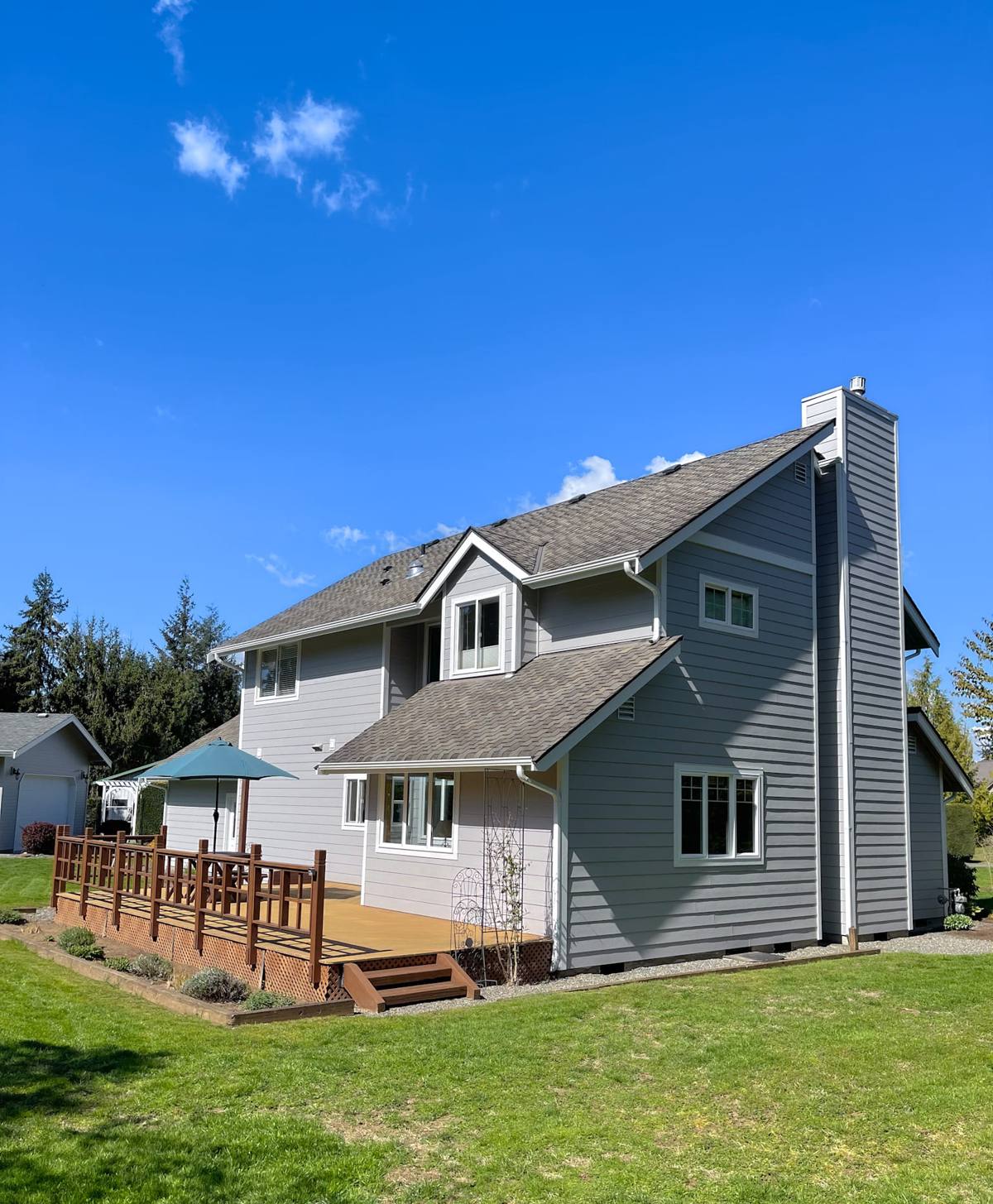
What Salt Air Actually Does to Siding Over Time
Salt air doesn't just sit on a surface — it gets carried by wind and fog and settles into every seam, fastener head, and joint on the exterior of a home. On products with metal fasteners or trim that aren't rated for coastal exposure, that means corrosion starting years before it's visible. On paint and coatings, salt accelerates chalking and fading, especially on south- and west-facing elevations that also take the most sun. On wood-based products, salt moisture combined with humidity speeds up the cycle of swelling, drying, and cracking that eventually opens the door to rot.
None of this means a Ferndale home can't have great-looking siding. It means the product and the installation details have to be chosen with salt exposure specifically in mind — not just "will this look good on day one," but "will this still look and perform well in year fifteen."
Driving Rain and Moss: The Other Half of the Equation
Whatcom County rain rarely falls straight down. Wind-driven rain pushes water sideways into laps, seams, and any gap around windows, trim, or penetrations — which is exactly where poor installation shows up first as staining, then as rot. A siding system that isn't installed with correct overlaps, flashing, and drainage behind it will eventually let that water in, no matter how good the material itself is.
Moss and algae are the visible result of the same conditions: shade, moisture, and time. They don't damage fiber cement siding the way they can damage wood or some composite products, but they do need a surface that can be cleaned without degrading — and they're a signal that a wall isn't drying out properly between rain events, which is worth paying attention to.
The Three Things Ferndale Siding Has to Get Right
- Resist salt-driven corrosion and coating breakdown on fasteners, trim, and finish
- Shed and drain wind-driven rain without trapping moisture behind the cladding
- Tolerate a long moss and algae season without staining permanently or breaking down
Why We Only Install James Hardie Fiber Cement
We install James Hardie exclusively — not vinyl, not LP SmartSide, not Cemplank, Allura, primed spruce, or cedar. That's a deliberate standard, built on what actually holds up in this specific climate.
Fiber cement is non-combustible and dimensionally stable, meaning it doesn't expand, contract, or absorb moisture the way wood-based siding does. That matters directly in a driving-rain climate: wood and engineered-wood products swell and shrink with moisture cycles, which stresses joints and paint lines over time and is exactly where water intrusion starts. Hardie's ColorPlus factory finish is baked on under controlled conditions, which gives it better adhesion and fade resistance against sun and salt exposure than field-applied paint typically achieves — and it comes with its own finish warranty.
James Hardie also engineers its HZ5 product line specifically for the Pacific Northwest's wetter climate zone, which is the version we install in this area. It's built to perform in sustained moisture and humidity rather than a generic national spec.
We're not going to tell you vinyl or engineered wood siding is junk — plenty of it is installed and performs adequately in the right conditions. But in a salt-air, high-rainfall environment like Ferndale's, we've made a professional call: the maintenance burden, moisture sensitivity, and long-term appearance trade-offs of those alternatives aren't worth it when a better-suited product exists. Hardie is what we stand behind and warranty.
What a Correct Siding Installation Actually Involves
The siding material is maybe half the equation. The other half is installation details that are invisible once the job is done but determine whether the wall stays dry for the next 30-50 years.
Before the Siding Goes On
- Removing old siding and inspecting sheathing for hidden rot or moisture damage
- Repairing or replacing damaged sheathing before anything new goes over it
- Installing a code-compliant weather-resistive barrier as a second line of defense against wind-driven rain
- Flashing all windows, doors, and penetrations so water is directed out and away from the wall assembly
During Installation
- Maintaining correct fastener spacing and type — stainless or coated fasteners rated for coastal/corrosive exposure
- Keeping proper clearance between siding and grade, decks, roof lines, and other surfaces so water can't wick up into the board
- Correct panel overlap and joint treatment to shed wind-driven rain rather than trap it
- Caulking and sealing only where Hardie's specifications call for it — over-caulking traps moisture just as easily as skipping it lets moisture in
Skip any one of these steps and you can end up with a wall that looks fine for a few years and then fails quietly behind the surface — which is the most expensive kind of siding problem, because by the time it's visible, the sheathing and framing are usually already compromised.
How Our Process Works
| Step | What Happens |
|---|---|
| Initial assessment | On-site inspection of existing siding, trim, and any visible moisture or rot issues |
| Scope and estimate | Written estimate covering material, prep, flashing, and labor — no vague allowances |
| Tear-off and sheathing check | Old siding removed, sheathing inspected and repaired as needed before anything new is installed |
| Weather barrier and flashing | Weather-resistive barrier and flashing installed at every window, door, and penetration |
| Hardie installation | HZ5 panels or planks installed to manufacturer spec — fastening, clearances, overlaps |
| Trim and final detailing | Corner trim, caulking per spec, and a final walkthrough |
What Drives Cost on a Ferndale Siding Job
| Factor | Why It Matters |
|---|---|
| Sheathing condition | Hidden rot found during tear-off adds repair scope before new siding can go on |
| Home size and complexity | Multiple stories, dormers, and cut-up walls take more labor per square foot than a simple rectangle |
| Siding profile | Lap siding, shingle-style panels, and board-and-batten each install differently and price differently |
| Trim and detail work | Corner boards, window trim, and fascia detailing add labor beyond the field siding |
| Access | Tight lots, landscaping, or limited staging space can affect labor time |
We don't quote a per-square-foot number without seeing the house — sheathing condition alone can change a job's scope significantly, and that's something we'd rather flag before starting than discover halfway through.
Signs Your Ferndale Home's Siding Needs Attention
- Persistent staining or dark streaking on north- or west-facing walls that returns quickly after cleaning
- Soft spots, bubbling, or visible warping in the siding surface
- Paint that's chalking, peeling, or fading unevenly, especially on sun- and wind-exposed elevations
- Gaps opening up around trim, corners, or window edges
- Rust streaking near fasteners or trim edges
- Musty smells or visible moisture inside exterior walls
Any one of these on its own isn't necessarily an emergency. Several at once, or moisture showing up inside the home, means it's worth having someone look at what's underneath before it gets more expensive.
Why Working With a Crew That Already Knows Ferndale Matters
A contractor who works this specific stretch of Whatcom County — Ferndale, Birch Bay, and the surrounding coastal areas — has already seen how salt exposure, prevailing wind direction, and moss buildup behave on homes in this exact environment. That's different from general Pacific Northwest experience. Fastener corrosion patterns, the elevations that take the worst wind-driven rain, and how quickly moss returns after cleaning all vary by how close a home sits to the water and which way it faces — and a crew that installs here regularly builds a feel for those details that a one-off crew from outside the area simply hasn't had the reps to develop.
It also means we're installing the same HZ5 product and the same flashing and clearance details on every job in this area, which is how a siding system stays consistent and warrantable instead of being a one-off guess.
Get a Straight Answer on Your Siding
If your Ferndale home's siding is showing its age, or you're planning ahead before the next wet season sets in, we're happy to take a look and give you a clear, no-pressure estimate — what we see, what it would take to do right, and what it would cost. Fill out the form below to get started.