 Birch Bay Siding
 Siding Built for Sandy Point's Waterfront Exposure
Sandy Point sits right up against the Strait of Georgia, and that location shapes everything about how a home's exterior ages here. Homes in this part of Whatcom County take a steady diet of salt-laden air, wind-driven rain coming straight off the water, and a wet season that stretches for months at a time. Add in the shade from mature evergreens on many lots, and you get long stretches where siding simply doesn't get a chance to fully dry out. That combination is hard on a lot of exterior products, and it's a big part of why we install only James Hardie fiber cement siding on the homes we work on in this area.
We're a local crew, not a regional outfit that treats Sandy Point as a stop between bigger jobs. We know which sides of a house take the worst of the weather here, how the tree canopy affects drying time on shaded elevations, and what it actually takes to keep a home's exterior performing over decades near the water, not just looking good on installation day.
What Salt Air and Moss Actually Do to a House
Salt Exposure
Airborne salt from the Strait doesn't just sit on the surface of your siding — over time it works into seams, fastener heads, and any spot where a coating has thinned or a caulk joint has failed. On metal fasteners and trim, that means accelerated corrosion. On wood-based siding products, salt-laden moisture speeds up the cycle of swelling, drying, and cracking that eventually opens the door to rot.
Driving Rain
Storms coming off open water tend to drive rain sideways, not straight down. That means water gets pushed up under laps, into panel seams, and behind trim in ways that vertical rain in a more sheltered inland location wouldn't. Siding systems and installation details that work fine in a protected neighborhood can underperform on an exposed waterfront lot.
Moss and Extended Dampness
Whatcom County's moss season runs long, and shaded, north-facing walls near tree lines are the first place it takes hold. Moss and algae hold moisture against the siding surface far longer than an exposed, sunny wall would ever experience. On products that are sensitive to sustained moisture contact, that's a slow but steady path to problems at the substrate level, not just a cosmetic issue.
Why We Standardized on James Hardie
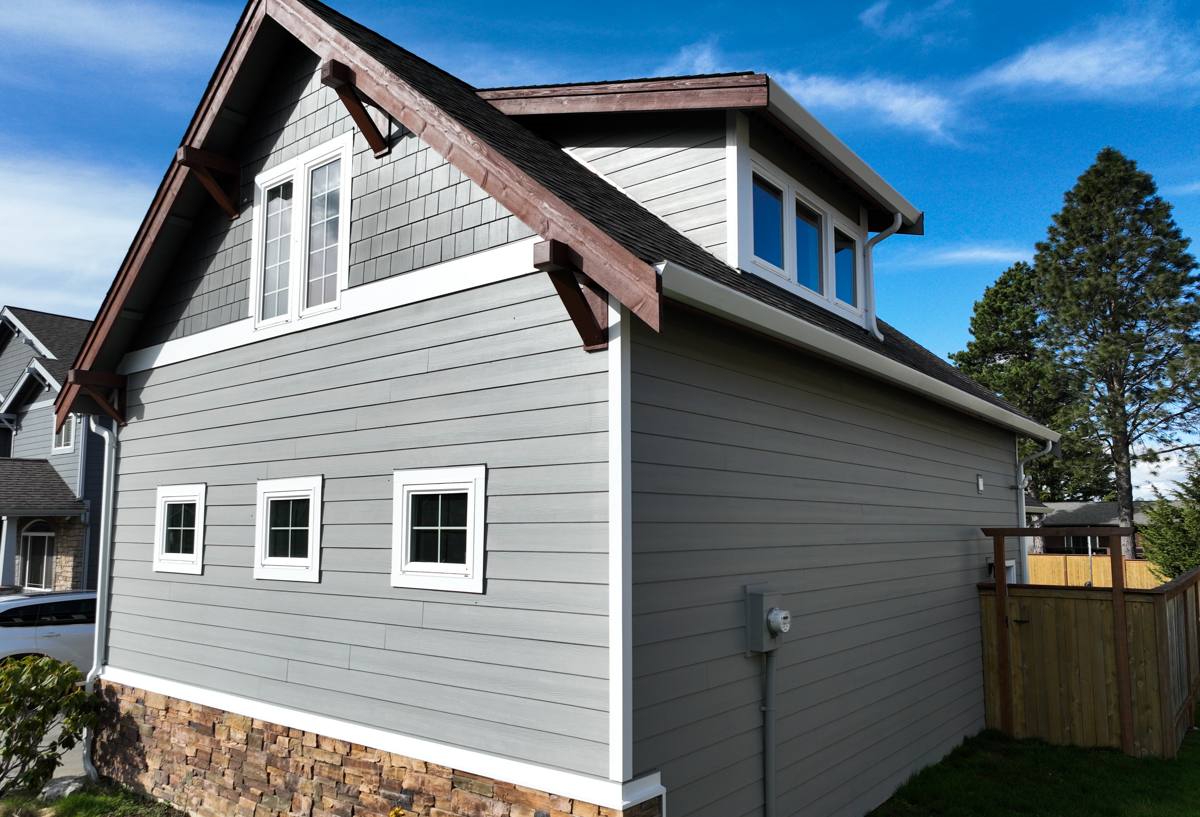
We used to install a wider range of siding products. We don't anymore, and that decision came from watching how different materials actually held up on homes in this climate over years, not just the first season. James Hardie fiber cement is engineered specifically to resist the failure modes that salt air, driving rain, and prolonged moisture exposure create:
- It's non-combustible fiber cement — cement, sand, and cellulose fiber, not wood fiber, so it doesn't feed a fire the way wood-based siding can, and it doesn't swell or rot the way wood products can when moisture gets in.
- Hardie's ColorPlus factory-applied finish is baked on under controlled conditions, giving it better adhesion and fade resistance than field-applied paint, which matters when a house is getting hit with salt spray and UV reflecting off open water.
- The HZ5 product line is engineered specifically for wetter, harsher climates — this isn't a generic siding shipped to every region the same way.
- It carries a strong, transferable limited warranty backed by a manufacturer with decades of performance history in coastal Pacific Northwest conditions, not just marketing claims.
We're upfront that Hardie siding costs more upfront than some alternatives and that it's a heavier, less forgiving product to install correctly. We think that trade-off is worth it on a home that's going to sit within sight of the water for the next thirty-plus years.
Why We Don't Install Everything Else
Homeowners in Sandy Point often ask why we don't offer vinyl, LP SmartSide, or primed wood siding as lower-cost options. It's a fair question, and the honest answer is that each of those products has real trade-offs that show up faster in this specific environment:
- Vinyl siding can warp or become brittle with temperature swings and UV exposure, and its seams and J-channels give wind-driven rain more opportunities to get behind the panel over time.
- LP SmartSide and other wood-strand products perform reasonably well when installation and maintenance are followed exactly to spec, but they're more sensitive to sustained moisture exposure than fiber cement, which raises the maintenance stakes on a shaded, moss-prone, salt-exposed lot.
- Primed spruce or cedar can look beautiful, but it needs a disciplined repainting and caulking schedule to keep water out, and that schedule gets harder to keep up with, not easier, in a marine climate with a long wet season.
None of these are bad products in every setting. We just don't think they're the right call for the specific conditions Sandy Point homes face, and we'd rather turn down that work than install something we don't believe will hold up.
Our Process for Sandy Point Homes
Inspection and Assessment
We start by walking the exterior and looking specifically at the elevations that take the worst exposure — usually the sides facing open water and any shaded, tree-adjacent walls. We check existing siding, trim, flashing, and any areas showing moss growth or staining, since those are often early indicators of moisture getting past the surface.
Moisture and Substrate Check
Before any new siding goes up, we want to know what's happening underneath the current material. Trapped moisture or compromised sheathing needs to be addressed first — covering it with new siding without fixing the underlying issue just resets the clock on the same problem.
Installation to Spec
James Hardie siding performs the way it's designed to only when it's installed correctly — proper fastener placement, correct clearances, and attention to flashing and water management details around windows, doors, and roof lines. This is where a lot of the long-term performance difference actually comes from, more than the product alone.
Trim, Flashing, and Water Management
On an exposed waterfront property, the details around penetrations — windows, vents, hose bibs, light fixtures — matter as much as the siding field itself. We pay particular attention to these transitions since they're the most common point where driving rain finds a way in.
Beyond Siding: The Full Exterior Envelope
Siding doesn't work in isolation. Roofing, windows, and decks all interact with the same weather Sandy Point homes deal with, and problems in one often show up as damage in another. A roof leak can travel down behind siding. A failed window seal can let moisture into a wall cavity. A deck built without the right ledger flashing can rot a band board that sits right behind your siding. We handle all four — siding, roofing, windows, and decks — because treating the exterior as one connected system, rather than four separate projects, is how you actually keep water out of a coastal home long-term.
Cost Factors for Sandy Point Projects
| Factor | Why It Matters Here |
|---|---|
| Exposure level | Direct water-facing elevations may need extra attention to flashing and fastening detail versus sheltered sides |
| Existing substrate condition | Moisture-damaged sheathing or framing found during tear-off adds repair scope before new siding can go up |
| Home size and complexity | Cut-up facades, multiple gables, and dormers take more labor and trim work than a simple rectangular footprint |
| Access | Waterfront lots with limited driveway or staging space can affect scaffolding and material staging logistics |
| Siding profile and color | Hardie offers multiple plank widths, textures, and ColorPlus finishes at different price points |
Signs Your Sandy Point Home May Need New Siding
- Persistent moss or algae staining that returns shortly after cleaning
- Soft spots, bubbling, or visible warping on wood-based or composite siding
- Cracking or splitting concentrated on the water-facing side of the house
- Paint that's failing faster than expected, especially on wood siding
- Visible gaps at seams, trim, or corners where wind-driven rain could get behind the panel
- Rising energy bills that may point to compromised insulation behind failing siding
Why a Local Crew Matters Here
Sandy Point isn't a generic subdivision, and it doesn't get treated like one on our jobs. We're familiar with how exposure varies from one side of the community to the other, how the shoreline wind pattern differs from more inland Birch Bay properties, and how the tree cover on wooded lots changes the moisture picture on shaded walls. That local knowledge shapes real decisions — where we pay extra attention to flashing, which elevations get prioritized in an inspection, and how we sequence work around the wetter months so materials aren't sitting exposed longer than necessary.
If you're weighing a siding project in Sandy Point, we're happy to walk your property, look at what your home is actually dealing with, and give you a straightforward assessment — no pressure, no upsell to a product we don't believe in. Reach out for a free estimate using the form below.