 Birch Bay Siding
 Cottonwood Beach: A Different Kind of Exterior Challenge
Cottonwood Beach sits right up against the water in Birch Bay, and that proximity to Whatcom County's coastline shapes everything about how a house ages here. Homes a mile inland deal with rain and cold like the rest of the Pacific Northwest. Homes closer to the water deal with that same rain plus salt-laden air, near-constant wind off the bay, and a wet season that can stretch on for months without much of a break. Exterior materials that hold up fine in a sheltered subdivision often show their weaknesses much faster this close to the shoreline.
We work throughout Birch Bay, and Cottonwood Beach is one of the areas where we see the clearest difference between siding that was chosen for looks or price and siding that was chosen to actually survive a marine climate. This page covers what that climate does to a house, how we approach exterior work for it, and why our crew installs one type of siding and one type only.
What the Marine Climate Does to a House Over Time
Salt air, driving rain, and prolonged dampness don't damage a house all at once — they work on it slowly, in ways that are easy to miss until a problem is already serious. Understanding the mechanics helps explain why some exterior products fail earlier here than the manufacturer's marketing might suggest.
Moss, Mildew, and the Long Wet Season
Whatcom County's wet season runs long, and in a shoreline community like Cottonwood Beach, surfaces often don't get enough direct sun or airflow to fully dry between rain events. That combination — moisture plus shade plus mild temperatures — is exactly what moss and mildew need. Wood-based siding products absorb that moisture into the substrate itself, which is where the real damage happens: swelling, soft spots, and eventually rot that isn't visible from the outside until it's advanced.
Salt Air and Finish Breakdown
Airborne salt is corrosive to fasteners and abrasive to paint and coatings. On a house exposed to wind coming off the bay, field-applied paint tends to chalk, fade, and fail at the seams and end-cuts noticeably faster than it would a few miles inland. Once a coating starts to break down at a seam, water gets behind it, and from there the clock is running on whatever's underneath.
Why We Install Only James Hardie Fiber Cement Siding
We don't install vinyl, LP SmartSide, cedar, or primed spruce, and that's a deliberate standard, not a limitation of what we're capable of doing. Each of those products has real strengths — vinyl is inexpensive and low-maintenance in mild climates, engineered wood siding can look good and install quickly, cedar has genuine natural appeal. But in a coastal, wet-winter environment like Cottonwood Beach, each of them carries a trade-off we're not willing to put on a homeowner's house without saying so plainly: wood-based products are vulnerable to moisture intrusion at cut edges and fastener points, vinyl can warp or become brittle with age and offers little protection against wind-driven rain at the seams, and both typically rely on field-applied or shorter-lived factory finishes that need repainting on a cycle homeowners often underestimate.
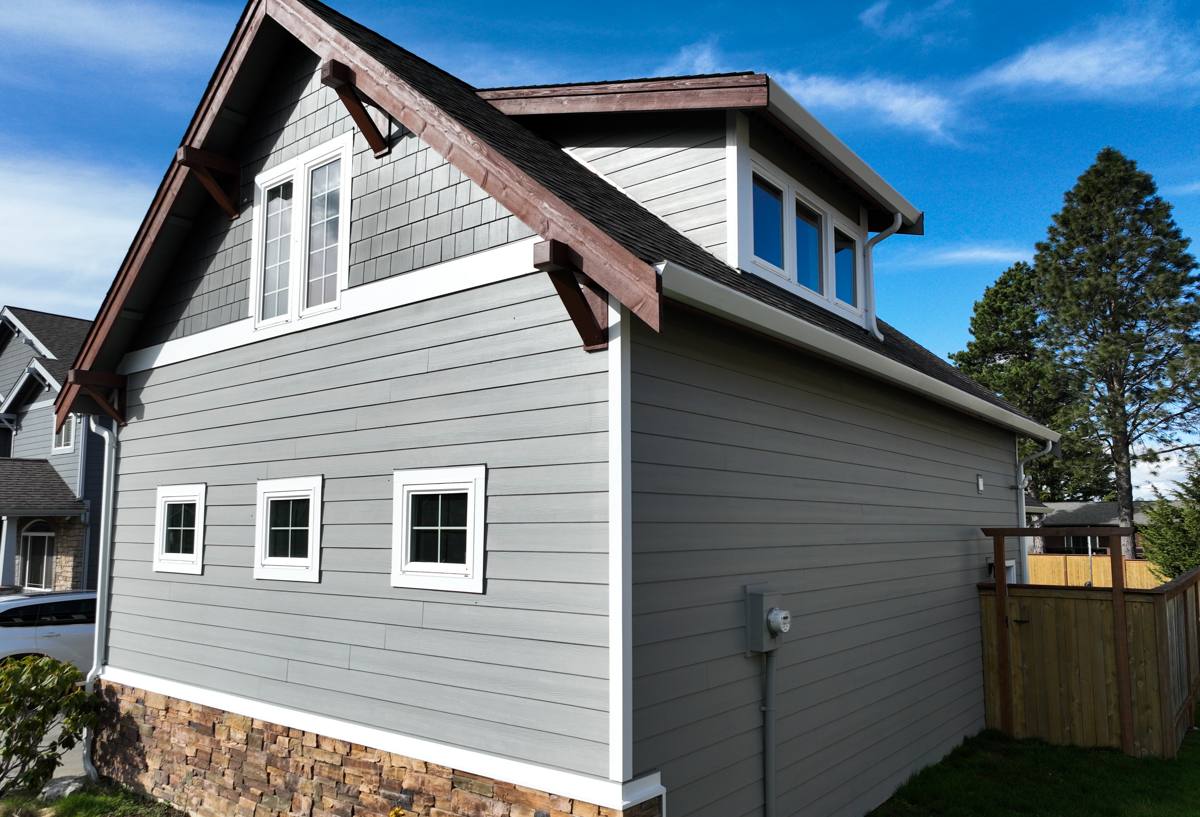
James Hardie fiber cement siding is what we've standardized on because it's engineered specifically for problems like the ones this climate creates.
Non-Combustible, Engineered for the Pacific Northwest
Fiber cement is made from cellulose fiber, sand, and cement — it doesn't absorb water the way wood-based products do, and it won't rot, delaminate, or attract wood-boring insects. Hardie also produces climate-specific product lines (their HZ5 line is engineered for regions with the freeze-thaw and moisture cycles typical of the Pacific Northwest), which means the product going on a Cottonwood Beach home is built for exactly the exposure it's going to see.
ColorPlus Factory Finish vs. Field-Painted Trim
Most of the early failures we see on other siding types trace back to the finish, not the substrate. Hardie's ColorPlus finish is baked on at the factory under controlled conditions, which gives it better fade and wear resistance than a coat of paint applied on-site in variable weather. It also comes with its own finish warranty separate from the product warranty — so the color and the material are both backed, not just the board itself.
How We Approach a Siding Project in Cottonwood Beach
The process itself matters as much as the material. Fiber cement performs the way it's supposed to only when it's installed to spec — clearances, fastening patterns, and flashing details all affect how the wall assembly handles water over the long run.
- Inspection of the existing siding, trim, and, where accessible, the sheathing underneath for signs of past moisture damage.
- Removal of the old siding and assessment of the wall assembly — any soft or damaged sheathing gets addressed before new material goes on, not covered over.
- Correction or installation of house wrap and flashing at windows, doors, and penetrations, with particular attention to the wall's exposure to wind-driven rain.
- Installation of James Hardie siding to manufacturer specifications, including proper clearances from grade, decks, and roof lines.
- Trim, caulking, and touch-up of factory-finished panels at cut ends.
- Final walkthrough and punch list before we consider the job done.
That second step is the one that gets skipped by crews trying to move fast. On a coastal property, covering damaged sheathing with brand-new siding just hides a problem that's going to resurface — usually somewhere expensive.
It's Not Just Siding: Roofing, Windows, and Decks Face the Same Climate
We handle siding, roofing, windows, and decks, and on a property like the ones in Cottonwood Beach, those systems aren't really separate — they're one exterior envelope. Flashing at a roofline has to tie into the siding above it correctly, or water finds the gap. Window flashing has to integrate with the siding's water-resistive barrier, or the same driving rain that stresses the walls will find its way in around the frames. Deck ledger boards, if not flashed properly where they meet the house, are one of the more common hidden rot points we find on coastal homes, often discovered only when siding comes off nearby.
When one crew is responsible for the whole envelope, these transitions get planned for instead of patched together after the fact by whoever shows up last.
Cost Factors for a Cottonwood Beach Home
Every house is different, and we don't quote sight-unseen, but these are the factors that most often move the price on an exterior project in this area:
| Factor | Why It Matters |
|---|---|
| Home size and wall complexity | More corners, gables, and dormers mean more cutting, flashing, and labor time. |
| Condition of existing siding and sheathing | Hidden moisture damage found during tear-off adds repair scope before new siding goes on. |
| Siding profile and trim detail | Lap siding vs. shingle-style panels, and the amount of trim and accent work, affect material and labor cost. |
| Product line (standard vs. HZ5) | Climate-engineered lines cost more upfront but are matched to the moisture exposure a shoreline property sees. |
| Access and site conditions | Waterfront lots, tight setbacks, or difficult equipment access can add time to the job. |
Why a Local Crew Matters Here
Whatcom County's permitting and code requirements, the realities of scheduling around a long wet season, and the specific way wind and rain move through a shoreline community like Birch Bay aren't things a crew learns from a manual — they're things you learn by working here repeatedly. A local crew knows which walls in Cottonwood Beach take the worst of the weather, how to sequence a job around the rain rather than fighting it, and what "driving rain" actually means for flashing detail on this stretch of coast, not just in general terms.
That local knowledge also shows up in smaller, practical ways — knowing which product lines have held up on similar homes nearby, understanding realistic timelines given the season, and being reachable afterward if a question comes up rather than having moved on to a different region entirely.
Maintenance Checklist for Coastal-Exposure Siding
Even low-maintenance materials benefit from periodic attention, especially this close to the water. A simple annual check can catch small issues before they become expensive ones:
- Rinse accumulated salt residue and grime off siding surfaces, particularly on walls facing the water.
- Check caulking at trim, window, and door edges for cracking or separation.
- Look for moss or algae buildup in shaded, low-airflow areas and remove it before it holds moisture against the surface.
- Inspect flashing above windows, doors, and where decks or roofs meet the wall for gaps or corrosion.
- Confirm gutters are clear and directing water away from the foundation and siding base.
- Watch for soft spots, discoloration, or paint failure at siding seams and cut ends — early signs of moisture intrusion.
Get an Honest Look at Your Home's Exterior
If you're weighing a siding, roofing, window, or deck project for a Cottonwood Beach property, we're glad to come take a look and give you a straightforward assessment — no pressure, no inflated urgency, just what we actually see and what it would take to address it. Use the form below to request a free estimate.