 Birch Bay Siding
 Building New in Point Roberts: What the Climate Asks of Your Windows
Point Roberts sits out on its own point of land, surrounded by water on three sides and cut off from the rest of Washington by the U.S.-Canada border. That geography is exactly why windows on a new build here need more thought than a standard inland install. Homes in this part of Whatcom County take a steady diet of salt-laden marine air, wind-driven rain off the Strait of Georgia, and long stretches of gray, damp weather that keep siding, trim, and window perimeters wet for days at a time. Add in the moss and algae growth that thrives in that kind of shade and moisture, and you've got an envelope that's working hard year-round, not just during the occasional storm.
None of that is a reason to over-build or over-spec everything. It's a reason to get the basics right: correct flashing sequence, the right frame material for a coastal marine environment, and glass and hardware that won't fight you for the next twenty years. That's the whole focus of this page — new-construction window work, done correctly, for this specific stretch of coastline.
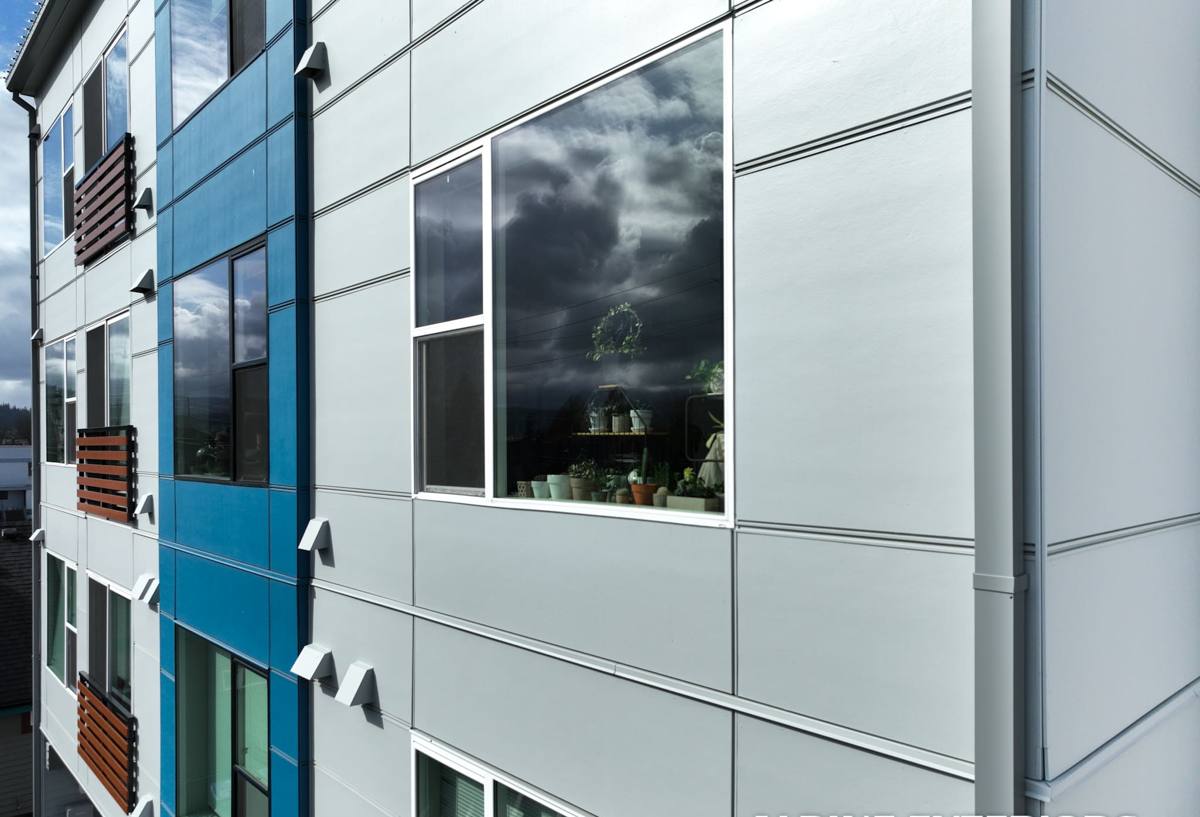
New-Construction vs. Retrofit: Why the Method Matters More Here
New-construction windows are installed with a nailing fin or flange that gets integrated directly into the wall's water-resistive barrier (WRB) before siding goes on. That's different from a retrofit or "pocket" replacement window, which drops into an existing frame after the siding is already in place. On a new build, you get one real shot at building the flashing and drainage plane correctly, because once siding closes it in, that work is hidden for the life of the house.
In a low-exposure, dry climate, a mediocre flashing job might not show problems for years. In a marine environment like Point Roberts, driving rain finds every shortcut fast — usually as staining, soft trim, or interior sill rot within the first few wet seasons. That's the main reason new-construction window work in this area is not a place to cut corners or rush to keep a framing schedule.
What "Correct" Actually Means on Site
- Sill pan flashing installed under every window opening, sloped to drain outward, before the window ever goes in
- Weather-resistive barrier lapped shingle-style — upper layers over lower layers — so water sheds down and out, never into the wall cavity
- Window flanges integrated into the WRB with flashing tape at the sides and top, in the correct sequence (sides first, then head flashing over the top, never the reverse)
- A gap or drainage path at the sill so any water that does get past the window has somewhere to go besides your framing
- Sealant used only where it's supposed to carry the load — not as a substitute for proper flashing
Frame Materials and Glass for Coastal Marine Exposure
Frame material choice matters more here than in a drier, inland part of the county. Salt air accelerates corrosion on hardware and fasteners, and constant dampness is unforgiving of any material that absorbs moisture or needs regular refinishing.
| Frame Material | How It Handles Salt Air & Moisture | Maintenance Reality |
|---|---|---|
| Vinyl | Won't corrode or rot; performs well in coastal exposure | Low — occasional cleaning, no repainting |
| Fiberglass | Very stable dimensionally, holds up well to damp cycling | Low — durable finish, minimal upkeep |
| Aluminum (non-thermally-broken) | Conducts cold and can corrode faster in salt air over time | Moderate to high, depending on coating quality |
| Wood or wood-clad | Handsome, but exposed wood is vulnerable to the moss-and-moisture cycle common here | High — regular sealing/painting to prevent rot |
We're not here to tell a homeowner a given material is bad — every one of these has a place. Our professional standard for Point Roberts new builds leans toward vinyl or fiberglass frames with corrosion-resistant hardware, simply because they hold up with the least maintenance burden in this specific climate. If a homeowner wants a wood-look interior with a low-maintenance exterior, wood-clad or fiberglass-clad options can split that difference — that's a conversation worth having at the estimate stage.
On the glass side, a good low-E, argon-filled double-pane unit is the baseline for new construction under current Washington energy code. In a house with a lot of west- or water-facing glass, upgrading to a better-performing glass package can cut down on condensation on cold, damp mornings — a common complaint in homes right on the water.
How Our Process Works on a Point Roberts New Build
Because Point Roberts is only reachable by road through Canada, logistics are part of the job in a way they aren't on a typical Whatcom County site. Material deliveries, crew scheduling, and border timing all have to be planned in advance rather than handled on the fly. We build that into the schedule up front so it doesn't turn into delays once framing is ready for windows.
The typical sequence:
- Plan review and window schedule — confirming sizes, egress requirements, and rough openings against the actual framing before anything is ordered
- Material staging — windows and flashing materials ordered and delivered with enough lead time to account for the border crossing and ferry-adjacent logistics of the peninsula
- Coordination with the framing/siding crew — window install has to happen at the right moment in the build sequence, after WRB is up and before siding closes the wall
- Flashing and installation — sill pans, jamb and head flashing, and window-to-WRB integration done in the correct order
- Inspection-ready documentation — window install work checked against Whatcom County building code requirements before the wall is closed up
- Final walkthrough — operation, weatherstripping, and hardware checked once the house is enclosed
Cost Factors on a New Build
New-construction window pricing depends on a handful of variables more than any single line item. Here's what actually moves the number on a Point Roberts project:
| Factor | Why It Matters |
|---|---|
| Number and size of openings | More glass, larger units, and specialty shapes (bay, picture, custom sizes) all add cost |
| Frame material | Vinyl is typically the most economical; fiberglass and wood-clad cost more upfront but shift the maintenance equation |
| Glass package | Standard low-E vs. upgraded coatings or triple-pane for extra water-facing exposure |
| Access and delivery logistics | Point Roberts' cross-border delivery route adds lead time and can affect scheduling costs on tight timelines |
| Flashing and building wrap scope | Doing it correctly the first time costs less than fixing water damage from a rushed job later |
We give straightforward, itemized estimates rather than a single lump number, so a homeowner can see exactly where the budget is going and where there's flexibility.
Mistakes We Watch For on New Builds in This Area
Most window problems we get called out to fix on newer homes near the water trace back to a handful of avoidable issues:
- Flashing installed in the wrong order (head flashing tucked under siding but not properly lapped over the WRB below it)
- Sealant used to "fix" a gap instead of proper flashing — sealant fails; flashing sheds water for decades
- Windows set before the WRB was fully lapped and taped, leaving a hidden entry point for wind-driven rain
- Hardware and fasteners not rated for coastal/marine exposure, leading to premature corrosion
- No sill pan or drainage path, so any incidental moisture has nowhere to go but into the framing
Every one of these is invisible once the house is finished — which is exactly why they matter so much during the construction phase, not after.
Why a Crew Already Working Point Roberts Matters
Point Roberts isn't a place a contractor can swing by on the way to another job. Getting a crew and materials there involves planning around the border crossing, and a general unfamiliarity with that reality shows up as missed schedules and rushed work. A crew that already builds in this community treats that logistics puzzle as routine, not a surprise that eats into install quality.
There's also a familiarity factor with the specific way this coastline behaves — which sides of a house take the worst of the wind-driven rain, how much shade and dampness to expect on the north side of a lot, and what kind of moss and algae growth is normal versus a sign of a bigger moisture problem. That local pattern recognition is hard to replicate on a one-off visit, and it's exactly what should inform flashing detail and material choice on a new build here.
A Quick Homeowner Checklist for a Window Install You Can Trust
- Ask to see the sill pan and flashing before the wall is closed up — a contractor confident in their work will welcome the question
- Confirm the WRB lap direction and flashing sequence in writing or in the project notes
- Get frame material and glass package specified clearly on the estimate, not just "vinyl windows" as a line item
- Ask how deliveries and scheduling account for Point Roberts' access logistics
- Request documentation or photos of the flashing work before siding covers it — it's the only stage where that detail is visible
Maintaining New Windows Once the Build Is Done
Correct installation does most of the work, but a little seasonal attention keeps new windows performing for the long haul in this climate:
- Rinse frames and tracks periodically to clear salt residue, especially on water-facing elevations
- Clear moss or algae buildup on nearby trim and siding promptly — it holds moisture against the wall
- Check weep holes and drainage paths each fall before the wet season sets in
- Have caulking and sealant joints inspected every couple of years, since sealant is a wear item even when flashing is done right
If you're planning a new build in Point Roberts and want windows installed the right way the first time, we're happy to walk the plans, talk through material options, and put together a straightforward estimate. There's no pressure and no obligation — just use the form below to get started.