 Birch Bay Siding
 Storm Damage Roof Repair for Point Roberts Homes
Point Roberts sits in a strange spot on the map — a small piece of Washington State, part of Whatcom County, physically cut off from the rest of the U.S. mainland by an international border. The only way in or out by road is through Canada. That detail matters more than most homeowners realize when a storm tears loose a section of shingles or opens up a leak around a chimney, because it changes who can actually show up quickly, haul materials in, and get a dumpster or trailer onto the property without the trip turning into a half-day ordeal.
Add in the climate — salt-laden air off the water, wind-driven rain that doesn't fall straight down so much as get shoved sideways under roof edges, and a moss season that runs long on shaded, north-facing slopes — and you get a community where roofs take a specific kind of beating. This page covers what storm damage repair actually needs to involve here, and why a crew that already works Point Roberts regularly is worth choosing over one that doesn't.
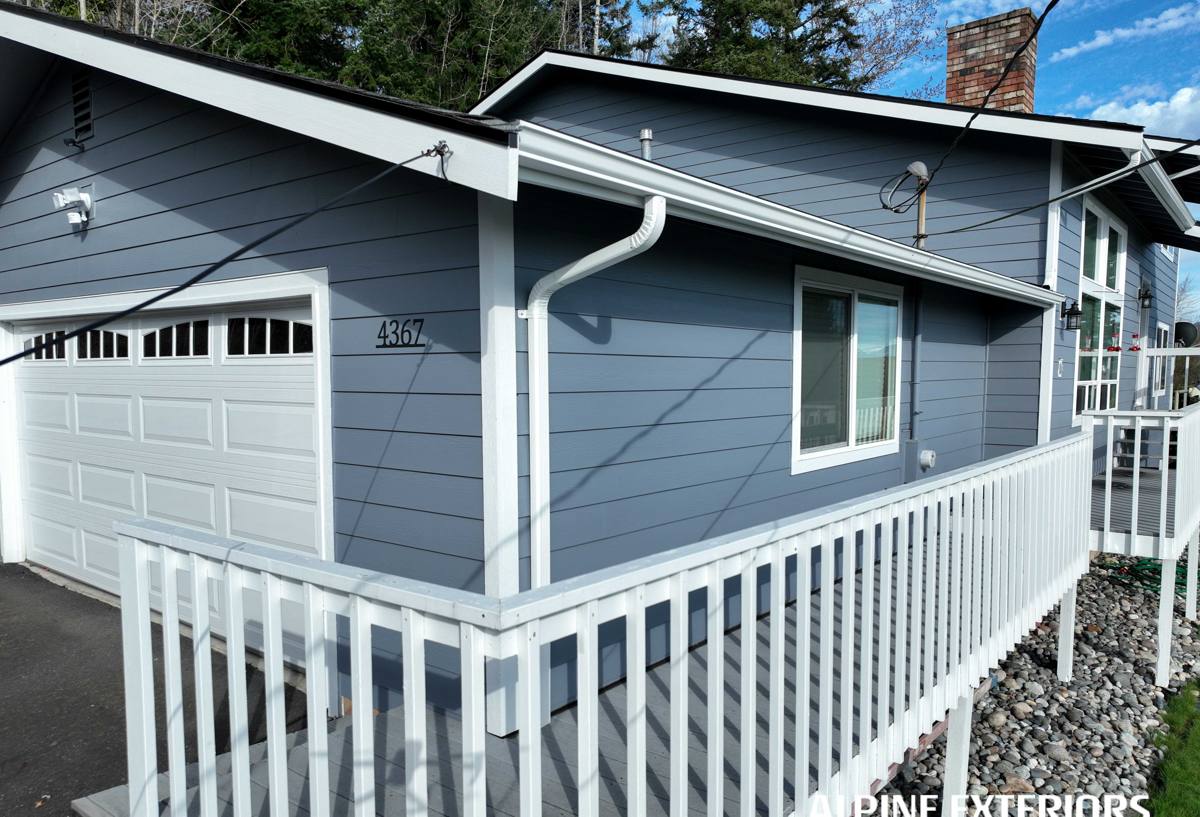
What Storms Actually Do to a Point Roberts Roof
Roof damage after a storm isn't always obvious from the ground. A homeowner might notice a single lifted shingle or a water stain on a ceiling and assume that's the extent of it, when the actual damage pattern is wider and less visible.
Common Damage Patterns After Wind and Rain
- Wind-lifted or creased shingles — shingles that got pushed up and partly torn from their seal, which may look intact from the ground but no longer shed water correctly
- Granule loss — driving rain and wind strip the protective granule layer off asphalt shingles, accelerating UV and moisture damage even where nothing is visibly torn
- Flashing failures — the metal at valleys, chimneys, skylights, and wall intersections is where storm-driven water most often finds a way in, especially once corrosion from salt air has already weakened it
- Fastener corrosion — nails and screws exposed to marine air corrode faster than inland installations, and a corroded fastener can back out or fail entirely during high wind
- Moss-related deck softening — a long moss season traps moisture against roof decking, and a storm can be what finally pushes an already-softened section past the point of holding a proper seal
The point isn't to alarm anyone — it's that a proper storm damage inspection has to look past the obvious spot and check the roof as a system, because wind and rain rarely damage just one thing in isolation.
Why Local Point Roberts Experience Actually Matters Here
Every roofing crew will tell you they do good work. The difference shows up in the logistics most homeowners never think about until they're stuck waiting on them.
A crew that already works Point Roberts has a system for getting people, tools, and materials across the border reliably, instead of treating each trip as a one-off. They know what a typical border wait looks like at different times of day, they plan material deliveries so a job doesn't stall out waiting on a second trip, and they're not caught off guard by the paperwork involved in bringing tools and supplies across for a job. None of that is exotic — it's just operational knowledge that only comes from doing it repeatedly.
There's also a familiarity factor with the housing stock itself. Point Roberts has a mix of older cottages, seasonal homes, and newer construction, and a crew that's worked here before has a feel for common roof framing quirks, typical deck condition on older homes, and how prior owners or builders handled flashing details in this specific pocket of the county. That local pattern recognition speeds up diagnosis and reduces surprises once the tear-off starts.
Response time matters too. After a regional storm, demand for roof repair spikes across Whatcom County all at once. A contractor whose normal service area already includes Point Roberts is far more likely to prioritize a call here than one who'd be adding an unfamiliar cross-border trip to an already packed schedule.
What a Correct Storm Damage Repair Involves
A proper repair starts with keeping water out immediately, then moves to an honest assessment of what's actually damaged before any permanent work begins.
The Right Order of Operations
- Emergency weatherproofing — tarping or temporary sealing of the damaged area to stop active water intrusion, done safely and without causing additional damage to surrounding shingles
- Full roof inspection, not just the visible damage spot — checking the whole slope and adjoining flashing, since wind damage rarely stays confined to one section
- Attic and decking check from the inside — water stains, soft spots, or trapped moisture visible from underneath often tell you more than what's visible from the roof surface
- Matching materials to the existing roof — shingle color, profile, and manufacturer matched as closely as possible so the repair doesn't stand out as an obvious patch and so the new section performs the same way the rest of the roof does
- Flashing rebuilt, not just re-sealed — caulk over failing flashing is a short-term cover-up; a proper repair replaces compromised flashing metal so the fix actually holds through the next storm
- Documentation — photos of the damage and the completed repair, useful both for your own records and for any insurance claim
Skipping steps to save time is exactly how a "repaired" roof ends up leaking again at the next storm — usually at the same spot, because the underlying cause was never actually fixed.
Quick Patch vs. Proper Storm Repair
| Approach | What It Actually Does | Trade-off |
|---|---|---|
| Surface caulk or sealant over damaged flashing | Stops a visible drip short-term | Doesn't address corroded or displaced metal underneath; commonly fails again within a season or two |
| Single shingle swap without checking surrounding area | Fixes the one obviously torn shingle | Misses wind-lifted or granule-stripped shingles nearby that will fail next |
| Tarp left as a "temporary" long-term fix | Keeps most water out in the short run | UV exposure and wind flutter degrade tarps quickly; trapped moisture underneath can worsen deck damage |
| Full assessment with flashing rebuild and matched materials | Restores the roof section to proper working condition | Costs more upfront and takes longer than a patch, but is the only version that actually holds |
None of the shortcuts above are necessarily dishonest — sometimes a tarp genuinely is the right call for a day or two while parts are sourced. The problem is only when a temporary measure gets treated as the finished repair.
How Our Process Works
- Initial call: We ask what you're seeing — active leaking, visible missing shingles, a specific room with a stain — so we can prioritize appropriately if water is actively getting in.
- On-site inspection: A full roof and attic check, not just a look at the spot you called about, with photos documenting everything found.
- Written estimate: A clear breakdown of what needs repair, what materials will be used, and why, before any work starts.
- Temporary weatherproofing if needed: Done immediately if the roof is actively letting water in, regardless of when the permanent repair is scheduled.
- Repair work: Completed with matched materials and rebuilt flashing where needed, not just surface patching.
- Final walk-through: We show you what was done and answer questions before considering the job finished.
Storm Damage and Insurance Claims
Many storm damage repairs get filed as insurance claims, and the documentation from the inspection matters directly here. An honest assessment — noting exactly what was storm-caused versus what was pre-existing wear, like moss-related deck softening that predates the storm — protects you during the claims process more than an inflated damage list would. Adjusters generally respond better to a clear, photo-documented, itemized report than to a vague description, and a contractor who's straightforward with you about what is and isn't storm damage is also going to be straightforward with your insurance company.
If you're not sure whether something qualifies as storm damage or ordinary wear, that's a fair question to ask before you file anything — sometimes a repair is worth doing out of pocket rather than triggering a claim, depending on your deductible and the scope of the work.
Keeping a Point Roberts Roof Storm-Ready Between Events
A roof that's already in good condition going into a storm sustains far less damage than one carrying unaddressed moss, clogged gutters, or aging flashing. A little seasonal attention goes a long way here given how long the wet season runs.
- Clear gutters and downspouts before the fall storm season so water isn't backing up under the roof edge
- Have moss and organic growth treated on shaded, north-facing slopes before it works its way under shingle edges
- Get flashing at chimneys, skylights, and valleys checked periodically for early corrosion, especially given the salt air here
- Trim back tree limbs that overhang the roof, since falling branches are a common source of impact damage during high wind
- Check attic ventilation — poor airflow traps moisture that softens decking from underneath, making storm damage worse when it does occur
Getting an Estimate
If a recent storm left you with missing shingles, a slow leak, or just an uneasy feeling about a roof you haven't had checked in a while, a straightforward inspection is the fastest way to know what you're actually dealing with. We're happy to take a look, give you an honest read on what's damage versus what's ordinary wear, and put together a written estimate with no pressure to act on it right away — reach out below to schedule a free estimate.