 Birch Bay Siding
 Roofing on the Point Whitehorn Side of Birch Bay
Point Whitehorn sits on the exposed edge of Birch Bay, facing open water with very little tree cover or terrain to break the wind. Homes here take a different kind of weather beating than houses set back in the trees a mile inland. Salt-laden air moves off the water and settles on every exterior surface, wind-driven rain gets pushed sideways into roof edges and penetrations, and the long, damp Whatcom County shoulder seasons keep roof surfaces wet for weeks at a stretch. A roof that would hold up fine in a sheltered neighborhood can wear out early out here.
That's the case for metal roofing on this stretch of coastline. Done correctly, with the right panel system, the right fasteners, and flashing detail that respects how water actually moves in wind-driven rain, a metal roof handles Point Whitehorn's conditions better than most alternatives. Done poorly — wrong fastener metal, skipped underlayment, sloppy flashing — it fails faster than a basic asphalt roof would have, and costs more to fix. The install quality matters more here than in almost any other part of our service area.
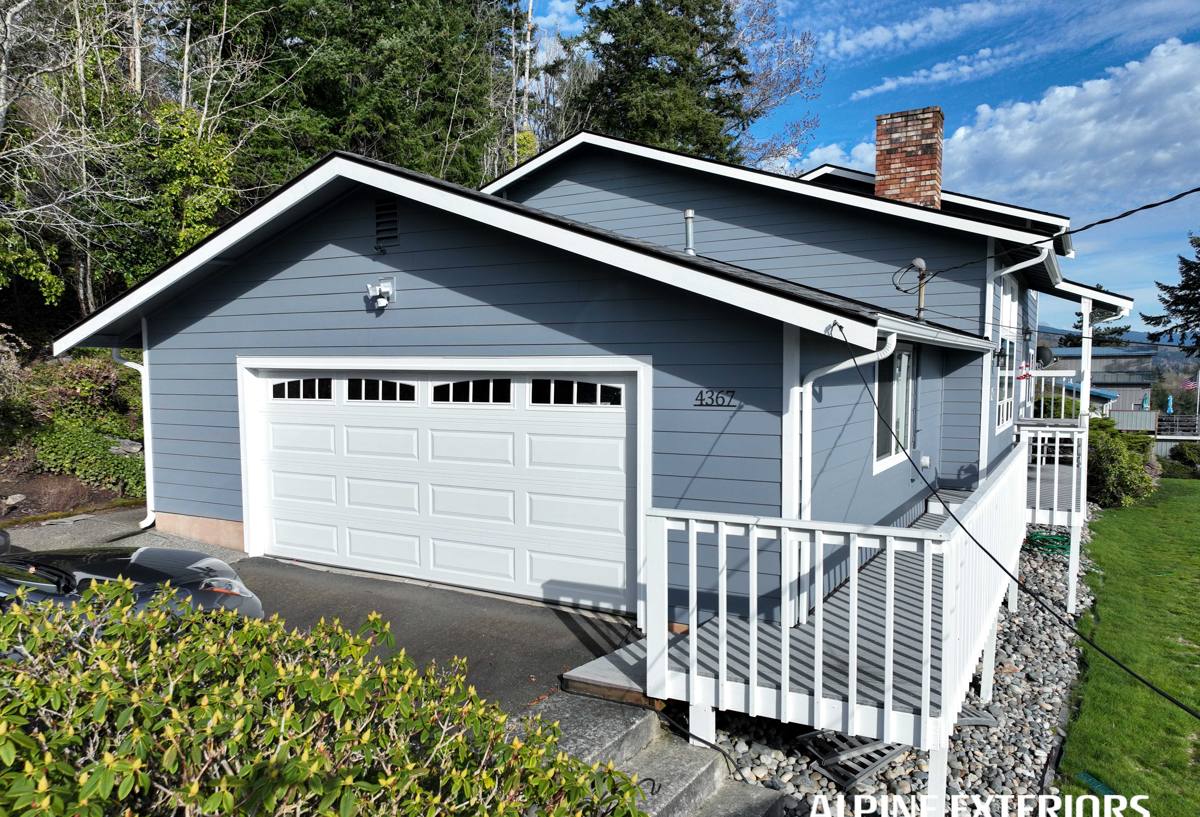
What Salt Air and Driving Rain Actually Do to a Roof
It helps to understand the specific mechanisms at work before talking about materials, because they explain every recommendation that follows.
Salt air and corrosion
Airborne salt is an electrolyte. It accelerates corrosion on any exposed metal — fasteners, flashing, panel edges — especially where dissimilar metals touch and set up galvanic reaction. This is why fastener selection and coating quality matter more in Point Whitehorn than they would twenty miles inland, and why we won't mix incompatible metals on a roof system here.
Wind-driven rain
On an exposed shoreline, rain doesn't just fall straight down — sustained onshore wind pushes it sideways and even upward under eaves, ridge caps, and flashing laps. A roof detail that sheds vertical rain fine can still let wind-driven rain work backward under a lap or fastener head. Every flashing and seam detail on an exposed property has to be built assuming rain will hit it from an angle, not just from above.
Moss and prolonged dampness
Whatcom County's long wet season keeps north-facing and shaded roof slopes damp for extended stretches, and moss takes hold anywhere organic debris and moisture sit long enough. On some roofing materials, moss growth traps moisture against the surface and works into laps and granules. On a properly installed metal roof, moss has a much harder time getting a foothold, and what does grow is easier to remove without damaging the roof surface underneath.
Why Metal Roofing Fits This Environment
Metal roofing isn't the right fit for every home or budget, but for an exposed, salt-air property like the ones around Point Whitehorn, it solves several problems at once:
- Sheds wind-driven rain more reliably when panels and flashing are lapped and sealed correctly for the prevailing wind direction
- Doesn't absorb water into a mat or granule layer the way asphalt shingles do, so it dries faster after a storm and holds less moisture against fasteners and decking
- Gives moss far less to grip onto compared to a granulated or textured surface
- Handles wind uplift well when installed with the correct fastening pattern for an exposed coastal exposure
- Holds up over a long service life when the coating system and fastener metal are matched correctly to a marine environment
None of that happens automatically just because a roof is metal. The coating, the fastener alloy, the underlayment, and the flashing detail all have to be chosen specifically for salt exposure — a metal roof spec that works fine forty miles from the water can underperform out here if it isn't adjusted for the environment.
Panel and Material Options
There isn't one "correct" metal roofing product for every home — the right choice depends on the home's style, roof pitch, and budget. Here's how the common options compare for a coastal Whatcom County property:
| Panel Type | Typical Finish | Coastal Suitability | Notes |
|---|---|---|---|
| Standing seam steel | Baked enamel or PVDF coating | Strong choice for exposed sites | Concealed fasteners reduce penetration points exposed to salt air |
| Exposed-fastener steel panel | Painted galvanized or galvalume | Workable with upgraded fasteners | Lower upfront cost, but fastener gaskets need attention and eventual replacement |
| Aluminum standing seam | PVDF coating | Excellent for direct salt exposure | Naturally corrosion-resistant metal; often preferred closest to the water |
| Stone-coated steel | Granule-coated steel | Good, with correct detailing | Mimics shingle or tile look while keeping metal's core performance |
For homes closest to the water's edge in Point Whitehorn, we lean toward aluminum or a high-quality galvalume steel with a PVDF finish, simply because they resist salt-driven corrosion with the least long-term maintenance. Further back from the shoreline, standard coated steel panels are often perfectly adequate and more budget-friendly.
What a Correct Installation Actually Involves
Metal roofing rewards a careful installer and punishes a rushed one more than almost any other roofing material. The panels themselves are durable, but the roof's actual performance comes down to what's underneath and around them.
Deck condition and underlayment
We check the roof deck for soft spots, rot, and prior moisture damage before anything goes down — panels installed over a compromised deck will fail regardless of how good the metal is. Over the deck, we use a high-temperature synthetic or self-adhered underlayment rated for the panel type, with extra attention to eaves and valleys where wind-driven rain and ice concentrate.
Fastener selection
Fasteners have to match the panel metal to avoid galvanic corrosion, and they need the correct coating and gasket for a salt-air environment. This is one of the most common shortcuts on a rushed job, and one of the first things to fail when it's cut.
Flashing and penetrations
Every chimney, vent pipe, skylight, and roof-to-wall transition is a potential entry point for wind-driven rain. We detail flashing assuming rain will hit it sideways, not just vertically, which is standard practice for any home on this exposed shoreline.
Ventilation
A metal roof needs proper intake and exhaust ventilation to manage condensation on the underside of the panels, especially in a climate where humidity stays high for long stretches. Skipping or under-sizing ventilation is a common cause of hidden moisture problems on metal roofs installed by crews unfamiliar with marine climates.
Edge and rake details
Drip edges, rake trim, and ridge caps take the brunt of wind uplift on an exposed property. These get fastened and lapped to the manufacturer's high-wind specification, not the minimum standard spec meant for sheltered sites.
Our Process for a Point Whitehorn Metal Roof
We keep the process straightforward and transparent, because homeowners on an exposed coastal lot deserve to know exactly what they're getting and why:
- On-site inspection of the existing roof, deck condition, and specific exposure of the property to prevailing wind and salt spray
- Recommendation on panel type and metal based on the home's distance from the water, roof pitch, and budget — not a one-size-fits-all pitch
- A written estimate that spells out materials, fastener spec, underlayment, and flashing approach in plain language
- Deck repair where needed, done before any panel goes down
- Installation following manufacturer specifications adjusted for coastal exposure, including fastener pattern and flashing detail
- Final walkthrough covering what maintenance the roof will and won't need going forward
Cost Factors for Metal Roofing Here
Every home is different, but the factors that move the price on a Point Whitehorn metal roof are fairly consistent:
| Factor | Why It Matters |
|---|---|
| Panel material (steel vs. aluminum) | Aluminum costs more upfront but resists corrosion better in direct salt exposure |
| Roof complexity | More valleys, dormers, and penetrations mean more flashing work and labor time |
| Deck repair needed | Rot or soft decking found during tear-off adds material and labor before panels go on |
| Fastener and underlayment spec | Coastal-grade fasteners and high-temp underlayment cost more than standard-grade materials but last longer |
| Roof access | Steep pitches or difficult site access on some Point Whitehorn lots affect labor and staging |
We'll always give a straight answer on where a homeowner can reasonably save money versus where cutting cost creates a maintenance problem down the line — particularly around fastener quality and flashing detail, which are the two areas most likely to cause an early failure on this coastline.
Maintenance in a Marine Climate
Metal roofing is low-maintenance, not no-maintenance, especially this close to the water. A few habits go a long way:
- Clear debris from valleys and gutters before the wet season builds up, since trapped organic matter holds moisture against the panel surface
- Check and gently remove moss on shaded slopes before it spreads, rather than letting it establish
- Have flashing and fastener condition checked periodically, particularly after severe wind events off the water
- Keep gutters and downspouts clear so water isn't backing up against roof edges during heavy rain
- Avoid pressure washing the roof surface directly, which can damage coatings and force water under laps
Why Local Experience on This Coastline Matters
A crew that mostly works inland jobs may not think twice about fastener alloy or flashing angle, because it rarely matters much away from the water. On an exposed property in Point Whitehorn, those details are the difference between a roof that performs for decades and one that develops leaks or corrosion within a few years. We work this stretch of Birch Bay and the surrounding Whatcom County coastline regularly, so the adjustments for salt exposure, wind-driven rain, and moss aren't an afterthought — they're built into the estimate from the start.
If you're weighing a metal roof for a home in Point Whitehorn, we're happy to walk the roof with you, talk through panel options honestly, and put together a clear, no-pressure estimate. There's a request form below whenever you're ready.