 Birch Bay Siding
 Why a Birch Bay Village Deck Needs More Than a Standard Build
A deck in Birch Bay Village does more work than a deck built a few miles inland. This is a waterfront community, and outdoor living space here usually means a deck oriented toward the water — for morning coffee, for entertaining, for just sitting outside without walking down to the beach. That orientation is exactly what puts the structure in the path of everything Whatcom County's coastline throws at it: salt-laden air off the bay, rain that comes in sideways more often than straight down, and long stretches of the year damp enough to grow moss on anything horizontal and shaded.
None of that means a deck here can't be built to last. It means the planning has to start from what this specific location does to lumber, fasteners, and finishes, rather than from a generic build sheet that assumes a drier, calmer site. We build custom decks for Birch Bay Village homes with that exposure in mind from the first conversation, not as an afterthought once boards start cupping or fasteners start bleeding rust.
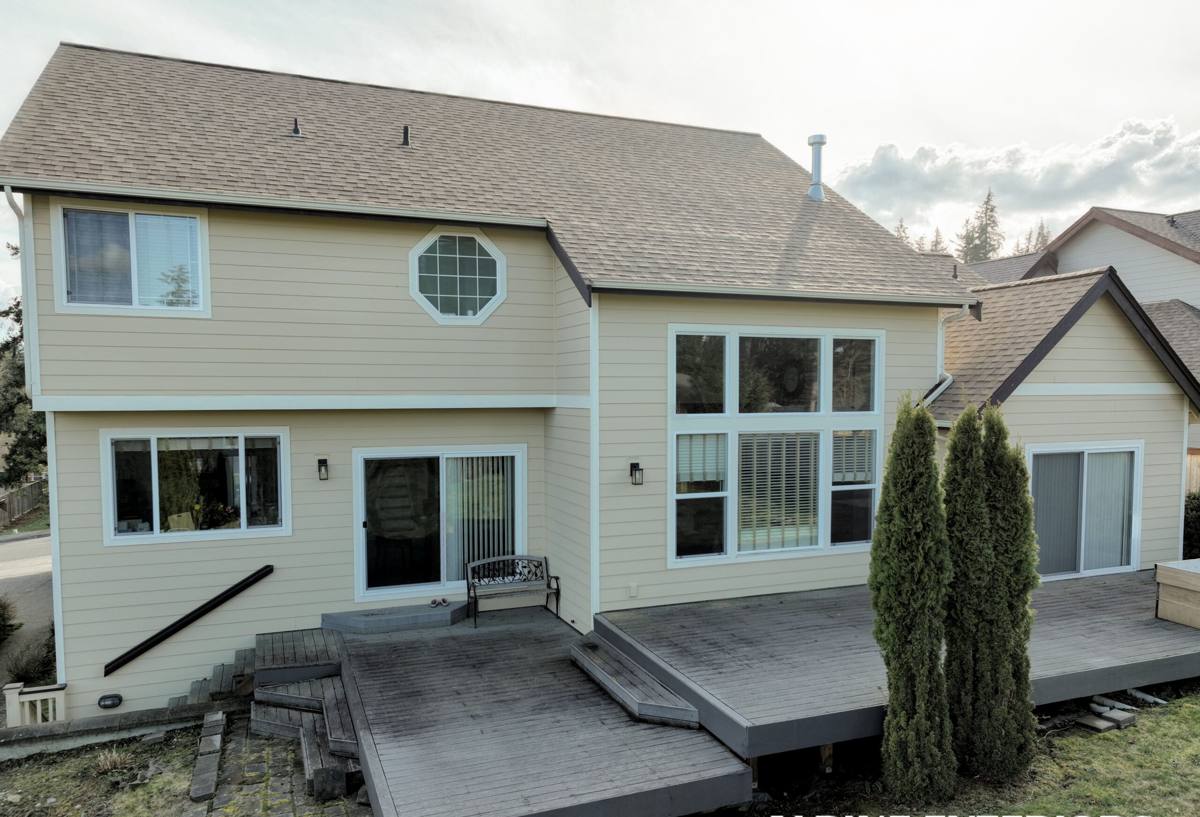
What Salt Air, Rain, and Moss Season Actually Do to a Deck
Salt Air
Airborne salt off Birch Bay settles on every exposed surface, not just during storms but as a steady, low-grade condition. On a deck, that means accelerated corrosion on any fastener, bracket, or piece of hardware that isn't rated for it. A standard galvanized screw can start losing its coating years before a homeowner notices, and once corrosion reaches the fastener shank, holding strength drops long before the deck looks obviously bad. Railing hardware and post connectors, which carry real structural load, are the pieces where this matters most.
Driving Rain
Storms off the water tend to push rain sideways rather than straight down, which changes where water actually ends up on a deck. It gets forced under railing bases, behind fascia boards, and into any gap in the ledger flashing where the deck attaches to the house. A deck built assuming rain only falls vertically will have weak points at exactly those spots — the ledger connection is the single most common place a poorly built deck lets water into the house framing.
Moss Season
Whatcom County's wet season runs long, and shaded or north-facing sections of a deck can stay damp for weeks at a stretch. That's exactly the condition moss needs to establish. Beyond looking bad, moss holds moisture against the board surface, which shortens the life of wood decking and can make boards slick and genuinely unsafe underfoot. Board spacing, airflow underneath the deck, and how much shade a given section gets all affect how much of a moss problem a deck develops over time — and some of that can be designed around at the framing stage, not just managed after the fact with a scrub brush.
Choosing Decking Material for This Location
There isn't one correct decking material for every Birch Bay Village property — sun exposure, how close the deck sits to the water, and how much upkeep an owner actually wants to do all factor in. What we won't do is recommend a material based only on upfront cost without walking through how it performs here specifically.
| Material | Salt Air & Moisture Behavior | Moss & Maintenance | Typical Lifespan Here |
|---|---|---|---|
| Capped composite | Strong — protective cap resists moisture absorption and salt-driven wear | Occasional washing; won't rot, but moss can still grow on a dirty surface | Long-term, backed by manufacturer warranty |
| Cellular PVC | Excellent — no wood fiber to absorb moisture | Occasional washing; very low upkeep | Long-term, generally higher upfront cost |
| Cedar | Naturally rot-resistant but still needs sealing to hold up to salt exposure | Regular cleaning and periodic sealing/staining required to resist moss | Moderate, shorter without consistent upkeep |
| Pressure-treated fir/hem-fir | Weaker against salt air over time; fasteners corrode faster | Needs regular sealing; prone to moss without upkeep | Shortest of the common options, lowest upfront cost |
Composite and PVC decking cost more up front but ask less of the homeowner over the life of the deck, which matters in a climate that punishes anything left unsealed. Cedar and pressure-treated wood remain reasonable choices for owners who want a traditional look and are willing to keep up with sealing on a regular schedule — we'll be straightforward about that commitment rather than downplaying it to close a sale.
Framing, Footings, and What's Underneath the Boards
The decking surface gets the attention, but the framing underneath is what actually determines whether a deck holds up. In this soil and climate, footings need to be set to the depth required to handle frost and ground moisture, not just poured to whatever depth is fastest. Post bases should hold the post above standing water and direct ground contact rather than letting wood sit in wet soil. Joist hangers, ledger bolts, and any structural connector exposed to salt air need to be stainless steel or otherwise rated for coastal exposure — standard interior-grade hardware simply doesn't last out here.
Ledger flashing deserves its own mention because it's the connection point where the deck attaches to the house, and it's the single most consequential detail on the whole build. Done correctly, it sheds water away from the house framing even under wind-driven rain. Done wrong, or skipped to save time, it's a slow leak that can rot framing behind the siding long before anyone sees a problem on the deck surface itself.
Railings, Stairs, and Code Requirements
Railings and stairs are where Washington building code sets firm minimums — height, baluster spacing, guard requirements on elevated decks, and stair rise and run all have to meet code, not just look right. On a waterfront property, railing posts and their connections also take more wind load than an inland deck sees, so post spacing and attachment need to account for that, especially on decks built up higher off grade. We handle the permitting and inspection process as part of the build rather than leaving code compliance for the homeowner to research on their own.
Our Process, Start to Finish
- Site visit — we look at grade, drainage, sun and shade patterns through the day, and how exposed the site is to wind and water
- Design and material conversation — an honest walkthrough of decking options, framing needs, and layout based on how the space will actually be used
- Permitting — we handle the Whatcom County permit process rather than leaving it to the homeowner
- Footings and framing — footings set to proper depth, structural connections rated for coastal exposure, ledger flashing done correctly at the house connection
- Decking, railing, and stairs — installed to the layout and material plan, with attention to board spacing and airflow to help manage moss over time
- Final walkthrough — we go over what your specific decking material actually needs for upkeep, so there are no surprises a year in
Keeping a Birch Bay Village Deck in Good Shape
Even a well-built deck needs some regular attention in this climate. Most of it is simple, and skipping it is what turns a manageable maintenance item into a structural one:
- Sweep or rinse the surface regularly, especially shaded sections, to keep moss from getting established
- Keep gaps between boards clear of debris so water can drain and air can circulate underneath
- Reseal or restain wood decking on the schedule the product actually needs — skipping a year adds up faster here than inland
- Check railing posts and hardware yearly for early signs of corrosion or loosening, especially after winter storms
- Trim back landscaping that shades a section of deck or blocks airflow underneath it
- Address any soft framing, standing water underneath, or a leaning post right away — those are structural issues, not cosmetic ones
Why a Crew That Already Works Birch Bay Village Matters
General deck-building advice is written for average conditions, and Birch Bay Village doesn't have average conditions — salt air, driving rain, and a long moss season all push harder against a structure than they would a few miles inland. A crew that already builds and repairs decks in this specific community isn't guessing at what holds up here. We know which fastener grade actually lasts, how ledger flashing needs to be sequenced to handle wind-driven rain, and which decking products perform well against this climate over years rather than months, not just according to a manufacturer's brochure.
That familiarity also means being straightforward with homeowners about trade-offs — where a lower-maintenance material is worth the extra upfront cost, and where a traditional wood deck still makes sense if you're willing to keep up with it. We'd rather tell you that plainly than upsell you on something your specific property doesn't need.
Get a Free, No-Pressure Estimate
If you're planning a new deck, replacing one that's showing its age, or just want an honest read on what your current deck actually needs, we're happy to walk the site with you. Use the form below to schedule a free, no-pressure estimate for your Birch Bay Village property.