 Birch Bay Siding
 Why Decks Near Blaine Wear Out Faster Than People Expect
If you own a home in the Blaine area near Birch Bay, you already know your deck doesn't age the way a deck in a drier inland town does. The combination of salt-laden air off the water, near-constant driving rain through the fall and winter, and a moss season that can stretch six months or longer puts a different kind of stress on outdoor structures. Salt air accelerates corrosion on fasteners, hardware, and any exposed metal connectors. Driving rain doesn't just fall straight down here — wind pushes it sideways and up under rail caps, ledger boards, and stair treads, finding every gap in old flashing. And moss doesn't just look bad on a deck surface; it holds moisture against wood and composite decking alike, keeping boards damp long after a storm has passed.
None of this means a deck can't last in Whatcom County. It means the deck has to be built and detailed for these specific conditions, not built to a generic spec sheet. A lot of the deck failures we get called out to inspect aren't failures of the decking material itself — they're failures of flashing, fastener choice, or ledger attachment that let moisture and salt air do their damage over a few winters.
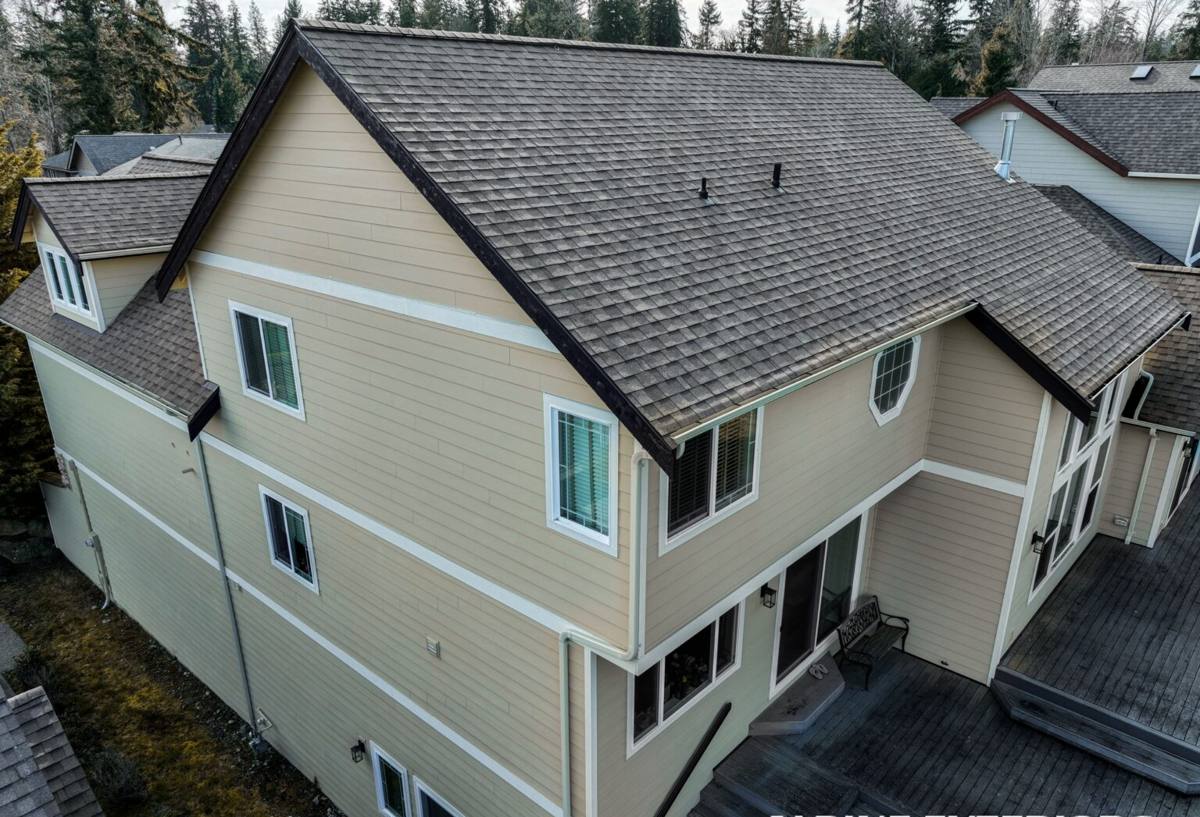
Signs a Deck Needs Replacing, Not Just Patching
Homeowners often ask whether a deck can be repaired instead of replaced. Sometimes it can. But there's a point where patching individual boards is just delaying a bigger job, and in a climate like ours, that point comes sooner than people expect.
- Soft, spongy spots when you walk across the deck, especially near the ledger board or stair landing
- Visible rot or dark staining at joist ends, under rail posts, or where the deck meets the house
- Persistent moss or algae that comes back within weeks of cleaning, even in summer
- Rusted, streaking, or crumbling fasteners and hardware — a strong sign the framing underneath has been wet for a long time
- Rail posts that wiggle or flex, which usually means the post-to-frame connection has failed
- A ledger board separating from the house, or gaps where flashing should be sealing that joint
If you're only seeing one or two worn boards on a deck that's otherwise solid, a repair is reasonable. If you're seeing several of the signs above, or the deck is old enough that the framing itself is original, replacement is almost always the more honest recommendation — and cheaper in the long run than repeated patch jobs.
What a Correct Deck Replacement Actually Involves
A deck replacement is more than swapping old boards for new ones. Done right, in this climate, it starts from the structure and works outward.
Framing and Ledger Attachment
The ledger board — where the deck attaches to the house — is the single most common source of hidden water damage on decks in this region. It needs proper flashing that directs water away from the house wall, not just caulk, which fails within a few seasons under constant rain exposure. Joists and beams need to be sized correctly for the span and load, and connected with fasteners rated for exterior, coastal-adjacent use.
Fasteners and Hardware
Standard hot-dip galvanized hardware can corrode faster near salt air than it would further inland. We spec fasteners and structural connectors rated for coastal exposure, which costs a little more up front but avoids the rust streaks and weakened connections that show up in five to seven years with lower-grade hardware.
Decking Surface and Drainage
Whatever decking material is chosen, the framing beneath it needs airflow and drainage so water doesn't pool and sit. Board spacing, joist tape, and proper slope away from the house all matter more here than they would in a dry climate, because the deck rarely gets a long enough dry stretch to recover from poor drainage on its own.
Stairs and Rails
Stair stringers and rail posts take a disproportionate amount of moisture exposure because water runs off the deck surface and collects at these points. These get the same attention to flashing and fastener quality as the main structure — it's a common place for corner-cutting to show up later as a safety issue, not just a cosmetic one.
Decking Material Options for This Climate
There's no single "best" decking material for every home — it depends on budget, maintenance appetite, and how much sun versus shade the deck gets. Here's how the common options actually perform under Birch Bay and Blaine-area conditions:
| Material | Moisture & Moss Resistance | Maintenance | Typical Lifespan Here |
|---|---|---|---|
| Pressure-treated wood | Fair — absorbs moisture, needs sealing to resist moss and rot | Annual cleaning, re-sealing every 2-3 years | 10-15 years with upkeep |
| Cedar | Good natural rot resistance, but still needs sealing against constant rain | Regular sealing/staining, moss cleaning | 15-20 years with upkeep |
| Composite decking | Very good — doesn't absorb water the way wood does, but surface moss/algae still needs occasional cleaning | Low — periodic washing, no sealing | 25-30+ years, manufacturer-dependent |
| PVC decking | Excellent — fully synthetic, no wood fiber to hold moisture | Lowest — occasional washing | 25-30+ years, manufacturer-dependent |
Our standard recommendation for most Blaine-area replacements is composite or PVC decking, simply because the maintenance burden of natural wood in a climate with this much rain and moss pressure is real — it's not a small chore, it's a recurring seasonal job. That said, we still build plenty of wood decks for homeowners who prefer the look and are committed to the upkeep. It's a legitimate choice as long as it's an informed one.
Our Deck Replacement Process
- On-site assessment. We look at the existing deck's framing, ledger connection, and any rot or hardware corrosion before quoting anything — you can't price a replacement honestly without seeing what's underneath the boards.
- Written estimate. You get a clear scope: what's being removed, what's being rebuilt, materials, and a price — no vague allowances that turn into surprise change orders.
- Permitting. Deck replacements in Whatcom County typically require a permit, especially when structural framing is being replaced. We handle that process rather than leaving it to you.
- Demolition and disposal. Old decking, framing, and hardware are removed and hauled off — we don't leave debris piled in the yard.
- Framing and flashing. This is where the climate-specific detailing happens — ledger flashing, joist protection, and coastal-rated fasteners go in before a single deck board is installed.
- Decking, rails, and stairs installed. Final surface, railing, and stair work, checked for level, secure rail connections, and proper drainage.
- Final walkthrough. We go over the finished deck with you, including basic maintenance guidance specific to the material you chose.
Permits and Local Considerations
Most deck replacements in Whatcom County require a building permit when the structure — framing, footings, or ledger attachment — is being rebuilt, even if the footprint stays the same. Decks attached to the house also need to meet current code for ledger flashing and guard rail height, which older decks built decades ago often don't. Replacing a deck is a natural point to bring these details up to current standards rather than rebuilding around outdated framing. We manage the permit process as part of the job so you're not stuck navigating county requirements on your own.
Cost Factors to Understand Before You Get a Quote
Deck replacement pricing varies widely based on size, material, and how much of the substructure needs rebuilding. Rather than quote a number that won't mean much without context, here's what actually drives the price:
| Factor | Why It Matters |
|---|---|
| Deck size and shape | Larger and multi-level decks require more material and labor; irregular shapes add cutting and framing complexity |
| Decking material chosen | Composite and PVC cost more upfront than wood, but reduce long-term maintenance spending |
| Condition of existing framing | If joists, beams, or the ledger board are rotted, more of the substructure needs rebuilding, not just resurfacing |
| Height and stairs | Elevated decks with stairs and multiple rail sections take more labor than a low, simple platform |
| Permit and inspection requirements | Structural rebuilds typically require permits and inspections, which add time but protect you long-term |
The honest range for a full deck replacement is broad — a modest wood deck rebuild costs meaningfully less than a large composite deck with multiple stair sections and rail runs. That's exactly why we do an on-site assessment before quoting rather than giving a number over the phone.
Why a Crew That Already Works Blaine and Birch Bay Matters
Deck construction detail that works fine in a drier region can fail here within a few years — not because the crew did bad work by general standards, but because they didn't build for this specific combination of salt air, rain volume, and moss pressure. A crew that works this stretch of Whatcom County regularly knows which ledger flashing details actually hold up, which fastener grades are worth the extra cost, and which decking products handle a long wet season without turning into a slip hazard under moss growth.
That local familiarity also shows up in smaller ways — knowing what the county permit office expects to see on a deck rebuild application, understanding how prevailing wind and rain direction on a given lot affects where water actually hits the structure, and having already seen how different decking materials perform after a few winters on homes nearby, not just in a manufacturer's brochure.
Questions Worth Asking Before You Hire
- Will you pull a permit for this job, and is that included in the quote?
- What fastener and hardware grade do you use, and is it rated for coastal/salt-air exposure?
- How will the ledger board be flashed where the deck meets the house?
- What's your plan for drainage under the decking so water doesn't sit against the frame?
- Can you show me examples of decks you've built in this specific area, not just generally nearby?
- What's the manufacturer warranty on the decking material, and does your installation meet its requirements?
If a contractor can't answer these clearly, that's worth noting before you sign anything.
If your deck is showing wear, feels soft or shaky in spots, or you're just planning ahead for a rebuild, we're glad to take a look and give you a straightforward, no-pressure estimate. There's a form below — tell us a bit about your deck and we'll go from there.