 Birch Bay Siding
 Point Whitehorn's Waterfront Climate Is Rough on Decks
Point Whitehorn sits close enough to the water that homes here take a different kind of weathering than decks a few miles inland in Whatcom County. Salt-laden air off the Strait of Georgia works on fasteners and hardware year-round, driving rain comes in sideways during winter storms, and the tree cover and shade common to this stretch of Birch Bay keep decks damp long after a storm has passed. Add a moss season that can run from fall through spring, and you have a deck environment that punishes shortcuts fast.
None of this means composite decking is a bad fit here — it's usually the opposite. But it does mean the details of how a deck is built and installed matter more in Point Whitehorn than they would in a drier, more sheltered part of the county. A deck built the same way you'd build one in eastern Washington will show problems within a couple of seasons on this coastline.
Salt Air and Wind Exposure
Salt air accelerates corrosion on anything metal — screws, joist hangers, post bases, railing brackets. It also finds its way into any gap or seam that isn't properly sealed or flashed. Wind-driven rain pushes water into places a calmer rainstorm never would, including under rail posts and around stair stringers.
Moss, Shade, and Standing Moisture
Many Point Whitehorn lots have mature tree cover, which is part of what makes the area appealing but also means decks stay shaded and damp longer after rain. Moss and algae growth on decking, especially in low-traffic areas and under rail lines, is a near-constant maintenance issue if the deck isn't designed with drainage and airflow in mind from the start.
What Composite Decking Actually Solves — and What It Doesn't
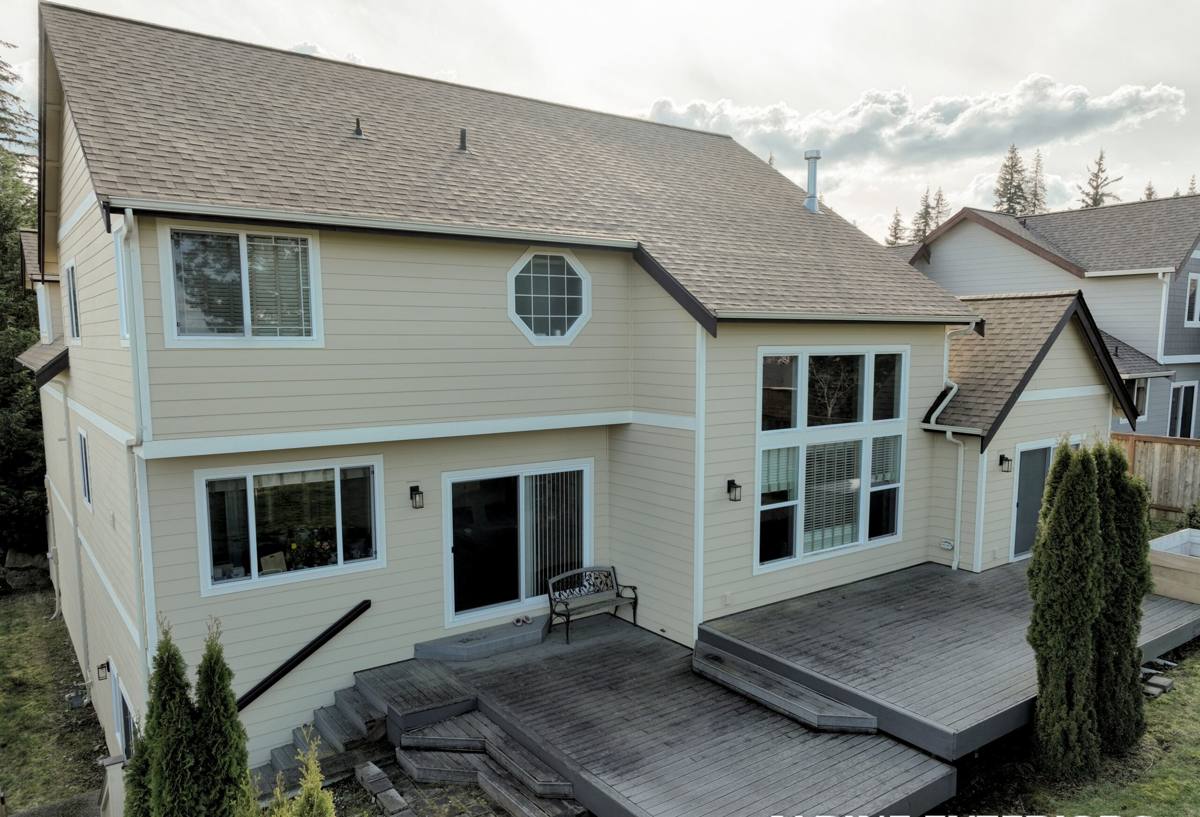
Composite decking is a good match for this climate because it doesn't absorb water the way wood does, doesn't need annual staining or sealing, and resists rot at the board level. That's a real advantage in a place where a wood deck can need refinishing every one to two years just to keep moisture out.
What composite decking does not do is eliminate every maintenance concern. Boards can still develop surface mold or algae film in shaded, damp spots if they're never cleaned. Hardware underneath the boards is still metal unless you specify otherwise, and it still needs protection from salt air. And composite decking is only as good as the frame it's fastened to — a solid composite surface over a poorly built substructure is still a problem waiting to happen.
Getting the Substructure Right First
Most deck failures we see in this area start below the decking, not on top of it. The framing, ventilation, and drainage underneath the boards are what determine whether a deck lasts fifteen years or needs major repair in five.
- Joist spacing matched to the specific composite product's span rating — not just "what we always use"
- Joist tape or flashing on top of every joist to keep moisture from wicking into the wood frame
- Corrosion-resistant fasteners and connectors rated for coastal or treated-lumber contact
- Adequate airflow underneath the deck so moisture doesn't sit trapped against the joists
- Proper slope and drainage so water sheds away from the house rather than pooling near the ledger
- A correctly flashed ledger board connection where the deck meets the house — a common source of hidden rot
None of this is visible once the decking goes down, which is exactly why it matters. A deck that looks fine on day one can be hiding a substructure that's already failing if these steps were skipped.
Choosing Boards and Hardware for a Point Whitehorn Home
Not all composite decking is built the same, and the differences matter more here than in a sheltered inland yard. Fully capped composite boards — where a protective polymer shell wraps the board on all sides — hold up better against moisture intrusion and staining than uncapped composite, which can absorb water at cut ends and fastener holes over time. In a climate with this much rain and shade, that difference shows up faster.
Fastener choice matters just as much as the board itself. Hidden fastener systems avoid the surface screw holes that can become entry points for moisture, and stainless or coated hardware resists the corrosion that plain galvanized fasteners struggle with near salt air.
| Consideration | Why It Matters Here |
|---|---|
| Fully capped vs. uncapped composite | Capped boards resist moisture wicking at cut ends and fastener holes, which matters in a wetter, shadier climate |
| Hidden vs. face-screwed fasteners | Hidden systems reduce surface penetration points where water and salt air can work in over time |
| Board color and texture | Darker, textured boards can hide moss film longer between cleanings; lighter boards show it sooner but also read cleaner overall |
| Railing material | Composite or coated aluminum rail systems avoid the wood rail maintenance cycle and hold up better against salt air than bare wood or plain steel |
| Structural hardware | Stainless or coated connectors are worth the added cost in a coastal-adjacent environment like Point Whitehorn |
Our Installation Process
We approach every Point Whitehorn composite deck the same methodical way, because the climate doesn't give us room to cut corners on any step.
- On-site assessment of the existing deck or ground conditions, drainage, and sun/shade exposure
- Review of board and hardware options with honest trade-offs, not just a catalog pitch
- Framing or reframing to current span and connection standards, with flashing and joist protection built in
- Proper ledger flashing and waterproofing at the house connection
- Composite board installation with attention to expansion gaps, which composite requires more than wood
- Railing, stair, and hardware installation matched to the board system's warranty requirements
- Final walkthrough covering drainage, care, and what to expect over the deck's first year
We don't treat the substructure as an afterthought to get to the "real" work of laying boards. In this climate, the substructure is the real work.
Maintenance in a Long Moss Season
Composite decking cuts maintenance significantly compared to wood, but "low maintenance" isn't "no maintenance" — especially with the shade and moisture common around Point Whitehorn.
- Sweep debris and leaf litter off the deck regularly, especially in fall when it accumulates fastest
- Rinse with a hose and mild soap a few times a year to keep algae and moss film from establishing
- Avoid pressure washers on the highest settings, which can damage the board surface over time
- Keep gutters and downspouts near the deck clear so runoff isn't dumping extra water onto the decking
- Check railing hardware annually for corrosion, especially screws and brackets closest to open air
- Trim back overhanging branches where practical to reduce shade and speed up drying between rains
A deck that's cleaned a couple of times a year rarely develops the slick moss buildup that becomes a slip hazard by late winter.
Cost Factors to Expect
Composite decking costs more upfront than pressure-treated wood, but the calculation changes when you factor in the refinishing wood would need in this climate. Exact pricing depends on size, board tier, railing choice, and site conditions, but the factors below are what typically move the number.
| Factor | Impact on Cost |
|---|---|
| Deck size and shape | More linear footage of framing, boards, and fascia; complex shapes add labor |
| Board tier (capped vs. uncapped) | Fully capped, longer-warranty boards cost more per square foot but hold up better here |
| Substructure condition | Reframing or repairing an existing frame adds cost but is not optional if it's compromised |
| Railing system | Composite, aluminum, and cable rail systems each carry different material and install costs |
| Site access and elevation | Multi-level decks, steep lots, or limited equipment access add labor time |
We give straightforward estimates broken down by these factors, so you can see where the cost is actually going rather than one lump number.
Why Hiring a Crew That Works This Area Matters
A contractor who mostly builds decks inland, away from the water, doesn't always account for the extra corrosion resistance, drainage detail, or moss management a Point Whitehorn deck needs. We work throughout Birch Bay and this part of Whatcom County regularly, so we're specifying hardware, flashing, and board systems with this specific climate in mind rather than a generic regional standard.
That local familiarity also means we're realistic with homeowners about trade-offs — where a cheaper board or fastener will save money now but cost more in callbacks or early replacement later, and where it genuinely won't matter. We'd rather tell you that upfront than let the weather make the point for us in a few years.
If you're planning a new composite deck or replacing an aging wood deck in Point Whitehorn, we're happy to take a look and put together a free, no-pressure estimate. Use the form below to get started.