 Birch Bay Siding
 Decks Built for the Point Whitehorn Coastline
Point Whitehorn sits close enough to the water that every outdoor structure on a property feels the effects of it. Salt-laden air moves inland off the Strait, rain settles into every joint and fastener hole that isn't sealed correctly, and shaded, tree-lined lots hold moisture long after a storm has passed. A deck built here isn't just a place to put a grill and some chairs — it's a structure that has to shed water, resist corrosion, and stay ahead of moss and algae for years without turning into a maintenance headache.
We build custom decks for homeowners in this part of Whatcom County, and we treat Point Whitehorn as its own case, not a copy-paste job from a drier neighborhood. The framing choices, fastener grades, and finish schedules that hold up on a sheltered inland lot often fall short a few miles closer to the water. This page walks through what we actually do differently here, and what to look for whether you hire us or someone else.
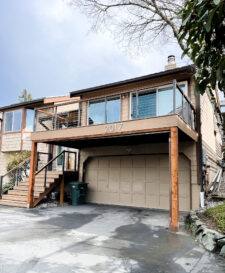
What This Climate Does to an Improperly Built Deck
Most deck failures we get called to look at aren't dramatic structural collapses — they're slow, quiet problems that started small and got worse because the deck wasn't built for the conditions it was sitting in. In Point Whitehorn, the usual suspects are:
- Fasteners and hardware corroding from the inside out because they weren't rated for coastal exposure
- Ledger boards and post bases holding moisture against the house or footing longer than they should, leading to rot
- Moss and algae building up on horizontal surfaces that don't get enough sun or airflow to dry out between rains
- Standing water at low spots in decking boards where gaps were cut too tight or sloped the wrong direction
- Railings and connectors that loosen over a few seasons because the original hardware wasn't built for repeated wet-dry cycling
None of these are exotic problems. They're the predictable result of using standard framing practices in a spot that isn't standard. A deck built with the right materials and details the first time avoids nearly all of it.
Choosing Decking Material for a Salt-Air, Moss-Prone Lot
Composite and PVC Decking
For most Point Whitehorn projects, we lean toward composite or PVC decking. These products don't absorb water the way wood does, which matters when a board is going to spend a good part of the year damp. They also don't feed moss and algae growth the way untreated wood surfaces can, and they hold up better against the fine salt residue that settles on decks near the water. The tradeoff is a higher upfront material cost and a more limited color and texture range than natural wood, but for a low-maintenance, long-term surface in this environment, it's usually the more honest recommendation.
Cedar and Pressure-Treated Wood
Real wood still has a place, especially for homeowners who want a natural look or plan to stain and maintain it themselves. Cedar handles moisture better than most softwoods and has natural rot resistance, but it still needs regular sealing or staining to perform well this close to the coast — skip that maintenance for a season or two and moss gets a foothold fast. Pressure-treated lumber is a reasonable structural choice for framing underneath, but we don't recommend it as a decking surface in a heavy-moss area without a real maintenance commitment behind it.
Fasteners and Hardware
Whatever decking material you choose, the hardware holding it together matters just as much. We use stainless steel or heavy hot-dip galvanized fasteners and connectors rated for coastal exposure, not the standard coated screws that are fine for drier inland builds but corrode faster in salt air.
| Material | Moisture & Salt Resistance | Maintenance Needed | Best For |
|---|---|---|---|
| Composite / PVC | High — doesn't absorb moisture | Occasional cleaning, no sealing | Long-term, low-upkeep decks |
| Cedar | Moderate — needs sealing to perform | Sealing/staining every 1-2 years | Natural look, hands-on owners |
| Pressure-Treated Wood | Moderate for framing, weaker as a surface | Regular sealing if used as decking | Substructure, budget framing |
| Standard Fasteners (non-coastal rated) | Low near the water | Prone to early corrosion | Not recommended for this area |
Framing and Drainage Details That Matter Here
Footings and Substructure
Point Whitehorn lots vary — some are more exposed to wind off the water, others are shaded and tucked among trees with slower-draining soil. Either way, footings need to be sized and set to local frost depth and soil conditions, not just "deep enough" by habit. We check drainage around each footing location before pouring, because standing water against a post base is one of the more common slow-motion failures we see.
Ledger Boards and Flashing
Where a deck attaches to the house, proper flashing is non-negotiable. A ledger board without correct flashing traps water against the house framing, and in a climate that gets driving rain from multiple directions, that's a rot problem waiting to happen. We flash every ledger connection as if the deck were going to see rain sideways — because here, it will.
Board Spacing, Slope, and Airflow
Decking boards need consistent gapping to let water drain through rather than pool on top, and the whole deck surface should have a slight slope away from the house. Underneath, we leave enough clearance for airflow so the substructure can actually dry out between storms instead of staying damp for weeks at a time — that airflow is one of the biggest factors in how fast moss and mildew take hold.
Our Process From First Call to Finished Deck
We keep the process straightforward and don't ask homeowners to make decisions they don't have the information for:
- Free on-site estimate — we look at your specific lot, sun exposure, drainage, and how sheltered or exposed the build site is
- Material and layout discussion, with honest tradeoffs laid out rather than a single "best" option pushed on you
- Written estimate covering scope, materials, and timeline before any work starts
- Permitting handled or coordinated as needed for your specific property
- Construction, with framing and flashing details built for this climate, not a generic inland spec
- Final walkthrough so you know what maintenance, if any, your specific materials will need
Permits and Local Requirements
Deck projects in unincorporated Whatcom County, including the Birch Bay and Point Whitehorn area, typically go through the county's permitting process, and requirements can depend on the deck's size, height, and proximity to property lines or shoreline setback rules. Exact requirements vary by property, so we don't guess — we confirm what's needed for your specific lot before work starts rather than assuming a standard suburban build applies. If your property is closer to shoreline jurisdiction, that can add another layer of review, and we plan for that up front rather than discovering it mid-project.
Maintaining a Deck Through a Long Moss Season
Even the right materials benefit from some basic upkeep, especially through the wetter months. A simple seasonal routine goes a long way:
- Sweep debris off the deck surface regularly — wet leaves and needles trap moisture and feed moss growth
- Rinse composite or PVC decking periodically to clear salt residue and organic buildup
- Reseal or restain wood decking on schedule rather than waiting until it visibly needs it
- Check railings, stair connections, and fastener heads once or twice a year for early signs of corrosion or loosening
- Keep gutters and downspouts near the deck clear so runoff isn't dumping extra water onto the structure
- Trim back overhanging branches where possible to let more sun and airflow reach the deck surface
Why Local Experience on This Specific Coastline Matters
A lot of deck problems we're asked to fix started with a crew that builds fine decks — just not decks built for this exact stretch of coastline. Knowing how exposed a given part of Point Whitehorn is to wind and salt, how shaded certain lots stay through the wet season, and which framing details actually hold up here isn't something you get from a general specification sheet. It comes from working this area repeatedly and seeing what lasts and what doesn't. That's the experience we bring to every deck we build in this neighborhood, and it's the difference between a deck that needs attention every year and one that quietly does its job for a couple of decades.
If you're planning a custom deck in Point Whitehorn, we're happy to take a look at your property and talk through what makes sense for your site, your budget, and how you actually plan to use the space. Reach out for a free, no-pressure estimate using the form below.