 Birch Bay Siding
 Building a Deck That Lasts in Marietta's Coastal Climate
A deck in Marietta takes a different kind of beating than a deck built inland. This part of Whatcom County sits close enough to open water that homes deal with salt-laden air, wind-driven rain that gets pushed sideways under eaves and railings, and a moss season that can run eight months or more in a shaded, north-facing yard. A deck built with generic, catalog-spec methods will show it within a few years — cupped boards, rusted fasteners, soft spots where water sat instead of running off. A deck built for this specific climate holds its line, its finish, and its structural integrity much longer.
This page covers what a correctly built deck in Marietta actually requires: material choices that make sense here, the framing and waterproofing details that matter most in a wet marine climate, and how our process works from first conversation to finished project.
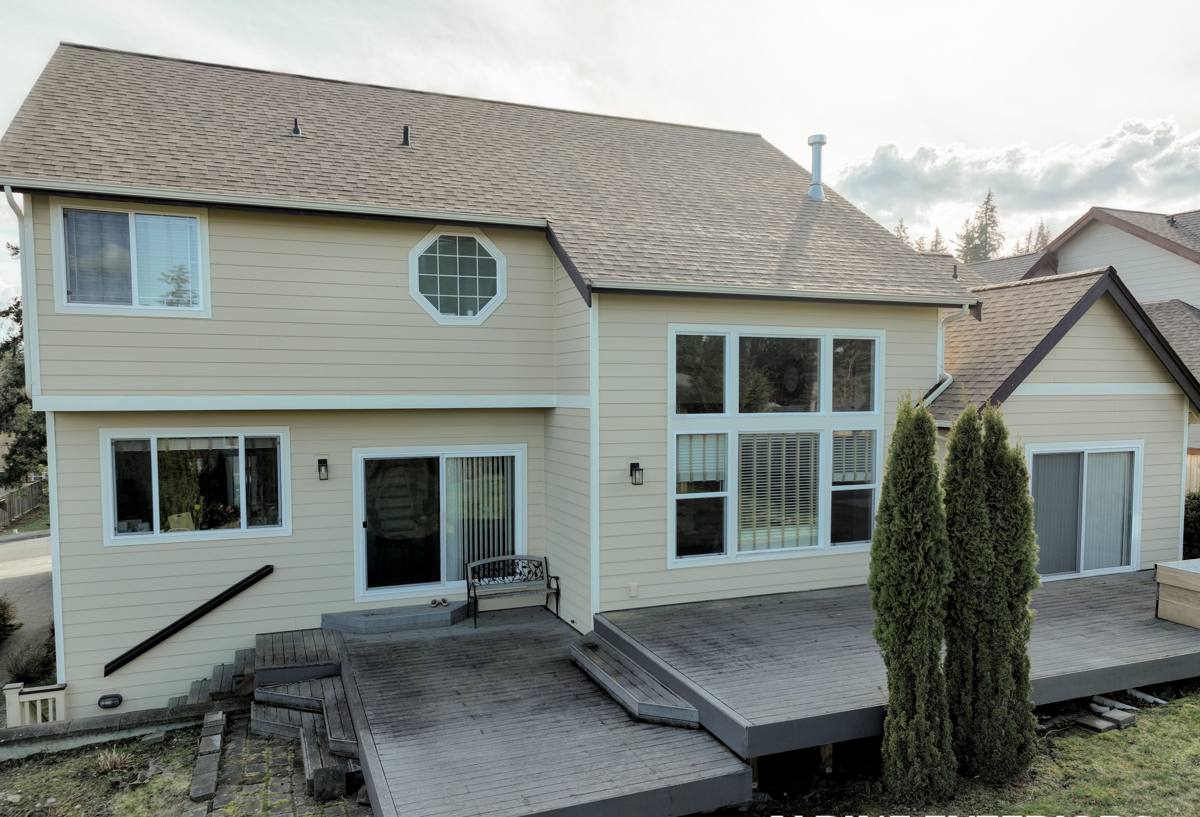
What Whatcom County's Coastal Climate Does to a Deck
Three conditions drive almost every decking failure we see in this part of the county, and they compound each other.
Salt Air and Corrosion
Even a few miles from the water, airborne salt accelerates corrosion on anything metal — screws, joist hangers, bolts, railing brackets. Standard electroplated fasteners can start rusting within a season or two in this environment. Once a fastener rusts, it weakens, stains the surrounding wood or composite, and eventually needs replacing — often after the decking is already down, which turns a cheap part into an expensive repair.
Driving Rain
Rain here rarely falls straight down. Wind off the water pushes it sideways, which means it gets up under railings, into board gaps, and against ledger boards and house walls in ways a calm-climate deck design doesn't anticipate. Flashing, gapping, and drainage details that would be optional in a drier region are not optional here.
A Long Moss Season
Cool, damp, and shaded conditions for much of the year make Whatcom County prime moss and algae territory. On a deck, moss doesn't just look bad — it holds moisture against the surface, and on wood it becomes a slip hazard and a wood-rot accelerant. Deck orientation, board spacing, and surface material all affect how much moss pressure a deck will face over its life.
Choosing Decking Material for This Climate
There's no single "best" decking material — the right choice depends on how much maintenance a homeowner wants to do, budget, and how exposed the deck is to shade and moisture. Here's how the common options actually perform in a Marietta-area yard.
| Material | How It Handles Salt Air & Rain | Moss & Algae Behavior | Maintenance Reality |
|---|---|---|---|
| Pressure-treated wood | Holds up structurally if properly sealed; fasteners must be corrosion-rated | Prone to moss in shaded areas without regular cleaning | Needs re-staining or sealing every 1–2 years |
| Cedar | Naturally rot-resistant, but surface still needs sealing against driving rain | Moderate — better airflow characteristics than PT lumber | Annual cleaning and periodic oil/sealer |
| Composite decking | Doesn't absorb water or rot; performs well in salt air | Can still grow surface algae in shaded, low-airflow spots — needs washing | Low — occasional wash, no staining |
| PVC decking | Fully water-resistant, handles salt air well | Similar to composite — smooth surfaces shed moss more easily than textured wood | Lowest — wash as needed |
We'll talk through this trade-off honestly during an estimate. Wood costs less up front and has a warmer look that some homeowners prefer, but it asks for more attention year to year in a climate that's actively working against it. Composite and PVC cost more initially but shift the maintenance burden way down, which matters if the deck is in a shaded or hard-to-reach part of the yard where regular upkeep is unlikely to happen.
Framing, Ledger Attachment, and Waterproofing Details
The part of a deck nobody sees after the project is done is usually the part that determines whether it lasts. Where a deck attaches to the house — the ledger board — is the single most common failure point in wet coastal climates, because that's where water gets trapped against the house structure if it's not flashed correctly.
A correct ledger installation includes:
- Proper metal flashing that directs water out and away from the house wall, not just a bead of caulk
- A waterproof membrane or joist tape between the ledger and the house sheathing
- Corrosion-rated lag bolts or structural screws, sized and spaced to code, not undersized deck screws
- A small air gap or drainage path so water that does get behind the ledger has somewhere to go
Beyond the ledger, every joist gets protected with joist tape before decking goes down. This one detail is easy to skip and impossible to fix later without tearing the deck apart — it's also exactly the kind of detail that separates a deck that lasts fifteen years from one that needs joist replacement in five.
Railings, Fasteners, and Hardware for Salt Air
Hardware choice matters as much as decking choice in this climate. We spec stainless steel or otherwise corrosion-rated fasteners and structural hardware for coastal-exposure decks — standard galvanized hardware can look fine for a year or two before rust starts bleeding into the surrounding material, and by the time it's visible, the fastener itself has already lost strength.
Railings deserve the same attention. Metal railing systems and cable rail hardware are especially vulnerable to salt air if they're not rated for coastal exposure, and a rusting railing post isn't just cosmetic — it's a structural safety issue on a component people lean on. Wood or composite railing systems need the same corrosion-rated fasteners as the deck frame underneath them.
Footings and Foundation Considerations
Whatcom County's coastal lowlands often mean wetter, less consistent soil than you'd find further inland or at higher elevation. Before we set footings, we look at drainage on the site, grade, and how water moves across the yard during heavy rain events — which, in this area, is most of the year.
Footings are set below frost depth and sized to local code, with concrete piers or footings that keep the post base above grade so wood posts aren't sitting in standing water after a storm. On sites with poor natural drainage, we'll sometimes recommend gravel drainage around footings or minor grading work as part of the project so the deck isn't fighting standing water at its foundation for the next twenty years.
Our Deck Building Process
Every deck we build in the Marietta and Birch Bay area follows the same process, whether it's a simple ground-level platform or a multi-level deck with railings and stairs.
- On-site consultation. We walk the property, look at sun and shade exposure, drainage, and how the deck will attach to the house, and talk through material options and budget honestly.
- Design and material selection. We finalize layout, decking material, railing style, and any add-ons like built-in seating or stairs, based on the specific site conditions.
- Permitting. Deck projects above certain heights or attached to the house typically require a permit through the county or applicable jurisdiction. We handle that process rather than leaving it to the homeowner.
- Site prep and footings. Layout, excavation, and footings are set first, accounting for the drainage conditions specific to the lot.
- Framing and waterproofing. Ledger flashing, joist tape, and corrosion-rated hardware go in before a single decking board is installed.
- Decking, railings, and finish work. Boards are installed with proper spacing for drainage and airflow, railings are set, and any stairs or trim are finished out.
- Final walkthrough. We go over the finished deck together, including what maintenance it will actually need given its material and how much sun or shade it gets.
Maintenance Through a Long Moss Season
No deck in this climate is truly maintenance-free, even composite and PVC. What changes by material is how much maintenance and how often. Here's a practical baseline for keeping a Marietta-area deck in good shape year-round:
- Sweep debris and standing organic matter (leaves, needles) off the deck regularly during fall and winter — it holds moisture and feeds moss growth
- Wash the deck surface at least once or twice a year with a deck-safe cleaner to remove algae and moss before it gets established
- Check railing posts, stairs, and any metal hardware annually for early rust staining, especially after the wettest months
- Re-seal or re-stain wood decking on the schedule the product calls for — skipping a cycle in this climate shortens the wood's life noticeably
- Confirm gutters and downspouts near the deck are directing water away, not dumping it onto or under the deck structure
- Keep board gaps and drainage paths clear of debris so water keeps moving instead of pooling
Why a Crew That Already Works Marietta Matters
A lot of deck-building advice is written for a generic climate that doesn't really exist anywhere. Marietta and the surrounding Birch Bay area have specific conditions — salt air, sideways rain, long damp shoulder seasons — that change real decisions: which fasteners hold up, how a ledger should be flashed, which decking material is worth the extra cost for a shaded lot. A crew that builds decks in this exact climate day to day has already made those calls dozens of times and knows which shortcuts cause callbacks two winters later.
Working locally also means we understand the permitting process for this part of Whatcom County, we know how local soil and drainage tend to behave, and we're not learning coastal-specific details for the first time on your project.
Get a Straight Answer About Your Deck Project
If you're planning a new deck or replacing one that's showing its age, we're happy to take a look and give you an honest read on materials, scope, and what it'll take to build something that holds up to Marietta's climate instead of fighting it. Reach out for a free, no-pressure estimate using the form below.