 Birch Bay Siding
 Decks in Custer Take a Different Kind of Beating
Custer sits close enough to the water that a deck out here lives a harder life than the same deck would ten or fifteen miles inland. Salt-laden air off the Strait works into fasteners and metal connectors year-round. Driving rain off winter storms doesn't just fall on a deck surface — it drives sideways under railings and into ledger connections. And Whatcom County's long, damp moss season means anything horizontal that doesn't drain and dry quickly stays wet for weeks at a stretch. Put those three things together over ten or fifteen years and you get the pattern we see on almost every deck replacement call in this area: soft ledger boards, rusted-through joist hangers, cupped or splintering decking, and a substructure that looks fine from the yard but isn't safe to stand on.
This page is about replacing a deck the right way for a Custer property specifically — not a generic overview of decking materials. If your deck is bouncy, visibly graying and splintering, showing gaps where the ledger meets the house, or you've just had a contractor tell you it needs new footings, this is what that job actually involves.
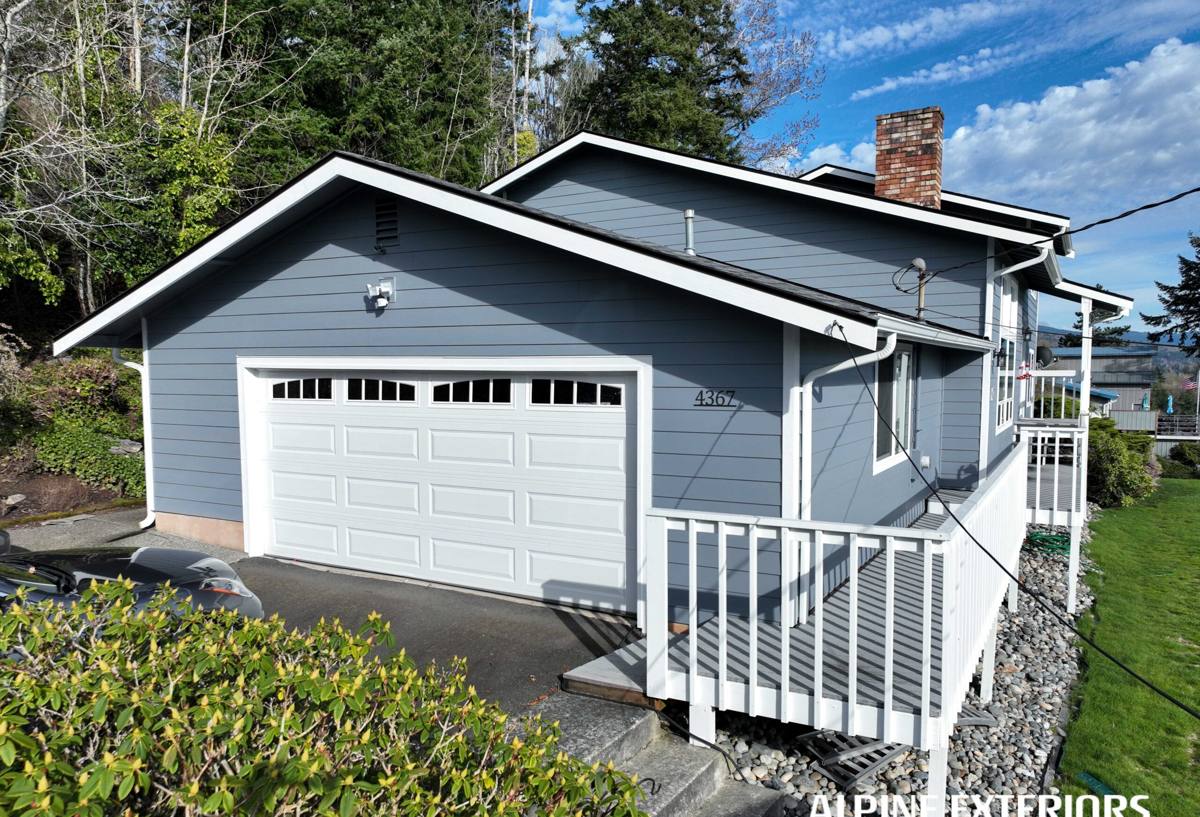
Why Deck Replacement Comes Up Sooner Here Than Inland
Salt Air and Fasteners
Standard galvanized fasteners and connectors have a shorter working life this close to the water. Salt accelerates corrosion, and once a nail, screw, or joist hanger starts to rust, it loses holding strength long before it looks obviously bad. We've opened up decks in the Birch Bay area where the decking still looked serviceable but the hardware underneath was compromised enough that the deck wasn't structurally sound.
Driving Rain and Wind-Driven Moisture
Rain that comes in mostly straight down is one thing. Rain that comes in sideways off a storm system is another — it gets pushed up under railing caps, into fastener holes, and behind ledger flashing that was installed for calmer weather. Over time that moisture finds every gap in the original construction.
Moss and Prolonged Dampness
Whatcom County's moss season isn't a cosmetic issue — it's a moisture-retention issue. Moss holds water against wood and composite surfaces far longer than open air would, which slows drying, promotes rot in real wood, and can trap grit against a decking surface in ways that accelerate wear. A deck that doesn't get regular sun and doesn't drain and dry well is going to show its age faster here than the identical deck somewhere drier.
Signs a Deck Needs Replacing, Not Patching
- Soft, spongy, or discolored wood where the deck attaches to the house (the ledger board) — this is a safety issue, not a cosmetic one
- Visible rust streaks or corrosion on joist hangers, bolts, or other hardware
- Decking boards that are cupping, splitting, or feel spongy underfoot
- A noticeable bounce or give when you walk across the deck
- Railings that wiggle or have any play when pushed
- Gaps opening up between the deck and the house siding or foundation
- Persistent moss or algae growth that comes back within weeks of cleaning
- Footings or posts that show cracking, heaving, or visible movement
Any one of these on its own might be a repair. Several together, or anything involving the ledger board or footings, usually means the deck has reached the point where patching costs nearly as much as replacement and leaves you with a structure that's still built on a compromised foundation.
What a Correct Deck Replacement Involves
A deck replacement done right in this climate isn't just swapping old boards for new ones. The parts nobody sees are what determine whether the new deck lasts 10 years or 25.
Ledger Connection and Flashing
The ledger board — where the deck attaches to the house — is the single most common failure point we find on older decks in this area, and it's also the connection most responsible for catastrophic deck failures when it's done wrong. A correct install uses proper structural fasteners (not just nails), through-bolts or approved ledger screws sized for the load, and flashing that actually sheds water away from the house rather than trapping it against the rim joist. Given how much driving rain this area gets, ledger flashing isn't optional detail work — it's the difference between a deck that stays dry at the house connection and one that rots from the inside out within a decade.
Footings and Framing
Footings need to be sized and set to current code for the deck's height, span, and loads — not just matched to whatever was there before. We check post spacing, joist spans, and beam sizing against actual code requirements rather than assuming the old layout was correct, because a lot of older decks in this region were built before current standards and were undersized to begin with.
Hardware
Given the salt-air exposure here, we use corrosion-resistant fasteners and connectors rated for the environment — this matters more in Custer than it would twenty miles inland, and it's a place where cutting corners doesn't show up until years later when a joist hanger fails quietly.
Decking and Drainage
Board spacing, direction, and any under-deck drainage system all affect how quickly water leaves the structure. In a moss-prone, high-moisture climate, a deck that drains and dries fast will outlast one that holds water — regardless of what material it's built from.
Decking Material Options for This Climate
There's no single "best" decking material for every homeowner — it depends on budget, maintenance tolerance, and how much upkeep you actually want to do. Here's how the common options hold up specifically against salt air, driving rain, and moss:
| Material | How It Handles This Climate | Maintenance | General Cost Position |
|---|---|---|---|
| Pressure-treated wood | Solid performer if sealed and maintained; needs attention to stay ahead of moisture and moss | Annual cleaning, periodic sealing/staining | Lowest upfront |
| Cedar | Naturally rot-resistant and handles moisture well, but still needs sealing to resist moss and graying | Regular cleaning and sealing | Mid-range |
| Composite decking | Resists moisture absorption and won't rot; some early-generation composites held moss and mildew on the surface more than modern capped boards do | Low — periodic washing | Higher upfront |
| PVC decking | Fully impervious to moisture and doesn't support rot; performs consistently in wet, salty conditions | Lowest — occasional washing | Highest upfront |
We'll walk through these trade-offs honestly during your estimate rather than pushing whatever has the best margin. If you want the lowest lifetime maintenance and don't mind the higher upfront cost, composite or PVC makes sense here given the moss and moisture. If you're comfortable staying on top of sealing every couple of years, wood is a perfectly good choice and costs less to start.
Our Process for a Custer Deck Replacement
- On-site assessment. We inspect the ledger connection, footings, framing, and hardware — not just the visible decking — to determine what's actually failing and why.
- Honest scope. You get a clear picture of what's structural (must be replaced) versus cosmetic (optional upgrade), so you're not paying to replace things that are actually fine.
- Demo and haul-away. Full removal of the old deck, footings included if they're undersized or compromised.
- Framing and footings built to code. Sized for your deck's actual dimensions and loads, not just matched to the old structure.
- Ledger flashing done properly. This is the step most likely to get rushed by crews that don't work this coastline regularly, and it's the one we don't shortcut.
- Decking, railing, and finish work in the material you've chosen.
- Final walkthrough so you understand what was done and what maintenance, if any, it'll need going forward.
Why Local Experience in Custer Matters
A deck built to a generic regional standard and a deck built for the Birch Bay area's actual conditions can look identical on installation day and perform very differently five years later. Crews that work this stretch of Whatcom County regularly know which ledger flashing details actually keep water out in wind-driven rain, which hardware holds up against salt exposure instead of just meeting minimum code, and how much slope and spacing a deck needs to shed moisture fast enough to keep moss from taking hold. That's not something you learn from a spec sheet — it's something you learn from opening up enough failed decks in this specific area to see exactly where they went wrong.
We also know the reality of scheduling around this area's weather windows — getting footings poured and framing dried in before a wet stretch moves through matters more here than it would in a drier inland community.
What to Expect Cost-Wise
Deck replacement cost depends on size, framing complexity (height, stairs, multiple levels), material choice, and how much of the substructure needs rebuilding versus reusing. A straightforward single-level deck replacement in pressure-treated wood will cost meaningfully less than the same footprint in PVC decking with custom railing. Rather than quote a number that doesn't mean anything until we've seen your deck, we'll give you a firm, itemized estimate after the on-site assessment — broken out so you can see what's structural, what's material, and where you have choices.
Ready to Get a Straight Answer on Your Deck?
If your deck in Custer or elsewhere in the Birch Bay area is showing soft spots, rust, movement, or persistent moss, it's worth having someone look at the framing before deciding between repair and replacement. We offer a free, no-pressure estimate — walk the deck with us, get an honest read on what's actually going on underneath it, and decide from there. Use the form below to get started.