 Birch Bay Siding
 Deck Replacement Built for Terrell Creek's Climate
Homes in the Terrell Creek area of Birch Bay sit close enough to the water and the marsh corridor that decks take a beating most inland Whatcom County properties never see. Salt-laden air off Birch Bay corrodes hardware faster than manufacturers' warranty language usually accounts for. Driving rain off Georgia Strait finds every gap in flashing and fastener placement. And the long stretch of gray, damp months each year keeps deck surfaces wet far longer than a sunnier climate would, which is exactly the condition moss and algae need to take hold. If your deck is cupping, staining green-black, or has fasteners bleeding rust, that's not bad luck — that's what this specific microclimate does to decks that weren't built or maintained for it.
Replacing a deck here isn't just swapping old boards for new ones. It's an opportunity to correct whatever the original build got wrong for this environment, so the next deck actually holds up.
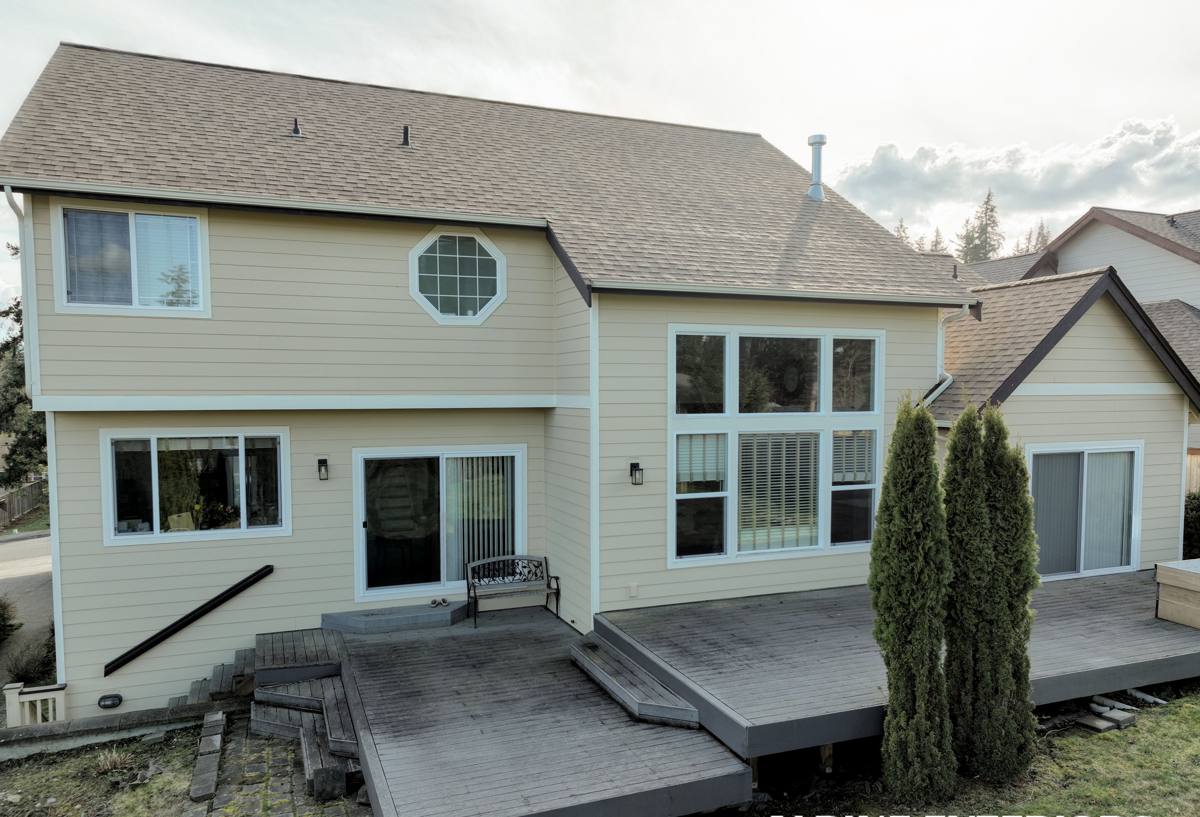
What Terrell Creek Homes Need From a Replacement Deck
Corrosion-Resistant Hardware, Not Just Treated Lumber
A lot of deck failures we see in this stretch of Birch Bay aren't structural failures of the wood — they're fastener failures. Standard hot-dip galvanized screws and nails degrade faster in salt air than most homeowners expect, especially where two dissimilar metals touch and start galvanic corrosion. For a deck replacement in this area, we spec stainless steel or coated fasteners rated for coastal exposure, and we match hardware to the framing connectors so nothing in the system becomes the weak link.
Drainage That Actually Moves Water Off
Driving rain doesn't fall straight down here — wind pushes it sideways under rail caps, into ledger connections, and along any horizontal surface that isn't sloped to shed water. A correct replacement gets proper slope built into the frame (not just the decking), flashing that actually laps the right direction, and gaps between boards sized to let water through instead of pooling.
Surfaces That Don't Turn Into a Moss Farm
Given how long surfaces stay damp through the fall and winter here, board selection and airflow underneath the deck matter as much as the finish on top. A deck built tight to the ground with poor ventilation will grow moss even if the boards themselves are fine — the fix is in the framing height and joist spacing, not just a yearly power wash.
Signs Your Terrell Creek Deck Needs Replacement, Not Repair
- Soft or spongy spots in the decking or around the ledger board — usually means moisture has gotten into the wood fiber, not just the surface
- Rust streaks running down from fastener heads or connector plates
- Persistent moss or algae that comes back within weeks of cleaning, even after a good scrub
- Visible gaps or separation where the deck ledger meets the house — a common entry point for water in wind-driven rain
- Railings that flex or posts that wiggle at the base, which points to compromised framing below
- Boards that have cupped, crowned, or are pulling away from fasteners
- A deck more than 15-20 years old built before current code required proper ledger flashing and lateral load connectors
Repair makes sense when the damage is isolated — a few bad boards, a loose rail. Replacement makes sense when the framing, flashing, or ledger connection itself has been compromised, because patching those issues without addressing the cause just buys a year or two before the same failure shows up again.
Material Choices for a Coastal Birch Bay Deck
There's no single right decking material for every home, but in a salt-air, high-moisture environment like Terrell Creek, some choices hold up with a lot less maintenance burden than others.
| Material | How It Handles Salt Air & Moss Season | Maintenance Reality |
|---|---|---|
| Composite decking | Resists moisture absorption and doesn't provide the same food source for mold/algae as raw wood; color-through options resist salt-related fading | Occasional cleaning to keep pollen and organic buildup from staining the surface; no annual sealing |
| Cedar | Naturally rot-resistant and handles the coastal look well, but softens over time with constant moisture exposure | Needs sealing or staining every 1-3 years to keep water resistance up; more prone to moss in shaded, damp spots |
| Pressure-treated pine | The chemical treatment resists rot, but it's still a softwood that will cup and check under repeated wet-dry cycles | Requires regular sealing and is the most likely of the three to need board-level repairs over time |
| Tropical hardwoods (ipe, etc.) | Extremely dense and naturally resistant to moisture and insects | Low maintenance but heavier, harder to fasten correctly, and a higher material cost upfront |
We'll walk through these trade-offs against your budget and how you actually use the deck — a rarely-used side deck doesn't need the same spec as a main entertaining space that gets foot traffic year-round.
What Correct Framing and Flashing Actually Look Like
Most of what determines whether a deck lasts 10 years or 25 years in this climate happens before a single decking board goes down.
Ledger Attachment
Where the deck attaches to the house is the single most common failure point we find on older decks in this area. It needs proper through-bolting (not just lag screws in many cases), a code-compliant flashing detail that directs water away from the house sheathing, and a gap or flashing tape system that keeps moisture from tracking behind the ledger into your wall assembly.
Joist Protection
Joist tops take standing water even on a well-sloped deck, since fasteners create small dams. Joist tape or a comparable flashing membrane over each joist top keeps water out of the end grain and fastener holes, which is where rot typically starts.
Post Bases and Footings
Wood posts set directly in or against concrete hold moisture against the end grain — that's a slow-motion failure in a climate that's damp most of the year. Post bases that hold the wood up off the concrete, combined with footings set to the correct frost depth, keep the structural posts dry and stable.
Our Deck Replacement Process
- On-site assessment — we look at the existing deck's framing, ledger connection, and any moisture or rot damage, and give you an honest read on repair vs. replacement
- Design and material walkthrough — size, layout, railing style, and material options discussed against your budget and how you use the space
- Permitting — most deck replacements in Whatcom County require a permit, especially for ledger reattachment and railing height changes; we handle that paperwork
- Demolition and disposal — old decking, framing, and hardware removed and hauled off
- Framing and flashing rebuild — ledger, joists, posts, and footings brought up to current code with coastal-appropriate hardware and flashing details
- Decking, railing, and finish installation — final surface installed to spec, with attention to drainage gaps and fastener placement
- Final walkthrough — we go over the finished deck with you, including what maintenance (if any) it needs going forward
Why Hire a Crew That Already Works Terrell Creek
A contractor who mostly builds inland, drier-climate decks will often spec the same materials and details they'd use anywhere else — and those choices don't hold up the same way this close to Birch Bay's salt air and marsh dampness. A crew that already works this specific area knows which fastener grades actually last here, where moss takes hold first, and how the wind-driven rain patterns off the water tend to find weak spots in flashing. That's the difference between a deck that needs attention again in five years and one that doesn't.
We also know the practical side of building in this pocket of Birch Bay — permitting expectations through Whatcom County, typical lot drainage patterns, and how to sequence a replacement around the wetter months so framing isn't left exposed longer than it needs to be.
Maintaining Your New Deck Through Moss Season
- Sweep debris and standing organic matter (leaves, needles) off the deck regularly through fall and winter — it's the main food source for moss and algae
- Keep gutters and downspouts near the deck clear so runoff isn't dumping extra water onto the surface
- Trim back overhanging branches to let more light and airflow reach the deck surface
- Rinse the deck periodically during the wet months rather than waiting for a heavy moss buildup, which is harder and more abrasive to remove
- Check railing posts and stair connections once a year for any looseness, which can signal moisture getting into a connection point
Get a Straight Answer on Your Deck
If your deck in Terrell Creek is showing rust, soft spots, or moss that won't quit, it's worth having someone look at it who understands why that's happening in this specific spot on the Birch Bay coastline — and what actually fixes it long-term. We'll give you a straightforward read on whether repair or replacement makes sense, with no pressure either way. Fill out the form below for a free estimate.