 Birch Bay Siding
 Siding Duty Near California Creek
Homes in the California Creek area sit close enough to Birch Bay and the surrounding shoreline that siding here works harder than siding twenty miles inland. Salt-laden marine air moves through on a regular basis, Pacific storm systems bring long stretches of driving rain rather than quick downpours, and the tree cover common to this part of Whatcom County keeps north- and east-facing walls shaded and damp for much of the year. That combination — salt, sustained moisture, and shade — is exactly the environment where moss, algae, and slow-building rot problems take hold. Siding that would hold up fine in a drier inland climate often struggles here within a decade or two.
We don't treat this as a generic siding job. A wall that faces the water or sits under mature trees needs a different level of attention at the seams, the bottom edge, and the drainage plane than a wall on the sheltered side of the same house. That's the lens we bring to every California Creek estimate.
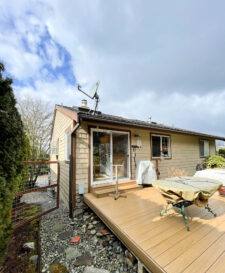
What This Climate Does to the Wrong Siding Choice
We've seen the pattern repeat across Whatcom County's marine-exposed neighborhoods:
- Vinyl siding expands and contracts with temperature swings, and over years that movement opens gaps at the panels and trim. Wind-driven rain finds those gaps, and once water gets behind vinyl it has nowhere good to go.
- Untreated or field-painted wood and cedar looks great on day one but needs repainting or restaining on a tight cycle in this climate. Skip a cycle in a shaded, moisture-heavy spot and moss and rot get a foothold fast.
- Engineered wood products like LP SmartSide perform reasonably when every cut edge and seam is sealed exactly to spec, but they're less forgiving of installation shortcuts — an unsealed edge near a downspout or a shaded corner is where swelling problems start.
None of this means these products are junk everywhere — it means they demand a level of ongoing maintenance and installation precision that doesn't match how most homeowners actually want to spend their weekends. That's the honest reason we standardized on one product system instead of offering all of them.
Why We Install Only James Hardie Fiber Cement
Fiber cement is cement, sand, and cellulose fiber pressed and cured into a rigid, dimensionally stable board. It doesn't expand and contract the way vinyl does, it doesn't feed rot or insects the way raw wood does, and it's non-combustible — a real consideration given how many Whatcom County properties border trees and brush. Hardie's ColorPlus factory finish is baked on under controlled conditions rather than brushed on in the field, which gives it better adhesion and better resistance to the mildew and algae streaking that field-painted siding develops in shaded, damp spots.
The HZ5 Product Line
James Hardie engineers its siding by climate zone, and the HZ5 line is built for regions like ours with sustained moisture exposure. It's formulated to resist moisture absorption and the freeze-thaw and wet-dry cycling that's routine in a Pacific Northwest marine climate. That's a meaningful difference from a one-size-fits-all siding product — it was designed with this exact weather pattern in mind.
ColorPlus Finish and Moss Resistance
Moss and algae need a surface they can grip and stay damp on. A factory-cured finish is smoother and more consistent than field-applied paint, and it holds its color and surface integrity longer under shade and moisture — which directly reduces (though doesn't eliminate) the moss buildup that plagues north-facing walls near tree lines.
What a Correct Installation Actually Involves
Fiber cement performs well for decades, but only when it's installed to manufacturer spec. In a salt-air, high-moisture area, the details that get skipped on a rushed job are exactly the details that cause problems five or ten years later:
- A weather-resistant barrier installed continuously behind the siding, with no gaps at seams or penetrations
- Proper clearance — at least 6 inches from grade and roofing, and roughly 2 inches from decks, patios, and other hardscape — so splashback and standing moisture can't wick into the bottom edge
- Correct flashing at every window, door, and roofline intersection, installed to shed water outward rather than trap it
- Manufacturer-specified fastener pattern and blind- or face-nailing, driven straight and to the correct depth — overdriven or underdriven nails are a common source of early failure
- Quality sealant at butt joints and trim, applied where Hardie's install guide calls for it and nowhere it doesn't
- Correct panel or plank overlap to maintain the drainage plane so any moisture that does get past the surface can drain and dry out
Every one of those steps matters more here than it would on a sheltered inland lot, because California Creek's exposure gives water more chances to find a weak point.
Siding Options Compared for This Climate
| Factor | James Hardie Fiber Cement | Vinyl | Cedar / Wood | LP SmartSide |
|---|---|---|---|---|
| Moisture resistance | Strong when installed to spec | Moderate; gaps open over time | Weak without regular maintenance | Moderate; edge-sensitive |
| Moss/algae resistance | Good, factory finish | Moderate | Poor in shaded, damp areas | Moderate |
| Fire rating | Non-combustible | Combustible | Combustible | Combustible |
| Maintenance cycle | Occasional wash, caulk check | Low, but repairs are visible | Repaint/restain every few years | Regular edge/seam inspection |
| Typical lifespan installed correctly | 30-50+ years | 20-30 years | 15-25 years with upkeep | 20-30 years |
Our Process, Start to Finish
For a California Creek project, our process looks like this:
- On-site assessment. We walk the whole exterior, note shaded and exposed walls separately, and check current siding and trim condition.
- Check behind the existing siding. Before any new material goes up, we inspect sheathing for hidden moisture damage or rot — a step that matters more on homes that have carried an older, less moisture-resistant siding for years.
- Repair sheathing as needed before anything gets closed back up. Siding installed over compromised sheathing fails no matter how good the siding itself is.
- Install a continuous weather-resistant barrier across the whole wall assembly.
- Install James Hardie siding and trim to manufacturer specification — correct clearances, flashing, fastening, and overlap throughout.
- Caulk, touch up, and finish trim work at all seams and penetrations.
- Full cleanup and a final walkthrough with you before we call the job done.
Maintenance in a Moss-Prone, Salt-Air Setting
Fiber cement is low-maintenance, not no-maintenance. A short annual routine keeps it performing the way it should:
- Rinse the siding once or twice a year, paying extra attention to shaded, north-facing walls where moss gets a start
- Keep gutters and downspouts clear so overflow doesn't run down the siding face
- Trim back trees and shrubs so foliage isn't holding moisture against the wall
- Do a quick visual check of caulking at trim and seams once a year and touch up anything that's cracked or pulled away
- Watch for moss or algae buildup specifically on shaded sections — catching it early keeps it from staining or gripping long-term
Cost Factors for a California Creek Project
| Factor | Why it moves the price |
|---|---|
| Home size and wall complexity | More square footage and more corners, gables, and dormers mean more cutting and trim work |
| Condition of existing siding and sheathing | Rot or moisture damage found during removal adds repair scope before new siding can go up |
| Siding profile (lap, shingle, panel) | Some profiles take more labor per square foot than others |
| Trim and color selection | Custom trim details and ColorPlus color choice affect material cost |
| Site access | Tight lots, slopes, or limited staging area near the shoreline can add labor time |
We give real numbers after we've actually looked at your walls — broad online estimates rarely account for what's happening behind the existing siding.
Why Local Installation Experience Matters
A crew that already works the Birch Bay and California Creek area knows which walls tend to hold moisture, how far wind-driven rain typically reaches up a wall face, and what Whatcom County inspectors expect to see on a fiber cement job. That familiarity shows up in the details — clearance heights, flashing choices, where extra caulking attention goes — rather than in anything you'd notice on the surface. It's the difference between a crew installing to a manual and a crew installing for this specific climate.
If you're weighing siding options for a California Creek home, we're happy to take a look and talk through what your walls actually need — no pressure, no obligation. Use the form below to request a free estimate.