 Birch Bay Siding
 Lummi Island's Climate Is Harder on Siding Than Most Homeowners Realize
Lummi Island sits out in the Salish Sea, exposed to weather that inland Whatcom County homes simply don't deal with. Salt-laden air moves off the water and settles on every exterior surface, wind-driven rain finds its way into seams and laps that would stay dry a few miles inland, and the long, damp stretch of fall through spring keeps north- and shade-facing walls wet enough, long enough, for moss and algae to take hold. None of that is exotic — it's the same marine climate that defines Birch Bay and the rest of the Whatcom County coastline — but it adds up faster on an exposed island lot than on a sheltered inland one.
Siding on a site like this isn't just a cosmetic layer. It's the only thing standing between that constant moisture load and the wall assembly underneath. Get the material or the installation wrong, and the consequences show up as soft trim, stained fascia, or rot behind the cladding within a few years instead of a few decades.
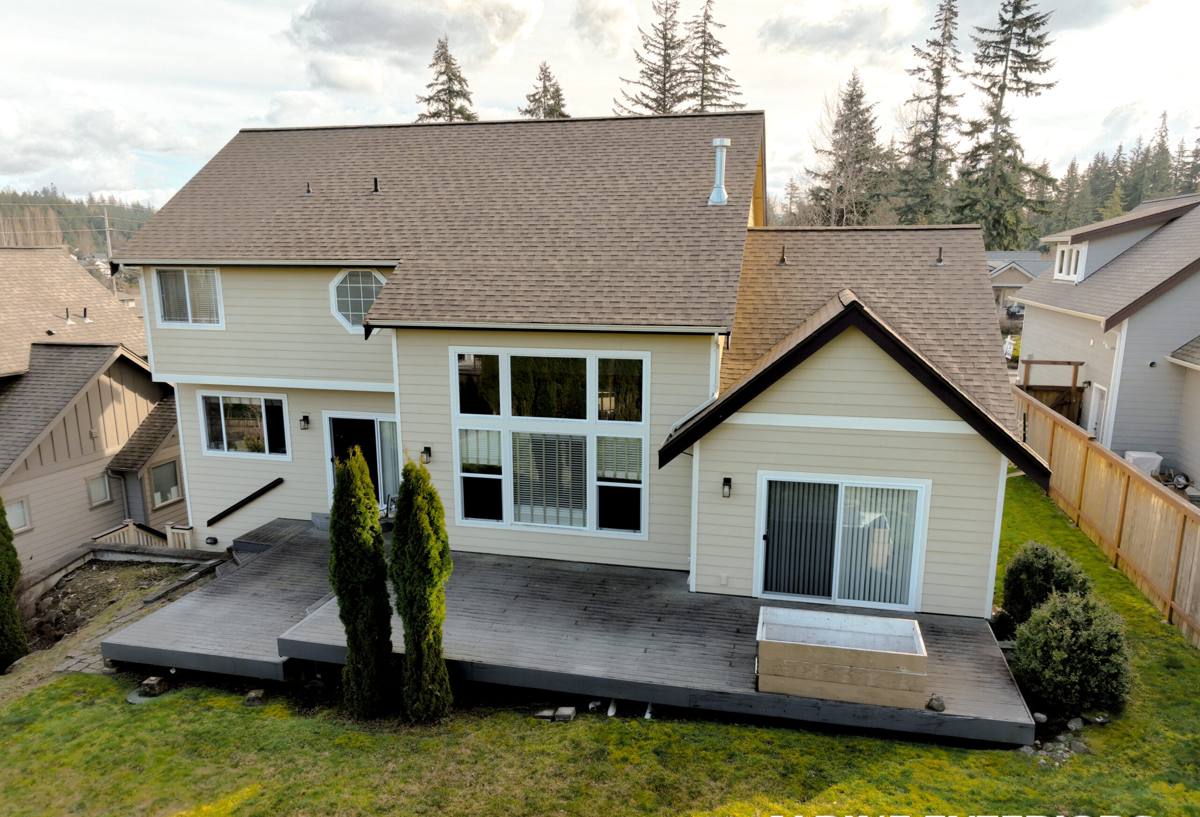
Why We Standardized on James Hardie Fiber Cement
We install one siding system, on every job, in every part of our service area including Lummi Island: James Hardie fiber cement. We don't install vinyl, LP SmartSide, cedar, primed spruce, or other fiber cement brands. That's not a marketing position — it's a decision driven by what actually holds up in this specific climate.
Fiber cement is a cement, sand, and cellulose fiber composite. It doesn't have an organic wood core that can absorb moisture and swell, and it isn't a thermoplastic that can soften, expand, or contract sharply with temperature swings the way vinyl can. Hardie's ColorPlus finish is baked on in a factory-controlled process rather than applied on site, which matters a great deal in a salt-air environment: factory-cured finishes hold color and resist chalking and fade far better than field-applied paint exposed to UV and salt from day one. Hardie also builds specific product lines engineered for wetter, cooler climates — the kind of engineering that's wasted in a dry inland market but earns its keep here.
None of this makes fiber cement "moss-proof" or maintenance-free. Nothing installed outdoors on Lummi Island is. What it does is give the material itself the best starting odds, so the difference between a good ten-year outcome and a bad one comes down almost entirely to installation quality — which is where most siding failures we're called out to actually originate.
Non-Combustible Is a Real Feature, Not a Footnote
Fiber cement doesn't support combustion the way wood-based sidings do. That's a genuine advantage for any coastal Washington home, and it's part of why we don't ask homeowners to weigh a cheaper wood-based alternative against it.
What a Correct Fiber Cement Installation Involves on a Site Like This
Fiber cement siding fails almost exclusively at the details, not the material. On an exposed, salt-air, high-rainfall site, three things matter more than usual.
Flashing and Moisture Management
Every window, door, and horizontal trim transition needs proper integrated flashing that sheds water outward rather than relying on caulk to do that job. Caulk is a maintenance item; flashing is a design element. On a wind-driven-rain site, skipping or shortcutting flashing is the single most common cause of hidden rot we find behind older siding.
Clearances and a Drainage Plane
Hardie's own installation instructions specify minimum clearances from grade, roof lines, and decks, plus a drainage plane (a water-resistive barrier, and ideally a rain screen gap) behind the siding so any moisture that does get past the cladding can drain and dry instead of sitting against the sheathing. In a climate that stays damp for months at a stretch, that drainage gap is what keeps a small amount of incidental moisture from ever becoming a rot problem.
Fastening, Joints, and Cut Edges
Fiber cement has to be fastened at the spacing and depth the manufacturer specifies — over- or under-driven nails compromise the board's ability to move slightly with moisture and temperature. Every field-cut edge needs to be sealed with a manufacturer-approved product before installation, since an unsealed cut edge is the one place on an otherwise factory-finished board where the raw material is exposed to salt air and rain.
Getting Materials and a Crew to an Island Project
Working on Lummi Island adds a logistics layer that a straightforward Birch Bay street job doesn't have. Reaching the island means a ferry crossing, which means material deliveries, crew scheduling, and any mid-project supply run all have to work around a schedule instead of a driveway. A crew that hasn't planned for this ends up making extra crossings, losing production days, or worse, showing up without the full material set and improvising with what's on hand — never a good foundation for a moisture-critical installation.
We plan island jobs differently from the estimate forward: full material takeoffs (including trim, flashing, and touch-up kits) ordered and staged before the crew crosses, a realistic day-count that accounts for weather windows on an exposed site, and a single mobilization plan instead of piecemeal trips. It's a scheduling discipline, not a special technique, but it's the difference between a job that runs smoothly and one that stalls out waiting on a part.
Our Process, Start to Finish
- Site visit and moisture assessment. We look at existing siding condition, wall exposure to prevailing wind and rain, and any signs of past moisture intrusion before quoting anything.
- Material and color selection. We walk through Hardie's plank, panel, and shingle profiles and ColorPlus palette options suited to the home and its exposure.
- Permitting. Exterior re-siding work is coordinated through the appropriate Whatcom County permitting process before work begins.
- Tear-off and sheathing check. Old siding comes off and the sheathing underneath gets inspected — this is often the first time hidden moisture damage becomes visible, and it gets addressed before anything new goes up.
- Weather barrier and flashing installation. The drainage plane and all flashing details go in before a single piece of siding is hung.
- Fiber cement installation. Boards or panels are installed to Hardie's fastening, clearance, and joint-treatment specifications.
- Final walkthrough. We review the finished work with the homeowner and address any punch-list items before calling the job complete.
How Fiber Cement Compares in This Climate
| Factor | James Hardie Fiber Cement | Vinyl | Wood / Untreated Cedar |
|---|---|---|---|
| Salt air / marine exposure | Engineered for coastal, wet climates | Can become brittle and fade with UV/salt over time | Vulnerable without diligent, repeated maintenance |
| Moisture and rot resistance | No organic core to absorb water | Won't rot, but seams can trap moisture behind panels | Absorbs moisture; prone to rot if maintenance lapses |
| Moss / algae buildup | Dense, low-porosity surface; reduced with proper install | Surface can host growth in shaded, damp areas | Porous surface holds moisture; readily supports growth |
| Finish durability | Factory-baked ColorPlus finish | Color is through-body but can chalk/fade | Requires field-applied paint or stain, reapplied often |
| Fire performance | Non-combustible | Combustible thermoplastic | Combustible |
Living With Fiber Cement Siding in a Salt-Air, Moss-Prone Climate
Correctly installed Hardie siding is low-maintenance, not no-maintenance. A little seasonal attention goes a long way toward getting the full lifespan out of it in this environment.
- Rinse siding periodically to clear salt residue, especially on walls facing open water or prevailing wind.
- Keep shrubs, trees, and vegetation trimmed back from the siding so shaded, damp wall sections get airflow and sunlight to dry out.
- Check caulking at trim and penetrations annually — it's a maintenance item, not a permanent seal, even when the flashing behind it is doing most of the real work.
- Watch north-facing and heavily shaded walls for early moss or algae growth and address it before it spreads.
- Keep gutters and downspouts clear so roof runoff isn't dumping extra water down the face of the siding.
- After storms, look over flashing at windows, doors, and trim for anything that's come loose or shifted.
What Actually Drives the Cost of a Project Like This
Every Lummi Island fiber cement project is different, but the same handful of factors move the price up or down. We walk through these during the estimate rather than quoting a number sight unseen.
| Cost Factor | Why It Matters |
|---|---|
| Site accessibility | Ferry logistics, staging area, and how easily material and equipment reach the walls |
| Existing damage or rot | Sheathing or framing repairs found during tear-off add scope beyond the siding itself |
| Siding profile and trim package | Lap, panel, and shingle profiles, plus trim detail, carry different material and labor costs |
| Tear-off vs. new construction | Removing and disposing of old siding adds labor that a bare-wall install doesn't have |
| Home shape and wall exposure | Cut complexity around dormers, gables, and multiple wall planes affects labor time |
Why It Matters to Hire a Crew That Already Works on Lummi Island
A siding crew that's never worked on the island is learning the ferry schedule, the material staging, and the exposure conditions on your project's clock. A crew that already works Lummi Island regularly has already solved those problems: they know how to build a mobilization plan around a ferry crossing, they've seen how wind and salt exposure actually behaves on this stretch of Whatcom County coastline, and they're not guessing at how much extra lead time a weather window costs on an exposed site. That familiarity doesn't change the fiber cement installation specs — Hardie's requirements are the same everywhere — but it does mean fewer surprises, fewer wasted trips, and a project that runs on the schedule you were quoted.
It also means direct, local accountability. If a question comes up after the job — a piece of trim, a flashing detail, a warranty question — you're working with a Birch Bay-based crew that's already familiar with your property and easy to reach, not a company that treated the island as a one-off job.
If you're planning a siding project on Lummi Island, we're happy to walk the property, look at your current siding's condition, and put together a straightforward, no-pressure estimate using the form below.