 Birch Bay Siding
 An Island Climate Asks More of Your Siding
Lummi Island sits out in the Salish Sea, reachable only by ferry, with homes wrapped by water on nearly every side. That location is the whole appeal of living there — and it's also why siding on Lummi Island takes more abuse than siding almost anywhere else in Whatcom County. Salt-laden air moves off the water and settles on exterior walls day after day. Wind-driven rain hits siding sideways during winter storms, forcing water into laps and seams that would stay dry on a more sheltered inland lot. Add in the shade from tall evergreens on many wooded parcels, and you get long stretches of damp, cool weather that never quite lets a wall dry out — prime conditions for moss, algae, and mildew to take hold.
None of that is a reason to avoid living on the island. It's a reason to be picky about what goes on the outside of the house. We install James Hardie fiber cement siding exclusively, on Lummi Island and everywhere else we work in Birch Bay and Whatcom County, because it's the one product line we trust to hold up to this specific combination of salt, moisture, and shade without turning into a maintenance project.
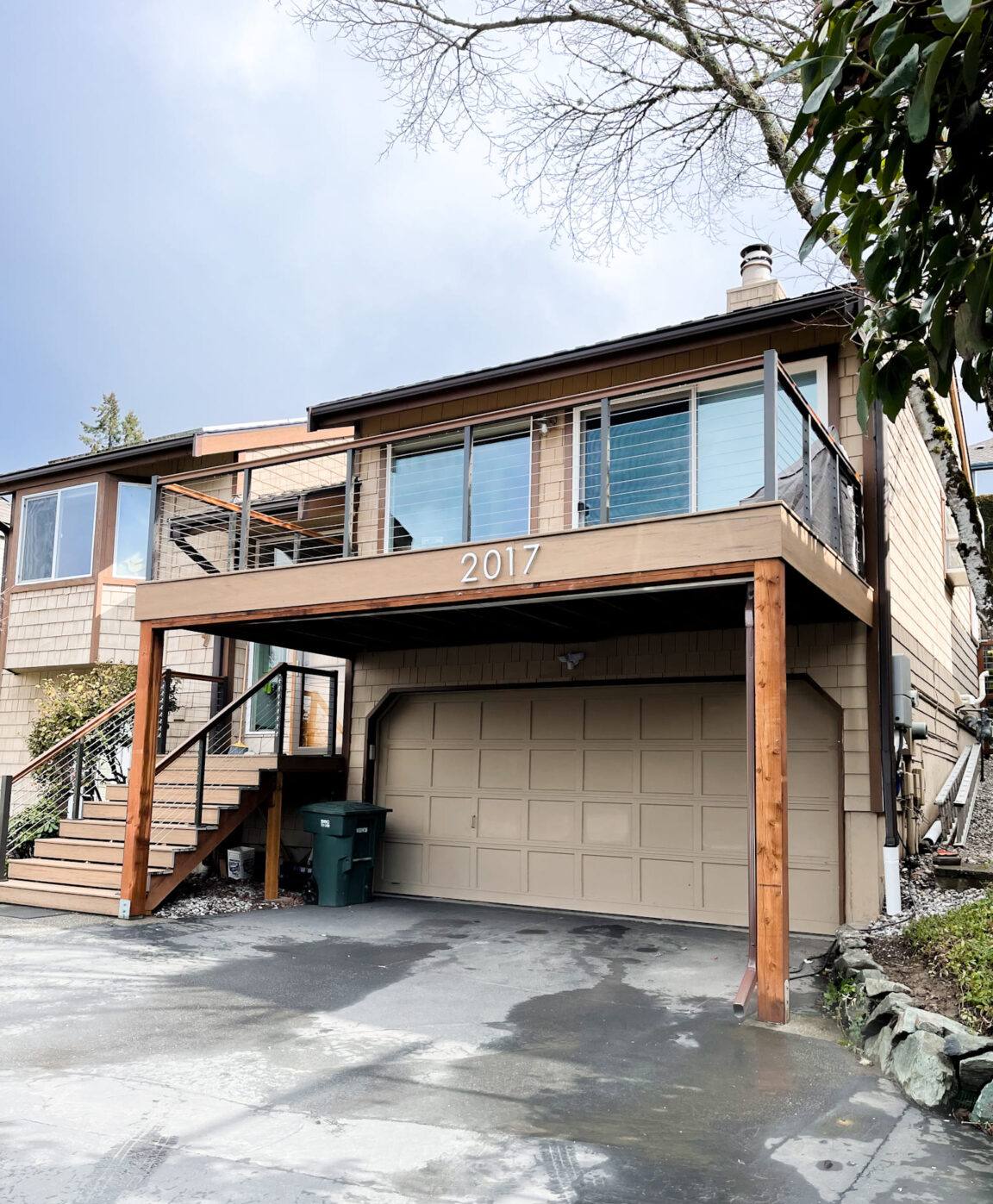
Why We Standardized on James Hardie for Homes Like These
We used to get asked why we don't offer vinyl, LP SmartSide, or cedar alongside Hardie. The honest answer is that each of those products asks a homeowner to accept a trade-off that shows up faster in a marine environment than it would somewhere drier and calmer.
- Vinyl expands and contracts with temperature swings and can warp or crack in sustained wind exposure; it also can't be painted a darker color without risk of heat distortion, which limits color choices on exposed, sun-facing walls.
- Cedar and other wood sidings look great new, but they're organic material sitting in a climate built for moss and rot — they need regular refinishing to keep water out, and salt air accelerates the breakdown of most exterior coatings.
- Engineered wood products (like LP SmartSide) use a wood-strand core that performs well when detailing is perfect, but any breach in the coating or flashing lets moisture into the substrate, and repairs aren't always as forgiving as with a cement-based product.
James Hardie's fiber cement formulation is non-combustible, dimensionally stable, and doesn't feed mold or insects the way wood-based products can. That's not a knock on every other product on the market — it's just the reason our crews only carry one system onto a job site, and why that system is Hardie.
HZ Climate Engineering: Why the Formulation Matters Here
James Hardie doesn't sell one formulation nationwide. The company engineers its fiber cement differently depending on regional climate, splitting the country into HZ5 and HZ10 zones. HZ10 formulations are built for regions that see a mix of sustained moisture and cooler, damp conditions — the kind of climate you get on a Salish Sea island, where humidity, rainfall, and shaded, slow-drying walls are the norm rather than the exception. Choosing siding engineered for the actual climate it's going into, rather than a generic version, is a big part of why we don't cut corners on which product line we bring to a Lummi Island job.
ColorPlus Factory Finish
Most of what we install carries Hardie's ColorPlus finish — a factory-applied, baked-on coating that's more consistent and more weather-resistant than field-applied paint. On a site-painted board, every coat is only as good as the weather conditions the day it was applied and the prep work underneath it. A factory finish removes that variable entirely, which matters when the siding is going to spend years absorbing salt spray and rain before it's ever due for a repaint.
What a Correct Installation Involves in This Environment
Fiber cement siding is only as good as the installation behind it. A rushed or generic install can leave a Hardie product performing worse than a cheaper material installed correctly. On an island property, we pay particular attention to a handful of details that matter more here than they would inland:
- Flashing at every penetration — windows, doors, hose bibs, light fixtures, and vents all get proper flashing so wind-driven rain can't track behind the siding field.
- Correct fastener spacing and type — corrosion-resistant fasteners set per Hardie's published fastening schedule, because salt air is unforgiving of the wrong hardware.
- Proper clearance at grade and roof lines — siding held off decks, patios, and roof surfaces by the manufacturer's minimum gap so splash-back and roof runoff don't sit against the board.
- Factory-primed cut edges sealed in the field — any board cut on site gets its exposed edge treated so raw fiber cement isn't left absorbing moisture.
- Rain-screen or drainage plane detailing where the wall assembly calls for it, giving bulk water a way out instead of trapping it against the sheathing.
Skipping any one of these doesn't show up on day one. It shows up two or three winters later as staining, soft trim, or premature caulk failure — exactly the kind of slow damage that's hardest to catch early on a property you might not be checking on every week.
Working on Island Time: How Our Process Handles the Ferry
Lummi Island's ferry access is a real scheduling factor, and we plan around it rather than treating it as an afterthought. Materials, crew, and equipment all move on the same ferry schedule as everyone else, so we build project timelines that account for it up front instead of discovering the constraint mid-job.
- Site visit and measurement — we walk the exterior, check existing siding and trim condition, and note wind exposure on each elevation.
- Material staging — full material orders are confirmed and staged before crew mobilization, so a single ferry crossing carries what the job needs rather than multiple partial trips.
- Crew scheduling around sailings — we plan arrival and departure times around ferry sailings so a work day isn't cut short waiting on a boat.
- Continuous installation — once we start, we keep the crew on-island until the scope is finished, minimizing the number of crossings and disruptions to the property.
- Final walkthrough — a full check of flashing, caulk lines, and finish before we call the job complete.
The point of planning it this way is simple: fewer trips back and forth means a tighter timeline and less chance of a job stalling out half-finished because of a missed sailing.
Hardie Product Lines: Matching the Line to the House
Not every Hardie product fits every home the same way, and part of doing this job right is picking the right line for the structure and its exposure.
| Product | Best fit | Why it works here |
|---|---|---|
| HardiePlank lap siding | Most single-family homes, traditional and craftsman styles | Classic horizontal profile, wide color and texture range, proven track record in wet coastal climates |
| HardiePanel vertical siding | Shops, accent walls, board-and-batten style homes | Fewer horizontal laps means fewer water-entry points on heavily exposed walls |
| HardieTrim boards | Corners, window and door surrounds, fascia | Matches the siding's moisture resistance so trim doesn't become the weak point in the system |
| HardieSoffit panels | Eaves and overhangs | Non-combustible and moisture-stable where roof runoff concentrates |
Comparing Siding Options in a Marine Environment
| Factor | James Hardie fiber cement | Vinyl | Wood / engineered wood |
|---|---|---|---|
| Salt air resistance | Strong — non-organic, factory-finished | Fair — can chalk and become brittle over time | Weak to fair — coatings break down faster near salt spray |
| Moss/mildew resistance | Strong when installed with proper clearance | Fair — moss can still grow on surface grime | Weak — organic material is a food source for growth |
| Wind-driven rain performance | Strong with correct flashing detail | Fair — can flex and open seams in high wind | Depends heavily on coating and joint maintenance |
| Fire resistance | Non-combustible | Melts/deforms under heat | Combustible |
| Long-term maintenance | Low — occasional wash, no refinishing needed with ColorPlus | Low — but limited repair/color options if damaged | High — regular refinishing and inspection required |
Living With Moss Season: A Homeowner Checklist
Even the right siding, correctly installed, benefits from a little seasonal attention on a shaded, damp island lot. None of this is difficult or expensive — it's mostly about catching small issues before they compound over a wet winter.
- Rinse siding once or twice a year with a garden hose to clear salt residue and organic buildup, especially on north-facing and shaded walls.
- Trim back vegetation and tree limbs that keep siding in constant shade or shed debris onto walls and into gutters.
- Check and clear gutters before the wet season so overflow doesn't wash down the siding face repeatedly.
- Walk the exterior once a year looking for caulk lines that have pulled away, especially around windows, doors, and trim joints.
- Watch for green or black staining concentrated in one spot — it usually means water is draining or splashing there repeatedly, not that the siding itself is failing.
- Avoid pressure washing directly at siding seams; a garden hose and soft brush are enough and won't force water behind the boards.
Why a Crew That Already Works Lummi Island Is Worth Choosing
Anyone can quote a siding job from a photo. Doing the work well on an island property means understanding the ferry schedule, the wind exposure on a waterfront elevation versus a wooded one, and how Whatcom County's permitting and inspection process applies to exterior work out there. A crew that's already made the crossing knows how to stage a job so it doesn't stall out waiting on a boat, and knows which details — flashing, clearance, fastening — actually matter in this specific climate versus a generic install checklist written for a drier part of the country.
That local familiarity is also what keeps a project on schedule and on budget. Surprises cost more when they surface after a crew has already left the island for the day. Working with a contractor who treats Lummi Island as a normal part of their route, not a special trip, means fewer surprises and a job that gets finished the way it was planned.
If you're weighing a siding project on Lummi Island or elsewhere in Birch Bay, we're glad to walk the property, look at what your current siding is telling us, and put together a straightforward, no-pressure estimate using the form below.