 Birch Bay Siding
 Metal Roofing on Semiahmoo: Built for an Exposed Coastal Climate
Semiahmoo sits out on a narrow spit between Semiahmoo Bay and Drayton Harbor, at the edge of Blaine in northern Whatcom County. It's one of the more exposed residential settings in the region — water on more than one side, open wind with little to break it, and a marine climate that stays wet and mild for most of the year. Roofs out here take the hardest and most direct hit from that environment, and the combination of salt air, driving rain, and a long moss season wears through a roofing system faster than it would just a few miles inland.
Metal roofing is one of the more effective answers to that specific combination of stresses, which is why we get asked about it often for homes in and around Semiahmoo. It isn't automatically the right choice for every roof or every budget, but on an exposed, moss-prone, salt-air property, it solves several problems at once that other roofing materials only partially address. This page covers what Semiahmoo's climate actually does to a roof, what a correctly installed metal roof involves, the real trade-offs between panel types, and how our process works from first look to finished roof.
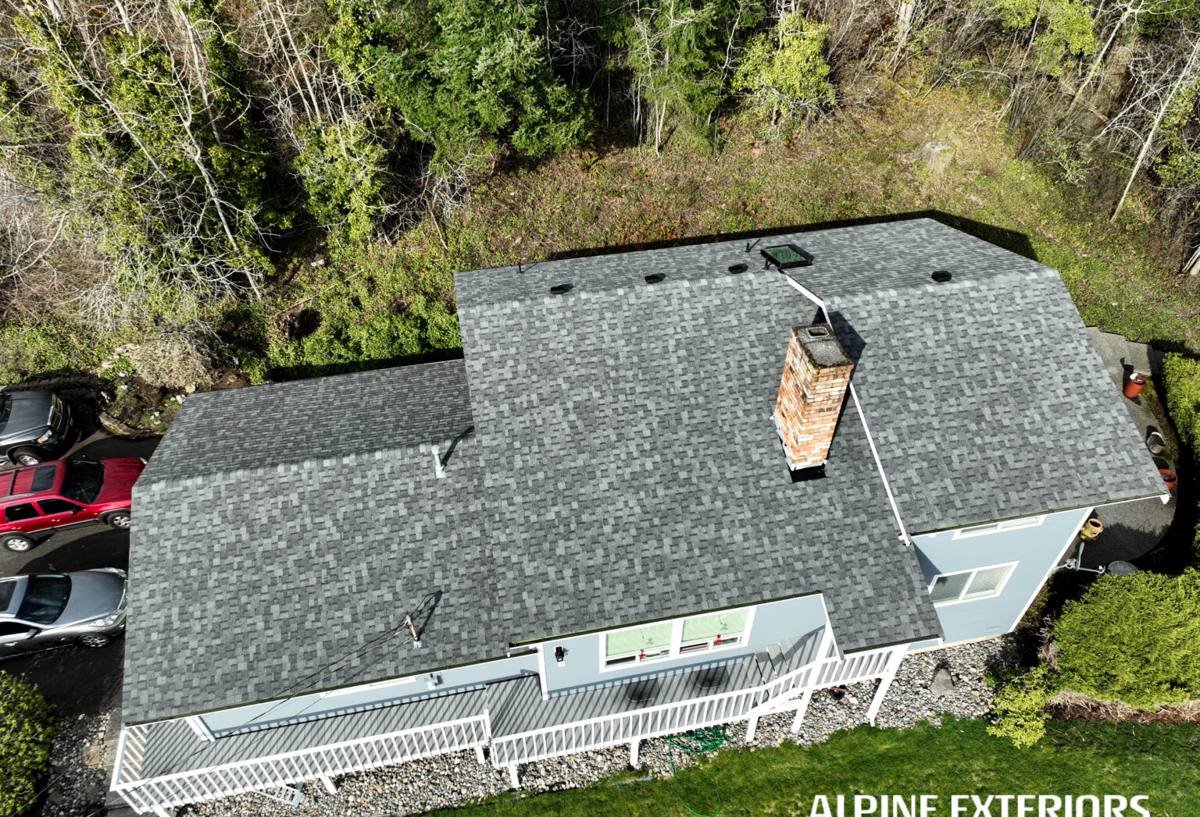
What Semiahmoo's Climate Does to a Roof
Salt Air From More Than One Direction
Because Semiahmoo has water on more than one side, homes here take on salt-laden air from multiple directions rather than a single prevailing exposure. Salt accelerates corrosion in fasteners, flashing, and any metal component that isn't specified for a marine environment. On a roof, that shows up first at the small stuff — screws, ridge caps, and flashing seams — long before it shows up in the field of the roof itself. A roofing system for this location needs every metal component, not just the main panels, chosen with that corrosion load in mind.
Wind-Driven Rain With Almost No Windbreak
With open water on more than one side and little to slow the wind down, rain on the spit rarely falls straight down. It gets pushed sideways into roof valleys, ridge lines, and any penetration — vent pipes, chimneys, skylights — with more force than a typical inland roof ever experiences. That's a heavier and more directional moisture load than annual rainfall totals suggest, and it's exactly where roofing systems with weak seams or under-detailed flashing fail first.
A Long Moss and Debris Season on a Non-Porous Surface
Mild temperatures and near-constant humidity give moss and algae a growing season that runs most of the year across this part of Whatcom County. Shaded and north-facing roof planes are hit hardest. Metal roofing doesn't stop moss spores from landing on a roof, but its smooth, non-porous surface gives moss far less to grip onto than a shingle's textured, granular surface does — which is a meaningful advantage on a property where moss pressure is constant rather than seasonal.
Why Metal Roofing Fits an Exposed Property Like This
Metal roofing isn't the right call for every home, but on a spit property dealing with salt air, open wind, and a long wet season simultaneously, it addresses several of those stresses directly instead of just tolerating them.
- Sheds water fast: A steep-profile metal panel moves wind-driven rain off the roof quickly instead of letting it sit against a porous surface.
- Resists moss buildup: The smooth surface holds far less moisture and organic debris than shingle or shake roofing, which slows moss and algae growth even in a shaded, humid climate.
- Handles wind well: Properly installed metal roofing has strong wind-uplift resistance, which matters on an open, wind-exposed lot with little natural shelter.
- Long service life: A correctly installed metal roof with the right coating system commonly outlasts asphalt shingle roofing by decades, which matters when factoring in how much harder this climate is on a roof to begin with.
- Low ongoing maintenance: Once installed correctly, metal roofing generally needs less routine upkeep than materials that require regular moss treatment or replacement of individual damaged pieces.
The trade-off is upfront cost and a different look than a traditional shingle roof, along with the fact that metal roofing is far less forgiving of installation shortcuts than some other materials. Those two factors are why the installation details below matter as much as the panel choice itself.
Metal Roofing Panel Types: What the Trade-offs Actually Are
"Metal roofing" covers more than one product, and the differences matter for a property in this specific climate. We'll walk through which option fits your roof's pitch, budget, and the amount of exposure it faces before recommending one.
| Panel Type | Fastening | Moisture & Salt-Air Behavior | Typical Lifespan Here |
|---|---|---|---|
| Standing seam | Concealed clips, no exposed fasteners in the field | Fewest penetration points for water and salt to reach; strongest long-term performer on exposed sites | 40-60+ years with correct install and coating |
| Exposed-fastener corrugated/ribbed panel | Screws driven through the panel face, with gaskets | Lower upfront cost, but fastener gaskets and washers are a maintenance point over time in salt air | 25-40 years, with periodic fastener checks |
| Metal shingle/shake profile | Interlocking panels, typically concealed fastening | Combines a traditional shingle look with metal's moisture and moss resistance | 30-50 years depending on product and coating |
For a fully open, wind- and salt-exposed property like Semiahmoo, standing seam is generally the strongest match because it has the fewest points where water and salt air can work their way into the fastening system over time. Exposed-fastener panels are a legitimate, lower-cost option for less exposed roof planes or secondary structures, as long as the fastener maintenance is understood and planned for going in.
Steel or Aluminum: The Material Question Underneath the Panel Choice
Panel profile is only half the decision — the base metal matters just as much on a property with this much salt exposure. Both steel and aluminum panels are used in residential metal roofing, and both can perform well here when specified correctly, but they behave differently in a marine environment.
- Galvanized or Galvalume steel: Strong and widely used, with a protective zinc or zinc-aluminum coating beneath the paint finish. Performs well in coastal settings as long as the coating and paint system are rated for marine exposure and any cut edges are properly sealed.
- Aluminum: Naturally corrosion-resistant because it doesn't rust the way steel can, which makes it a common choice on the most exposed coastal properties. It typically costs more than steel and is slightly softer, which matters more in hail-prone regions than it does here.
Either can be the right call depending on budget and exposure. What matters most is making sure the specific product and coating are rated for a salt-air environment, and that installation avoids mixing incompatible metals in ways that cause galvanic corrosion — a detail that's easy to get wrong and expensive to fix after the fact.
What a Correct Metal Roof Installation Involves
Underlayment and Moisture Barrier
A metal roof is only as good as what's underneath it. A high-temperature synthetic underlayment, along with ice-and-water shield at eaves, valleys, and any low-slope transitions, gives the roof a real secondary barrier if wind-driven rain ever gets past the panel seams — which, on an exposed spit property, it eventually will during a strong enough storm.
Fastener, Flashing, and Seam Details
This is where most metal roof problems actually originate. Standing seam panels need correctly spaced concealed clips that allow the metal to expand and contract with temperature changes without stressing the seams. Exposed-fastener panels need the right fastener type, torque, and gasket condition, since an over- or under-driven screw is one of the most common causes of leaks in that system. Flashing at every ridge, valley, wall transition, and penetration needs to be detailed for wind-driven rain coming from more than one direction, not just a straight-down rain assumption.
Ventilation and Thermal Movement
Metal expands and contracts more than asphalt shingle roofing does with daily and seasonal temperature swings. A roof system that doesn't account for that movement — through proper clip spacing, expansion detailing, and attic ventilation — will develop stress at the seams and fasteners over years, even if the panels themselves are a good product. Ventilation also matters for keeping the roof deck dry given how much of the year this climate stays humid.
Avoiding Galvanic Corrosion
Certain metal combinations react with each other when they're in direct contact, especially in a salt-air environment, and that reaction accelerates corrosion at the contact point. Flashing, fasteners, and any secondary metal components need to be compatible with the panel material, or properly isolated from it, so the roof doesn't develop corrosion problems at its own connection points within a few years of install.
Signs an Existing Roof Should Be Evaluated for a Metal Replacement
- Recurring moss growth that returns quickly after cleaning, especially on shaded or north-facing slopes
- Granule loss collecting heavily in gutters, signaling an aging asphalt shingle roof
- Repeated flashing repairs at the same valleys or penetrations after storms
- Visible rust or corrosion on existing metal flashing, vents, or fasteners
- A roof nearing or past its expected service life that's due for full replacement anyway
- Interest in reducing long-term maintenance on a home that sees heavy wind and salt exposure
None of these automatically mean metal roofing is the answer — a well-built asphalt shingle roof can still make sense depending on budget and how long you plan to stay in the home. But if several of these apply, it's worth having the comparison laid out honestly before committing to another asphalt replacement.
Our Process on a Semiahmoo Roofing Project
We start with an on-site look at the existing roof, the home's orientation to wind and water, and any signs of how the current system has held up to salt air and moisture over time. From there we go over panel type, base metal, and coating options against your budget and how long you're planning to stay in the home, rather than defaulting to whichever product is easiest to sell. Once you've settled on a system, we put together a clear written scope before any work begins. During installation, correct underlayment, fastener spacing, flashing details, and galvanic-corrosion avoidance are treated as standard practice on a property like this, not as optional upgrades that cost extra.
Why a Crew That Already Works Semiahmoo Matters
A roofing crew that regularly works this specific stretch of coastline already knows how salt air, open wind, and sustained moisture behave differently here than they do even a few miles inland in Blaine proper. That experience shows up in specific decisions: which fastener grade and coating actually hold up under multi-directional salt exposure, how much extra flashing detail a given valley or wall transition needs on a fully open lot, and which panel systems are worth the added upfront cost versus which ones are overbuilt for a given roof. It also means someone who has already seen what happens to roofing systems that weren't specified for this exact environment, and knows what to do differently.
If you're weighing metal roofing for a home on Semiahmoo, or want an honest comparison against a shingle replacement, we're glad to walk the roof with you and lay out the real trade-offs. Reach out using the form below for a free, no-pressure estimate.