 Birch Bay Siding
 Why Nooksack Siding Wears Out Faster Than the Brochures Say
Homes in and around Nooksack sit in one of the more punishing siding environments in Washington, even if it doesn't always feel that way day to day. You're close enough to the Salish Sea to get salt-laden air on windy days, squarely inside a marine weather pattern that delivers long stretches of driving rain rather than quick downpours, and shaded by a tree canopy and a climate that keeps humidity high enough for moss and algae to take hold on north-facing walls for much of the year. None of these forces are dramatic on their own. Together, over ten or fifteen years, they're exactly why siding that looked fine on installation day starts failing quietly from the inside.
Salt air accelerates corrosion on fasteners, flashing, and trim. Driving rain — rain that comes in sideways instead of straight down — finds every gap in a siding system that wasn't detailed for wind-driven moisture. And a long moss season means organic growth sits against your siding for months at a time, holding moisture against the surface even after the rain has stopped. A siding replacement in this area isn't just a cosmetic upgrade. It's an opportunity to correct a moisture and material mismatch that may have been baked into the house since it was built.
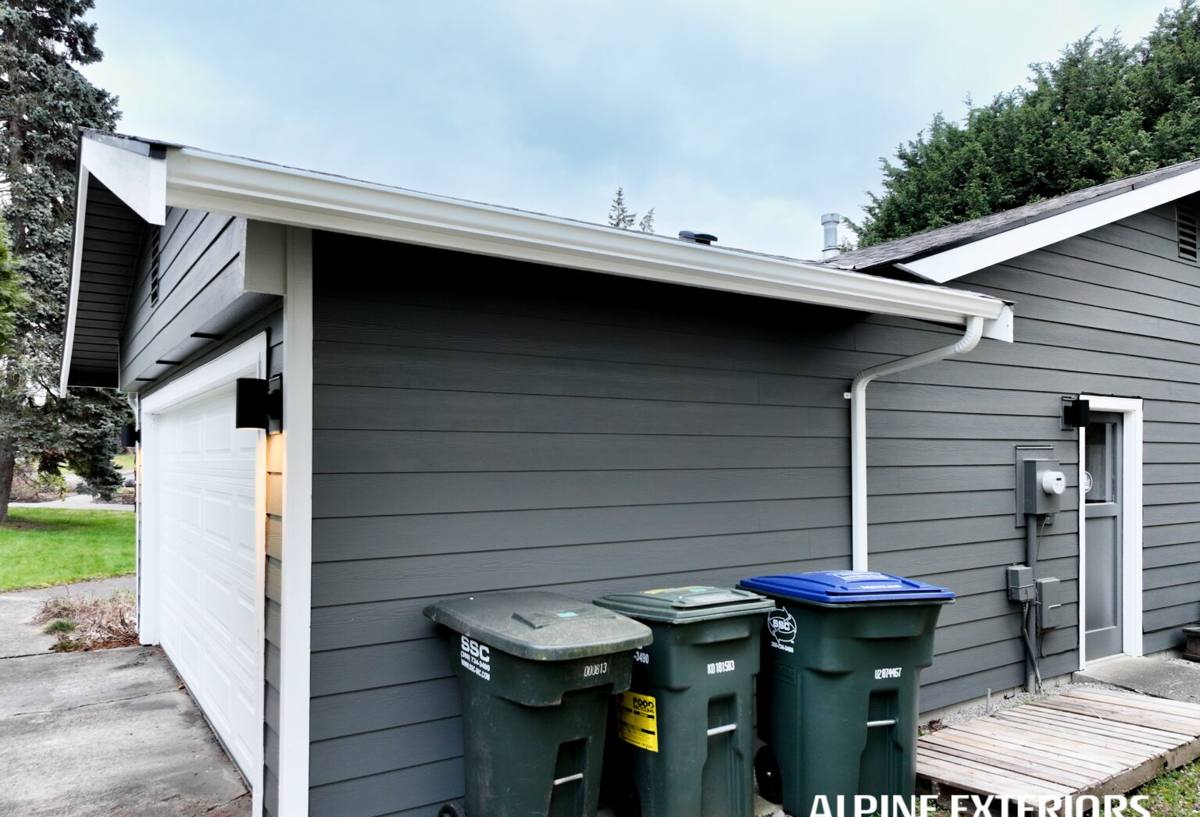
Signs a Nooksack Home Needs Replacement, Not Another Repair
Whatcom County homeowners often ask us to patch a section of siding, only to find the damage is symptomatic of something bigger. Here's how to tell which situation you're actually in.
Cosmetic wear you can usually repair
- Faded paint or a chalky surface on one or two sun-exposed walls
- A single cracked or split board from an isolated impact
- Surface mildew or moss that wipes clean and doesn't return quickly
- Loose caulking around trim that hasn't let water behind the siding yet
Signs you're past the point of repair
- Soft, spongy, or crumbling siding when you press on it, especially near the bottom courses
- Persistent moss or black streaking that returns within weeks of cleaning
- Visible warping, buckling, or gaps between boards after wind events
- Paint that won't hold no matter how many times it's redone
- Interior signs — musty smell, peeling interior paint, or soft drywall near exterior walls
If you're seeing items from the second list, the underlying sheathing or house wrap may already be compromised. That changes the job from a siding swap into a full replacement with a look at what's happening behind the wall.
What a Correct Siding Replacement Actually Involves
A siding replacement done right is mostly invisible once it's finished — which is exactly why so many jobs get cut short in ways homeowners can't see until years later. In a climate like this one, the steps that happen underneath the finished siding matter more than the siding itself.
Full tear-off and inspection
We remove the old siding down to the sheathing, not just the visible cladding, so we can actually see what the last twenty or thirty years of weather did to the wall assembly. This is the point where hidden rot, failed flashing, or a missing water-resistive barrier gets caught — problems that a re-side over existing siding would simply seal in.
Repair before cover
Any soft or damaged sheathing gets replaced before anything new goes back on. Covering rotten wood with new siding doesn't stop the rot; it just hides it for a while longer.
A weather-resistive barrier built for wind-driven rain
Given how much of the Whatcom County rain load comes in sideways rather than straight down, the house wrap and flashing details around windows, doors, and penetrations matter as much as the siding itself. Proper lapping, taped seams, and correctly integrated window flashing are what keep driving rain from finding a path behind the cladding.
Fastening and clearances to spec
Fiber cement siding has manufacturer-specified fastener types, spacing, and minimum clearances from grade, roofing, and other surfaces. Getting these wrong is the single most common cause of premature siding failure — and it's invisible to a homeowner until the problems show up years later.
Finish work that resists this climate
Caulking, trim, and touch-up painting at cut edges all need to hold up to salt air and near-constant moisture cycling, not just look good on install day.
Why We Install James Hardie Fiber Cement — and Nothing Else
We standardized on James Hardie fiber cement siding and don't install vinyl, LP SmartSide, primed spruce, cedar, or other fiber cement brands. That's not a marketing position — it's a decision based on what actually holds up in this climate over decades, not just years.
Fiber cement is non-combustible, which matters increasingly in Washington. It doesn't warp, rot, or feed insects the way wood-based products can. Hardie's ColorPlus factory-applied finish is baked on under controlled conditions rather than field-painted, which gives it more consistent adhesion and UV resistance than a coat applied on-site in variable weather — a real advantage when a home sits under tree cover with limited direct sun to dry the surface. And Hardie backs its products with a long, transferable limited warranty that's meaningful specifically because the material is engineered and manufactured to a tight, repeatable standard.
We'll talk through other products honestly if you ask — every siding material has real strengths. But when the job is protecting a Whatcom County home from salt air, driving rain, and moss, fiber cement engineered for climate performance is what we're willing to put our name behind.
Comparing Siding Materials for a Marine Climate
| Material | Moisture Behavior | Maintenance Load | Typical Lifespan |
|---|---|---|---|
| James Hardie fiber cement | Non-combustible, dimensionally stable, resists moisture-driven warping | Low — factory finish, occasional wash | Decades with correct install |
| Vinyl | Sheds water on the surface but can trap moisture behind it; prone to warping in heat/cold swings | Low, but limited repair options if damaged | Moderate, shortens with UV and impact damage |
| Cedar / wood | Absorbs moisture readily; needs a dry season to recover between wet spells | High — regular sealing, staining, moss treatment | Shorter without diligent upkeep |
| LP SmartSide / engineered wood | Treated to resist moisture but relies on edge sealing and caulk integrity staying intact | Moderate — edge and seam maintenance is critical | Moderate, sensitive to installation quality |
The pattern across a marine climate like this one is consistent: materials that depend on an unbroken protective layer (paint, sealant, factory coating) tend to fail exactly where that layer gets interrupted — a cut edge, a nail hole, a seam. Fiber cement's dimensional stability and factory finish give it more margin when that layer is imperfect, which it always eventually is on a real house.
Our Siding Replacement Process
1. On-site assessment
We walk the exterior with you, check for soft spots and moisture entry points, and give you a straight read on whether you're looking at repair or full replacement.
2. Scope and product selection
We help you choose the right Hardie plank profile, panel style, and color for your home, and put the full scope — tear-off, sheathing repair allowance, flashing details, fastening spec — in writing before work starts.
3. Tear-off and wall prep
Old siding comes off, damaged sheathing gets replaced, and the weather-resistive barrier and flashing go in correctly around every window, door, and penetration.
4. Installation to manufacturer spec
Hardie siding goes up with the fastening pattern, clearances, and joint treatment the manufacturer requires — the details that determine whether the warranty holds and the siding performs for its full service life.
5. Trim, caulk, and touch-up
Cut edges get sealed, trim gets finished, and the site gets cleaned up.
6. Walkthrough
We go over the finished work with you and answer any questions before we call the job done.
What Drives the Cost of a Siding Replacement
Every Nooksack-area home is different, so we won't quote a number without seeing the house. But these are the factors that move a project up or down in scope and cost.
| Factor | Why It Matters |
|---|---|
| Extent of hidden sheathing damage | Found only after tear-off; more rot means more repair before new siding goes on |
| Home size and wall complexity | Dormers, gables, and cut-up wall lines take more labor and material than a simple rectangle |
| Siding profile and trim detail | Lap width, panel style, and trim complexity affect both material and labor |
| Access and site conditions | Tree cover, tight lot lines, and grade changes affect setup and staging time |
| Window and door flashing needs | Older homes often need flashing upgrades during re-side to meet current moisture standards |
Questions worth asking before you sign a contract
- Is this a full tear-off, or is new siding going over the old material?
- Who inspects the sheathing, and what happens if they find damage?
- What weather-resistive barrier and flashing details are included?
- Is the crew certified to install the specific Hardie product being quoted?
- What does the written warranty actually cover, and is it transferable?
Why It Matters That We Already Work in Nooksack
A crew that already works Whatcom County homes has seen how this specific mix of salt air, wind-driven rain, and moss actually behaves against a wall over years, not just how it looks in a manufacturer's spec sheet. That translates into practical judgment calls — where to add extra flashing attention, which wall orientations need closer moss and moisture monitoring, how local permitting and inspection typically go — that a crew unfamiliar with the area has to learn on your house instead of bringing with them.
It also means we're not guessing at how a product performs here. We've watched fiber cement hold up through repeated wet-dry cycles and salt exposure in this exact region, which is a large part of why we stopped installing anything else.
Get a Straight Answer on Your Siding
If your Nooksack-area home is showing soft spots, recurring moss, failing paint, or siding that's simply reached the end of its service life, we're glad to take a look and give you an honest read on repair versus replacement — no pressure, no inflated scope. Use the form below to request a free estimate and we'll get back to you with next steps.