 Birch Bay Siding
 Why Decks Wear Out Faster in Semiahmoo
Semiahmoo sits right on the water, and that changes what a deck goes through year after year compared to a deck built a few miles inland. The salt air off the bay works its way into fasteners, hardware, and any exposed end grain. Combine that with the driving rain that comes off Puget Sound and a moss season that can stretch for months in the shoulder seasons, and you have a set of conditions that punishes shortcuts. A deck built with the wrong fasteners, poor flashing, or undersized ledger connections in Semiahmoo will show problems years before the same deck would in a drier, inland part of Whatcom County.
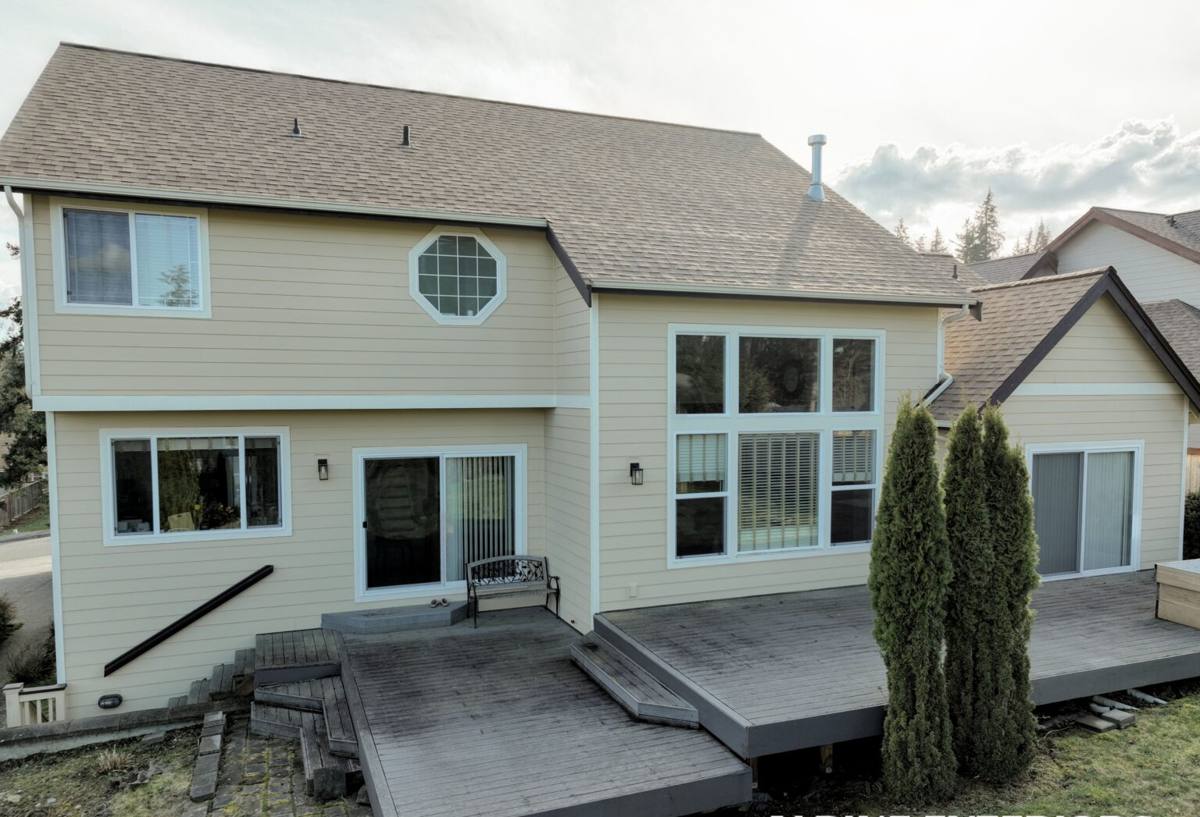
Most of what we see on aging decks in this area isn't dramatic failure — it's slow, steady damage that homeowners don't notice until it's serious: rusted-out fastener heads, soft spots where moss has held moisture against the boards, and joists that look fine from above but are compromised underneath. Replacement, done correctly, is the chance to fix all of that at once instead of patching around it.
Repair or Replace? What We Actually Look For
Not every deck problem means a full rebuild. We evaluate a few key things before recommending replacement over repair:
- Ledger board condition — if the ledger (where the deck attaches to the house) is rotted or was never flashed correctly, that's a structural issue, not a cosmetic one
- Joist and beam integrity — probe testing for soft, spongy, or delaminated wood, especially near ground contact and under high-traffic areas
- Post and footing condition — cracked, heaving, or undersized footings are common on older decks and aren't worth building on top of
- Fastener condition — corroded nails or the wrong-grade screws for treated lumber are a sign the whole build should be questioned, not just the surface boards
- Extent of moss and moisture staining — surface moss is cosmetic; moss that's been left long enough to hold moisture against the frame is a different story
If the framing is sound and it's really the decking surface that's failed, resurfacing can make sense. If the ledger, joists, or footings are compromised, resurfacing just hides a structural problem under new boards — and in a climate like this, that problem doesn't stay hidden long.
What a Correct Deck Replacement Involves
Structure First
Everything starts below the decking. That means correctly sized footings for our soil and frost conditions, properly rated joist hangers and structural screws (not just nails), and a ledger connection that's mechanically fastened and flashed to shed water away from the house framing — not toward it. A deck ledger that traps water against the rim joist is one of the most common causes of hidden rot we find on older builds in coastal Whatcom County.
Fasteners and Hardware
Salt air accelerates corrosion on standard hardware. For any deck we build in Semiahmoo, we treat corrosion-resistant, coated or stainless fasteners and connectors as the standard, not an upgrade. This matters more here than it does even a few miles inland, and it's one of the first things we check when evaluating an existing deck for reuse.
Drainage and Airflow
Moss and rot both need standing moisture to take hold. A correct rebuild accounts for drainage under and around the deck, proper board spacing for airflow, and grading that moves water away from posts and footings instead of pooling around them. Skipping this step is the single biggest reason we see decks fail early in this area.
Guardrails and Code
Any elevated deck replacement is an opportunity to bring guardrail height, baluster spacing, and stair geometry up to current code, even if the original deck predates it. We handle this as part of the build, not as a surprise change order.
Choosing a Decking Material for a Waterfront-Adjacent Climate
There's no single "right" material for every home — it depends on budget, maintenance appetite, and how close the deck sits to salt spray and standing moisture. Here's how the common options compare for a location like Semiahmoo:
| Material | Salt Air / Moisture Resistance | Maintenance | Typical Cost Position |
|---|---|---|---|
| Pressure-treated pine | Good if fasteners and sealing are done right; end grain needs attention | Regular sealing/staining needed, especially in the first few years | Lowest upfront cost |
| Cedar | Naturally moisture- and insect-resistant, but still needs maintenance near salt spray | Periodic staining or sealing to maintain color and protection | Mid-range |
| Composite decking | Very strong resistance to moisture, salt, and moss staining | Occasional washing; no staining or sealing | Higher upfront, lower long-term maintenance cost |
| PVC/capped polymer | Excellent moisture and salt resistance; fully capped boards resist staining | Lowest ongoing maintenance | Highest upfront cost |
We don't push one product on every homeowner. A cedar deck maintained properly can look great for many years even this close to the water — it just requires a homeowner who's willing to keep up with sealing. Composite and PVC decking trade a higher upfront cost for a lot less of that upkeep, which is why we see more homeowners in wetter coastal spots leaning that direction. We'll walk through the honest maintenance trade-offs for your situation rather than defaulting to whatever's easiest to sell.
Our Deck Replacement Process
- On-site evaluation — we inspect the existing deck's framing, ledger, footings, and hardware to determine what's salvageable and what isn't
- Written scope and estimate — a clear breakdown of what's being torn out, what's being rebuilt, and what materials are involved, with no vague allowances
- Permitting — most deck replacements in Whatcom County require a permit, especially for elevated structures; we handle that process rather than leaving it to the homeowner
- Demolition and disposal — full removal of the old deck surface and any compromised framing, hauled off site
- Rebuild — footings, framing, ledger flashing, decking, and guardrails installed to current code and to a standard built for this climate, not a minimum-pass standard
- Final walkthrough — we go over the finished deck with you, including what maintenance (if any) the chosen material needs going forward
Why Local Experience Matters for This Job
A deck built by a crew that hasn't worked near the water often looks fine on day one and starts showing problems within a couple of seasons — usually because the fastener choice, flashing detail, or drainage plan didn't account for salt air and sustained moisture. A crew that already works Semiahmoo and the surrounding Birch Bay area knows which details actually matter here: where moss tends to build up fastest, how driving rain hits certain exposures, and which hardware holds up versus which corrodes early. That experience shows up in decisions you won't necessarily see on the surface — the grade of fastener, the flashing detail at the ledger, the drainage path under the frame — but it's exactly what determines whether the deck is still solid in fifteen years or needs attention in five.
It also matters for permitting and inspection. Whatcom County's coastal jurisdictions have their own requirements around setbacks, elevation, and structural review depending on the property. A contractor who's been through that process locally moves faster and avoids the delays that come from guessing.
Maintaining a New Deck in a Moss-Heavy Climate
Even a well-built deck needs some ongoing attention in this environment. A short seasonal checklist goes a long way toward protecting the investment:
- Sweep debris and standing leaves off the deck surface regularly, especially in fall
- Rinse or gently brush off moss growth before it has a chance to hold moisture against the boards
- Check gaps between boards periodically to make sure drainage paths aren't clogged
- Inspect fastener heads and hardware once a year for early signs of corrosion or loosening
- Re-seal or re-stain wood decking on the schedule appropriate for the product — don't wait until it looks bad
- Keep an eye on the area under the deck for pooling water or vegetation growing against posts
None of this is complicated, but skipping it is how a good deck turns into a problem deck well before its time — especially this close to the water.
Get a Straight Answer About Your Deck
If your deck in Semiahmoo is showing soft spots, rust stains, persistent moss, or just isn't holding up the way it used to, we're glad to take a look and give you an honest read on whether it needs a full replacement or just targeted repair. There's no pressure and no obligation — just a straightforward assessment from a crew that already knows what this climate does to a deck. Use the form below to request a free estimate.