 Birch Bay Siding
 Storm Damage in Blaine: What Our Marine Climate Actually Does to a Roof
Blaine sits right on the water at the northern edge of Whatcom County, and that location shapes what "storm damage" means here. It isn't just the occasional windstorm ripping off a few shingles. It's the combination of salt-laden air coming off Semiahmoo Bay and Drayton Harbor, wind-driven rain that hits roofs sideways instead of straight down, and a moss season that runs longer here than almost anywhere else in the state. Each of these does a different kind of damage, and each one changes how a repair needs to be done.
Salt air accelerates corrosion on anything metal — nail heads, flashing, gutter hangers, even the fasteners holding your shingles down. A roof that would hold up fine forty miles inland can show rust streaks and weakened fastening within a few years this close to the water. Driving rain, especially during winter storms off the Strait of Georgia, gets pushed sideways and upward under shingle edges and around flashing in ways that gravity-only water never would. And moss, which thrives in our wet, mild winters, holds moisture against the roof deck for months at a time, slowly breaking down shingles from underneath even when the surface still looks intact.
When we talk about storm damage repair in Blaine, we're talking about fixing the immediate problem — a torn shingle, a lifted ridge cap, a leak after a windstorm — while also accounting for these three ongoing stressors. A repair that ignores salt exposure, wind-driven rain paths, or moss growth usually fails again within a year or two.
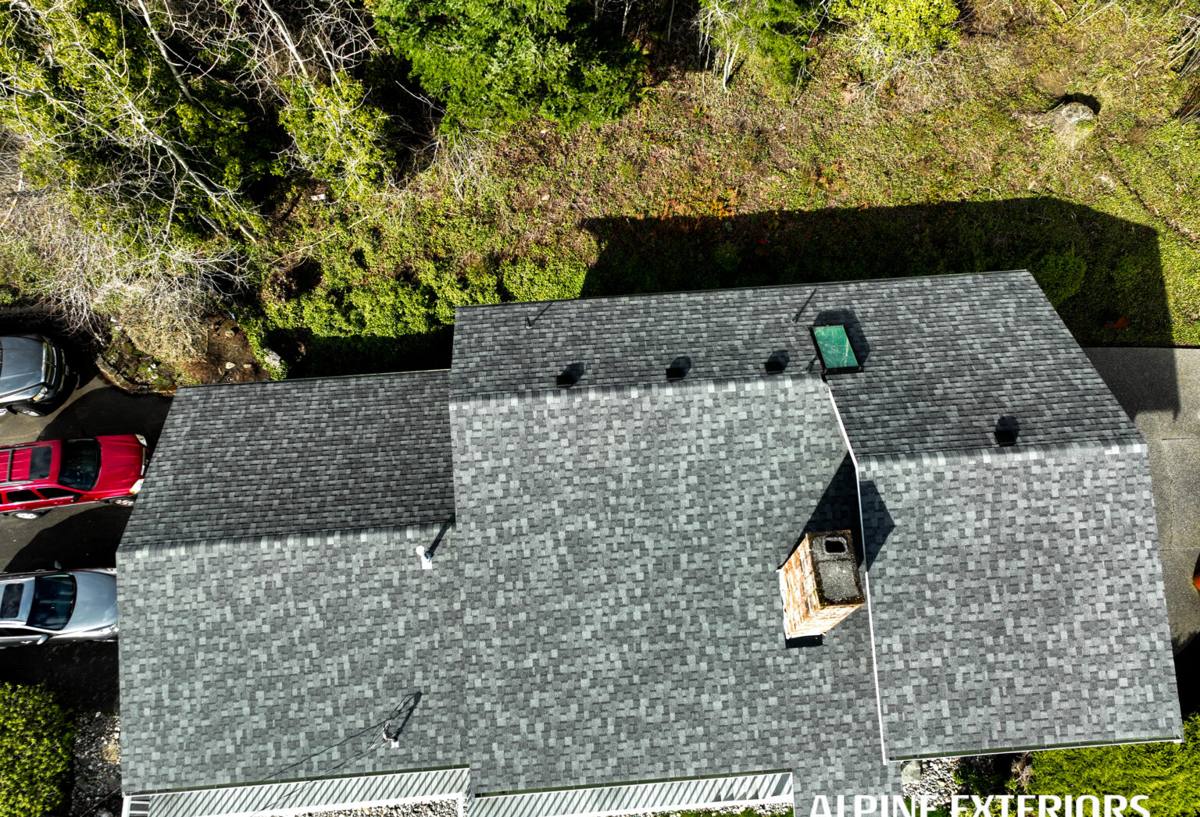
Signs Your Blaine Roof Took Storm Damage
What's Easy to Spot
Missing or torn shingles, visible dents from hail or debris, a bent or lifted ridge cap, and detached gutters or downspouts are usually obvious after a bad blow. If you can see daylight through the attic roof deck, or find water stains spreading across a ceiling after a storm, that's an active leak that needs attention right away.
What Gets Missed
The damage that causes the most long-term trouble is often the kind homeowners don't notice from the ground. Wind can lift shingle tabs just enough to break the sealant bond without tearing anything visibly loose — the shingle looks fine but no longer sheds water correctly. Flashing around chimneys, vent pipes, and roof-to-wall transitions can work loose in high wind and let water in slowly, showing up as a stain weeks or months later instead of a dramatic leak the next day.
- Granules collecting in gutters or at the base of downspouts after a storm
- Soft or spongy spots when walking the roof deck (attic inspection, not roof-walking, is the safer way to check)
- Daylight visible around vent boots, chimney flashing, or skylight edges
- Musty smell in the attic that wasn't there before the storm
- Ceiling stains that appear or grow after wind and rain events, even without a single obvious storm
What a Correct Storm Damage Repair Actually Involves
Beyond Patching the Visible Hole
A quick patch over a torn shingle can stop a leak for a while, but it doesn't answer the real question: why did that section fail, and is the surrounding area compromised too? A proper storm repair starts by pulling back shingles around the damaged area to check the underlayment and roof deck for water intrusion, not just replacing what's visibly broken on the surface.
Flashing and Underlayment Integrity
Because wind-driven rain in Blaine tends to find its way in at transitions — chimneys, valleys, vent penetrations, wall step-flashing — a repair that only addresses the field of the roof and skips these details usually leaks again in the next storm. We check flashing seals, valley metal, and underlayment condition at every repair, even when the storm damage looks like it was limited to one area.
Matching Materials Correctly
Shingle color and profile change over the years, and a mismatched patch stands out and can also create a slightly different water-shedding pattern at the seam. We match as closely as the existing roofing allows, and we're upfront when an exact match isn't possible so you can decide how much that matters to you.
Our Process: From Inspection to Finished Repair
- Inspection. We walk the roof (weather permitting) and check the attic from inside, looking for both the obvious damage and the secondary signs — lifted seals, loose flashing, early moisture staining.
- Written assessment. You get a clear explanation of what's damaged, what's just wear, and what we recommend — in plain language, not a sales pitch.
- Temporary protection if needed. If there's an active leak, we can tarp or seal the area to stop further interior damage while a full repair is scheduled.
- Repair work. Damaged shingles, flashing, underlayment, or decking are replaced to match the surrounding roof, with attention to the wind and moisture patterns specific to your roof's exposure.
- Final check. We confirm the repair area sheds water correctly and walk you through what we did and why.
Repair vs. Replacement: How We Make That Call
Not every storm-damaged roof needs to be replaced, and not every roof can be reasonably repaired. The decision usually comes down to a few honest factors.
| Factor | Leans Toward Repair | Leans Toward Replacement |
|---|---|---|
| Age of existing roof | Under 12–15 years, shingles still flexible | Near or past expected lifespan, brittle shingles |
| Extent of damage | Localized to one section or slope | Spread across multiple slopes or the whole roof |
| Underlying deck condition | Deck is sound, no rot found | Soft or rotted decking discovered during inspection |
| History of prior repairs | First significant repair on this roof | Several patches already, recurring leak points |
| Material availability | Matching shingles still obtainable | Discontinued product, poor match likely |
We'll tell you plainly which side of that table your roof falls on. If a repair is the honest answer, that's what we'll recommend — a storm damage repair business built on pushing unnecessary replacements doesn't last long in a community this size.
Materials and Methods We Use for Blaine's Coastal Conditions
Given the salt air and wind exposure common in Blaine, we favor corrosion-resistant fasteners and flashing over standard-grade hardware, since ordinary galvanized fasteners can start showing rust streaks well before the shingles themselves wear out this close to the water. Underlayment gets extra attention at valleys, eaves, and any low-slope transitions, since those are the areas most likely to take on wind-driven rain. Where moss has been an ongoing issue, we'll talk through options for reducing regrowth around the repair area — this is a maintenance and material choice, not a one-time fix, since moss is a function of shade, moisture, and roof surface, not something a single treatment eliminates permanently.
We're straightforward about material trade-offs rather than pushing any one product as a cure-all. Some higher-end synthetic underlayments and treated shingles cost more up front but hold up better to sustained damp exposure; others are a better value if the roof is closer to a full replacement anyway. We'll walk through the honest trade-offs for your specific roof rather than defaulting to the most expensive option.
Insurance Claims and Storm Damage Documentation
Many storm repairs in Blaine end up going through homeowners insurance, especially after a significant wind event. We document damage with photos and a written scope of work at the time of inspection, which gives you something concrete to bring to your adjuster or claim. We're happy to be on-site or available by phone during an adjuster visit to point out damage that isn't obvious from the ground.
What we won't do is inflate a scope of work to chase a bigger claim payout, or promise a specific claim outcome — that's between you and your insurer. Our job is to document what's actually damaged and give you an honest repair estimate, whether that estimate is used for a claim or paid out of pocket.
Why a Crew That Already Works Blaine Matters
Storm damage repair isn't a generic service that looks the same everywhere in Whatcom County. A crew that regularly works Blaine roofs already knows how far wind-driven rain typically travels under shingles in this exposure, which flashing details tend to fail first on homes facing the water versus those set back from it, and how aggressive moss growth gets on north-facing slopes shaded by trees common to this area. That's knowledge you don't get from a crew driving up from out of the area for a one-off storm-chasing job after a bad windstorm.
There's also a practical side to it: a local crew can typically respond faster after a storm, is easier to reach for a follow-up if a repair needs adjustment, and has a reputation in the community worth protecting. We work out of Birch Bay, a short drive from Blaine, which means inspections and repairs don't get pushed to the back of a long travel schedule.
Reducing Future Storm Damage: A Homeowner's Checklist
Between storms, a few habits go a long way toward reducing how much damage the next windstorm or wet winter causes.
- Clear gutters and downspouts before the fall storm season so water has somewhere to go
- Trim back tree limbs that overhang the roof — both for storm debris risk and to reduce moss-friendly shade
- Have loose or lifted shingles resealed or replaced promptly rather than waiting for the next storm to finish the job
- Check attic ventilation — poor airflow keeps moisture trapped against the underside of the deck
- Schedule a roof check after any major windstorm, even if nothing looks wrong from the ground
- Address moss growth before it thickens into a mat that holds water against the shingles
If a recent storm has left your Blaine home with damage — or you're just not sure whether that lifted shingle or water stain needs attention — we're glad to take a look. Reach out for a free, no-pressure estimate using the form below, and we'll give you a straight answer about what's going on and what it would take to fix it right.