 Birch Bay Siding
 Living With Salt Air, Rain, and Moss: What It Does to Windows
Terrell Creek sits close enough to the water that salt air is a fact of daily life, not an occasional nuisance. Combine that with Whatcom County's long, wet winters and the moss season that follows, and you have a climate that is genuinely hard on windows. Salt-laden air corrodes exposed hardware and pits certain metal finishes over time. Driving rain, pushed sideways by wind off the water, finds every gap in flashing and sealant that a drier climate would never expose. And the months of overcast, high-humidity weather that bring the moss also bring condensation problems for windows that aren't rated to handle it.
None of this is unusual for a home near Birch Bay — it's just the trade-off for living where you do. But it does mean that a window built and installed for, say, eastern Washington or a drier inland market is the wrong tool for a Terrell Creek home. What holds up here is a specific combination of glass, frame, and installation detail suited to marine exposure, and that's what this page is about.
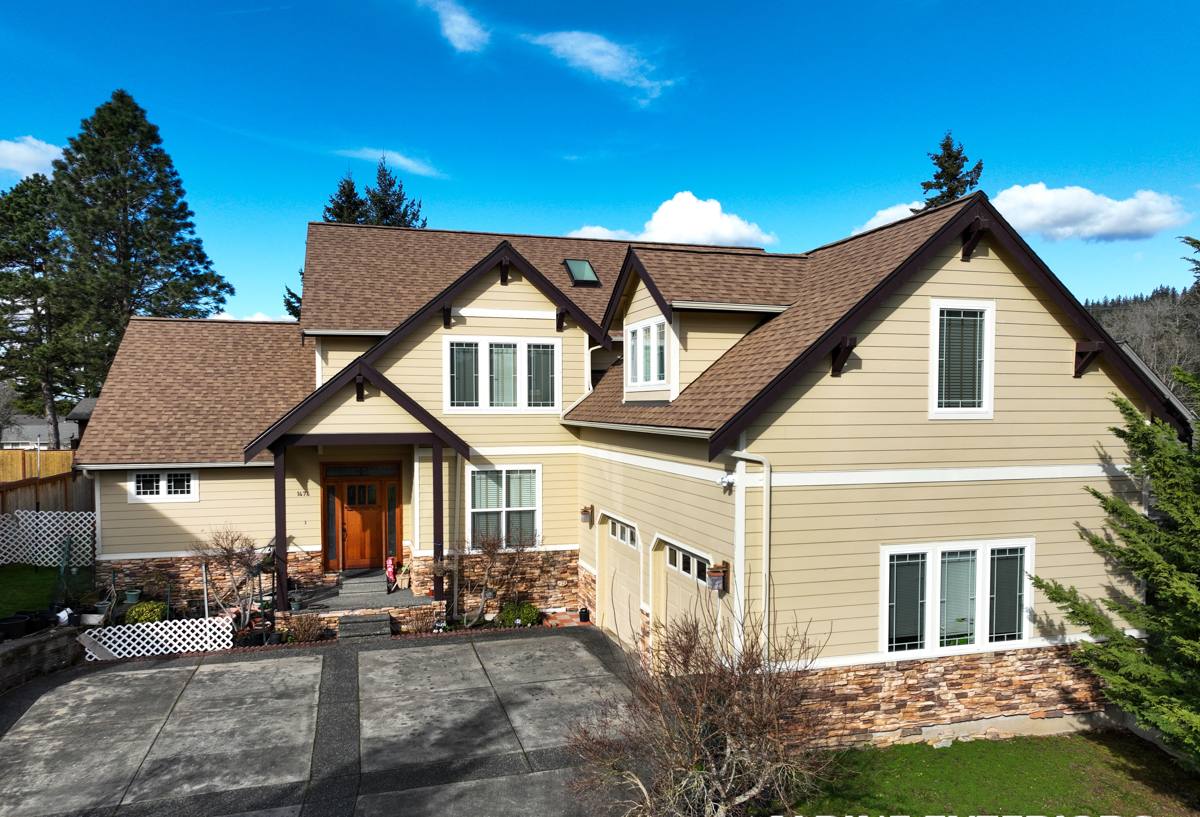
What "Energy-Efficient" Actually Means for a Home Here
"Energy-efficient" gets used as a marketing word a lot, but for a Terrell Creek home it should mean something specific: a window that keeps conditioned air in, keeps moisture out, and resists the particular wear that salt air and constant damp cause. That's a different set of priorities than a hot, dry climate would need.
Glass Packages Suited to the Pacific Northwest
For this area, we generally recommend dual-pane glass with a low-E coating tuned for a heating-dominated climate, combined with an argon or krypton gas fill between the panes. The low-E coating matters more here than the number of panes — it controls how much heat radiates back into the room and how the glass resists condensation forming on the interior surface during cold, damp mornings. Triple-pane glass is worth discussing for homes closest to the water or with unusually exposed elevations, but it's not automatically the right call for every window — it adds weight and cost that isn't always justified once the frame and installation are handled correctly.
Frame Materials and Salt-Air Exposure
Frame choice is where salt air really shows up as a factor. Vinyl and fiberglass frames don't corrode, which makes them a straightforward choice for homes with direct water exposure. Wood and wood-clad frames can look great and perform well, but they demand more consistent maintenance in a climate this damp — the finish and any exposed joints need attention on a schedule, or moisture will find its way in over the years. We'll walk through the honest trade-offs for your specific elevation and exposure rather than push one material as universally "best."
Signs Your Windows Are Underperforming
Homeowners in this area often live with a slowly worsening window problem for years before addressing it, partly because the symptoms show up gradually. Here's what we'd want you to look for:
- Condensation or fogging between the panes — a sign the seal has failed and the gas fill is gone
- Visible moisture, staining, or soft wood on the interior sill or frame
- A noticeable draft near the window frame on windy days
- Difficulty opening, closing, or latching — often a sign the frame has swelled or warped
- Hardware showing white corrosion or pitting, especially on windows facing the water
- Moss or dark streaking building up on the exterior frame or sill faster than on the siding around it
- A noticeable jump in heating costs without a clear other explanation
Any one of these on its own might not mean full replacement is needed. But two or three together, especially on the same window, usually means the unit is past the point where repair makes sense.
What a Correct Installation Involves
The window unit itself only accounts for part of how it performs. In our experience, most window failures we're called to look at in this area trace back to installation detail, not product quality. Getting it right matters more here than in a drier climate, because there's less margin for error before water finds a way in.
Flashing and Weather Barrier Integration
Every opening gets flashed to shed water downward and outward, tied into the existing weather-resistive barrier so there's a continuous drainage path — not a patchwork of sealant covering gaps. This is the single most important step for a home exposed to driving, wind-driven rain, and it's also the step that's easiest to shortcut if a crew is moving too fast.
Sealing, Insulation, and Interior Finish
Once the unit is set, the gap between the window frame and the rough opening gets insulated properly — not overpacked with foam, which can bow the frame and affect operation, and not left with voids that create cold spots and condensation risk. Exterior sealant goes on with attention to the specific joints that see the most water, and interior trim is reset cleanly so there's no gap for conditioned air to leak through.
Comparing Frame Options for This Climate
| Frame Material | Salt-Air / Moisture Resistance | Maintenance Needs | Typical Lifespan |
|---|---|---|---|
| Vinyl | Very good — won't corrode or rot | Low; occasional cleaning | 20–30+ years |
| Fiberglass | Excellent — very stable in temperature and moisture swings | Low | 30+ years |
| Wood-Clad | Good on the exterior cladding; interior wood needs protection from condensation | Moderate to high — finish and joints need regular attention | 20–30 years with upkeep |
| Aluminum | Prone to corrosion and heat transfer in this climate | Moderate | Varies widely; generally not our first recommendation here |
This is a starting point for a conversation, not a rule. The right frame for your home depends on which elevation faces the water, how much sun and wind exposure the opening gets, and what look you're trying to match on the house.
What Drives the Cost
Every Terrell Creek home is a little different, so we'd rather walk you through real numbers on-site than quote a price here that doesn't fit your project. In general, the biggest factors are:
- Number of openings being replaced and their size
- Frame material — vinyl and fiberglass are generally more budget-friendly than wood-clad
- Glass package — double versus triple pane, and any upgraded coatings
- Condition of the existing opening — whether there's hidden water damage or rot to address once old windows come out
- Whether trim, siding, or interior finish work is needed to match the new units in
That last point is worth flagging: on a home that's seen years of moisture exposure, it's common to find some soft framing or trim once a window is removed. We'll always show you what we find before doing any additional repair, rather than assuming and adding it to the bill.
Our Process, Start to Finish
- On-site assessment — we look at each opening, note exposure and condition, and measure accurately rather than estimating
- Product recommendation — we walk you through frame and glass options suited to that specific opening's exposure, with honest trade-offs
- Written estimate — clear line items, no vague allowances
- Removal and inspection — old units come out carefully so we can check the framing and sheathing underneath before anything new goes in
- Installation — flashing, insulation, and sealing done to hold up against driving rain, not just pass a quick visual check
- Final walkthrough — we test operation, check seals, and clean up before calling the job done
Why a Crew That Already Works Terrell Creek Matters
A lot of window problems in this area aren't caused by bad products — they're caused by installation that didn't account for local conditions. A crew that mostly works drier, inland areas may not think twice about flashing details or sealant choices that matter a great deal here. Working regularly in Birch Bay and the surrounding Whatcom County neighborhoods means we already know which elevations take the worst of the weather, what condensation looks like in a home that's been under-ventilated through a wet winter, and which materials are worth the extra cost versus which are overkill for a given exposure. That local pattern-recognition is hard to shortcut, and it's the difference between a window job that looks fine at handoff and one that still performs correctly five winters later.
If your Terrell Creek home has drafty, foggy, or hard-to-operate windows — or you're planning ahead for a remodel — we're happy to take a look and give you a straightforward, no-pressure estimate. Use the form below to get started.