 Birch Bay Siding
 Decks Near California Creek Take a Different Kind of Beating
California Creek sits close enough to the water that homes here deal with a combination most inland decks never see: salt-laden air off the bay, wind-driven rain that gets pushed sideways under railings and into ledger boards, and a moss season that can stretch from fall through spring in a wet Whatcom County year. None of those things are dramatic on their own. Together, over ten or fifteen years, they're exactly what turns a solid deck into a soft, spongy, rusted-fastener problem.
Salt air accelerates corrosion on anything metal — nails, screws, joist hangers, bolts — long before the wood itself gives out. Constant damp keeps moss and algae established on decking boards and stair treads, which isn't just cosmetic; it holds moisture against the wood and turns surfaces slick and dangerous. And repeated wet-dry cycling is what eventually splits boards, lifts fasteners, and rots ledger connections where the deck meets the house. A deck built without this climate in mind will show its age faster here than the same deck would twenty miles inland.
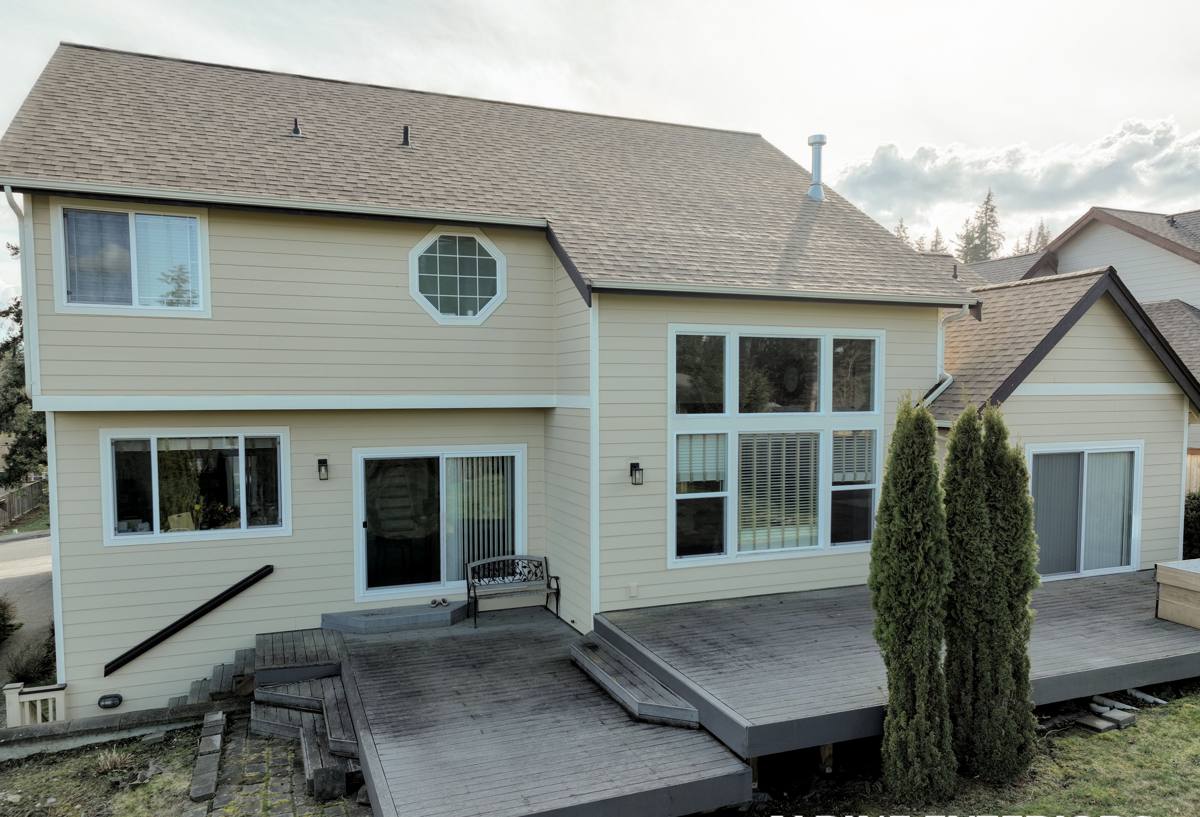
Repair or Replace? Signs It's Time
Not every tired-looking deck needs a full teardown. But there's a point where patching individual boards is just delaying a bigger repair bill — and risking a safety issue in the meantime. Here's what tells us a deck has crossed that line:
- Soft or spongy spots when you walk across the decking, especially near the house or stairs
- Rust streaking down from screw heads or joist hangers, or fasteners that spin freely without holding
- Persistent moss or dark staining that comes right back within weeks of cleaning
- Gaps opening up between boards, or boards that have cupped, crowned, or split along their length
- A ledger board (where the deck attaches to the house) that shows soft wood, gaps, or water staining on the siding above it
- Railings or stair stringers that feel loose or flex under normal weight
- Visible rot or insect damage in the substructure — posts, beams, or joists — rather than just the surface boards
If the problems are limited to surface boards on an otherwise sound frame, repair or a resurfacing can make sense. Once the framing, posts, or ledger connection are compromised, replacement is the honest recommendation — patching a failing structure just moves the cost down the road while adding risk in the meantime.
What a Correct Deck Replacement Actually Involves
The Substructure Comes First
The part of a deck that determines how long it lasts isn't the decking boards — it's everything underneath them. Footings need to be sized and set to current code depth, posts need proper post bases that keep wood off standing water, and the ledger connection at the house needs correct flashing so water is directed away from the wall, not trapped behind it. In a damp, salt-influenced climate like this one, we treat the ledger flashing detail as non-negotiable — it's the single most common failure point we see on decks that were built cheaply or built somewhere drier where it mattered less.
Fasteners and Hardware
Standard hot-dip galvanized hardware corrodes faster near salt air than most homeowners expect. We spec stainless steel or coated fasteners rated for the exposure the deck will actually see, along with joist hangers and structural connectors rated for the same conditions. It costs more up front than the cheapest hardware on the shelf, and it's the difference between fasteners that are still solid at year fifteen and ones that are already rust-streaked at year five.
Surface Decking
Whatever decking material is chosen, it needs to be installed with proper board spacing for drainage and expansion, correctly fastened to resist wind uplift, and detailed at the edges and stairs so water doesn't pool. A deck that looks finished but wasn't built with drainage and airflow in mind will grow moss and hold moisture no matter how good the material is.
Choosing a Decking Material for This Climate
There's no single "best" decking material — it depends on how much maintenance you want to take on, your budget, and how the deck will be used. Here's how the common options actually compare for a property dealing with salt air, rain, and moss:
| Material | Moisture & Moss Behavior | Maintenance | Typical Lifespan |
|---|---|---|---|
| Pressure-treated wood | Absorbs moisture, moss-prone without regular cleaning and sealing | Annual cleaning, periodic staining/sealing | 10–15 years with upkeep |
| Cedar | Naturally rot-resistant but still needs sealing to resist moss and graying | Regular sealing to maintain appearance and resistance | 15–20 years with upkeep |
| Composite decking | Doesn't absorb water like wood, but moss/algae can still grow on the surface film in constant shade and damp | Periodic washing, no staining or sealing | 25+ years, varies by brand and warranty |
| PVC/capped polymer | Fully moisture-resistant surface, easiest to keep moss from taking hold | Occasional washing | 25+ years, varies by brand and warranty |
We install a range of these depending on the homeowner's priorities. For a deck that gets a lot of shade near trees or the water — common in this area — composite or capped polymer usually saves the most long-term maintenance, but a well-built and properly sealed wood deck is still a legitimate, more affordable option if you're willing to keep up with it. We'll walk through the honest trade-offs for your specific site rather than pushing one product.
Our Deck Replacement Process
1. On-Site Assessment
We look at the existing deck's framing, ledger connection, footings, and overall condition to confirm whether replacement is actually the right call versus repair, and to understand what the new deck needs to handle given sun exposure, shade, and proximity to water.
2. Design and Material Selection
We talk through decking material, railing style, and layout, with honest input on what holds up best for the site's specific exposure — not just what looks good in a showroom.
3. Permitting
We handle the permit application and coordinate any required inspections through the appropriate Whatcom County process, including any additional review that can apply to properties near a creek or shoreline.
4. Demolition and Disposal
The old deck is removed and hauled off, with care taken around landscaping, siding, and anything below the deck that needs to stay intact.
5. Framing and Structural Work
New footings, posts, ledger flashing, and framing go in to current code, built for the exposure this specific property sees.
6. Decking, Railing, and Finish
Surface material and railings are installed and detailed for drainage, then finished — sealed if it's a wood deck, or simply cleaned up if it's composite or PVC.
7. Final Walkthrough
We walk the finished deck with you, point out any care or maintenance specifics for the material you chose, and make sure everything meets code and your expectations before we call it done.
Permits and Local Considerations
Deck replacement in Whatcom County generally requires a building permit, and that's true whether the new deck is the same footprint as the old one or a different size. Properties near a creek or other water feature can also fall under additional critical areas or shoreline-related review depending on exact location and how close the structure sits to the water or its buffer. We check this during the assessment stage so there are no surprises mid-project — it's far easier to sort out before demolition starts than after.
What Affects the Cost of a Deck Replacement
Every deck is different, so we won't quote a number without seeing the site, but these are the main factors that move the price up or down:
| Factor | Why It Matters |
|---|---|
| Deck size and shape | More square footage and complex angles mean more material and labor |
| Decking material | Composite and PVC cost more upfront than pressure-treated wood, less over time |
| Height and structure | Multi-level decks or decks requiring taller posts and additional footings cost more |
| Ledger and flashing condition | Rot behind the ledger found during demo can add repair scope to the siding or framing |
| Railing style | Cable, glass, or custom railing systems cost more than standard wood or composite balusters |
| Access | Decks with difficult site access for equipment and material delivery take more labor time |
As a broad starting point, straightforward wood deck replacements tend to run lower, while larger composite or multi-level decks with upgraded railing run higher — but the only way to get a real number is a site visit, since hidden framing damage is common on older decks in this climate.
Why Local Experience Matters for This Job
A deck built by a crew that hasn't worked this close to the water tends to under-spec the hardware, skip or shortcut the ledger flashing detail, and pick materials without accounting for how much moss and shade the site actually gets. Those shortcuts don't show up on day one — they show up five or ten years later as the exact problems described above. Working regularly in and around Birch Bay and California Creek means we already know how this specific stretch of Whatcom County treats a deck, and we build accordingly the first time instead of learning it at the homeowner's expense.
If your deck is showing its age or you're ready to replace one that's past saving, we're happy to take a look and give you a straightforward, no-pressure estimate — just fill out the form below.