 Birch Bay Siding
 Cherry Point's Shoreline Climate Is Rough on Ordinary Siding
Cherry Point sits on the Whatcom County shoreline along the Strait of Georgia, and homes here take a different kind of beating than houses even a few miles inland. Salt-laden air moves off the water and settles on exterior surfaces year-round. Wind-driven rain comes in sideways during winter storms, forcing water into seams and laps that a calmer climate would never test. And the long, damp Pacific Northwest shoulder seasons keep siding wet for days at a stretch, which is exactly the environment moss, algae, and mildew need to take hold.
None of this is unique to any one house on this stretch of coastline — it's the baseline every siding product has to survive here, year after year. Some materials shrug it off. Others slowly lose their finish, swell at the seams, or start hosting green growth within a few seasons. The siding choice matters less on a sheltered inland lot than it does on a Cherry Point property facing open water and prevailing wind.
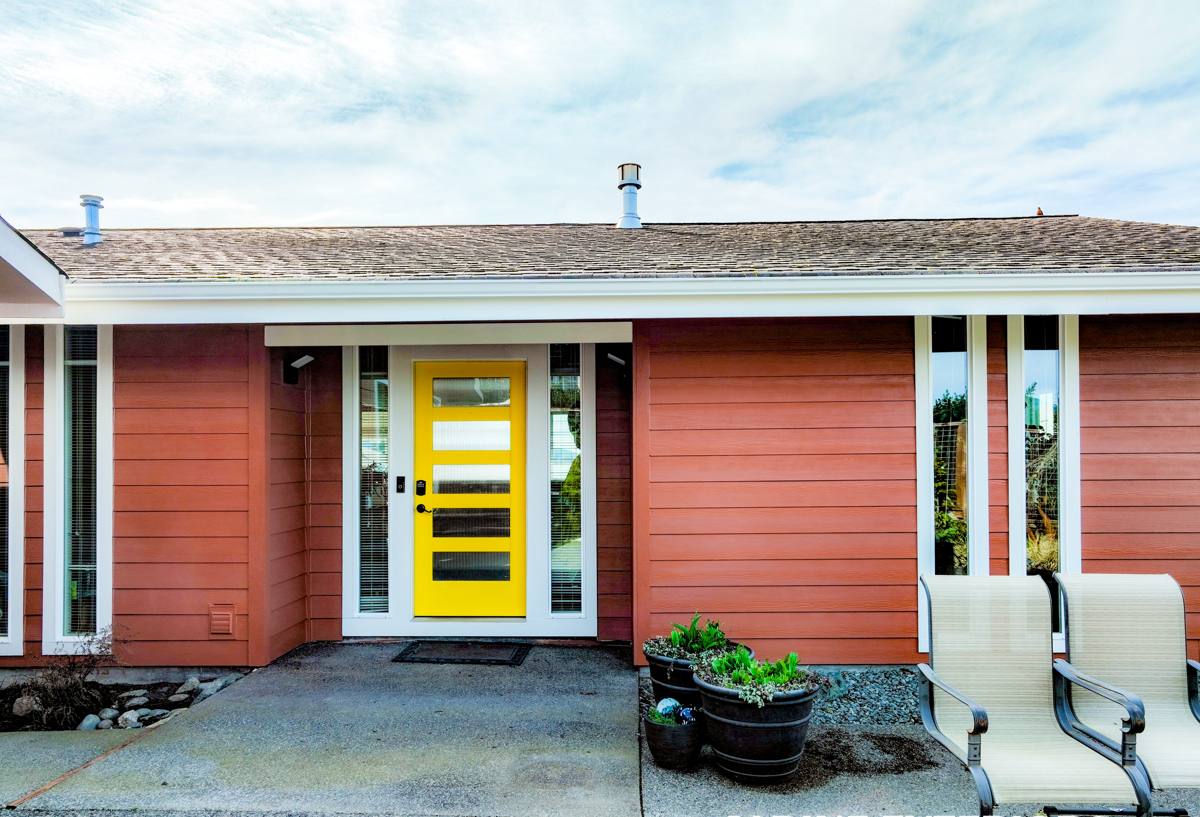
Why We Install Only James Hardie Fiber Cement
We don't install vinyl, LP SmartSide, Cemplank, Allura, primed spruce, or cedar. That's not a marketing line — it's a standard we hold because of what we've seen these products do (and not do) in coastal Whatcom County conditions over time. Vinyl expands and contracts with temperature swings and can warp or crack under UV and salt exposure. Wood-based products like primed spruce, cedar, and OSB-core siding absorb moisture at cut edges and fastener penetrations, and once moisture gets into the substrate, rot follows — often behind the face where you can't see it until it's advanced.
James Hardie fiber cement is cellulose fiber, sand, and portland cement pressed and cured into a rigid, dimensionally stable board. It doesn't absorb bulk water into the panel core the way wood-based sidings do, it doesn't warp or crack from thermal cycling the way vinyl can, and it's non-combustible — a real consideration given the wildfire smoke seasons the whole region has seen in recent summers. The ColorPlus factory-applied finish is baked on under controlled conditions, which gives it better fade and moisture resistance at the surface than field-applied paint, and it holds up better against salt exposure than most site-painted finishes.
What Hardie Doesn't Solve By Itself
To be fair to the material: Hardie siding is not maintenance-free, and it's not magic. It still needs correct flashing, proper clearances, and a maintained paint or ColorPlus finish to perform the way it's rated to. A poorly installed Hardie job in Cherry Point's climate can still trap moisture and grow moss just like any other siding installed wrong. The product gives you a strong starting point — the installation is what determines whether that potential is realized.
What Correct Installation Looks Like Here
James Hardie publishes detailed installation instructions specific to climate zones, and following them isn't optional if you want the manufacturer's warranty to mean anything. In a high-exposure coastal spot like Cherry Point, a few details matter more than they would on a sheltered inland lot:
- Rain-screen gap: A drainage gap behind the siding lets any moisture that does get past the face material drain and dry out instead of sitting against the sheathing.
- Flashing at every penetration: Windows, doors, hose bibs, light fixtures, and vents all need proper flashing and sealant details — these are the spots where wind-driven rain finds a way in first.
- Correct fastener pattern and type: Hardie specifies fastener spacing, embedment, and corrosion-resistant fastener types by exposure zone. Coastal salt air accelerates corrosion on the wrong hardware.
- Proper clearances: Minimum gaps from grade, roofline, decks, and other siding transitions keep the bottom edge of the board from sitting in standing water or trapped debris.
- Sealed and painted cut edges: Every field cut exposes raw fiber cement that needs to be sealed before it's weather-exposed, or it becomes a moisture entry point.
Skip any one of these and you can end up with a house wearing an excellent siding product that still fails early — not because the material was wrong, but because the installation didn't respect the site conditions.
Choosing the Right Hardie Product Line for a Coastal Lot
James Hardie engineers its HZ5 and HZ10 product formulations for different climate zones, accounting for freeze-thaw cycling, moisture exposure, and humidity. Western Washington's coastal zone, including Birch Bay and Cherry Point, falls under specific HZ engineering — using the correct HZ formulation, not just whatever's on the truck, is part of getting the product's real-world performance to match its rating. Beyond the base formulation, homeowners here typically choose between a few Hardie product styles:
| Hardie Product | Profile | Best Fit For |
|---|---|---|
| HardiePlank Lap Siding | Horizontal lap, several width/texture options | Most common choice; traditional or modern facades |
| HardiePanel Vertical Siding | Large-format vertical panels | Modern designs, accent walls, gable ends |
| HardieShingle Siding | Staggered or straight-edge shingle profile | Cottage or craftsman-style homes |
| HardieTrim Boards | Fascia, corner boards, window/door trim | Completing the water-management detailing around openings |
How the Job Works, Start to Finish
1. On-Site Assessment
We look at existing siding condition, sheathing and moisture status where accessible, exposure direction relative to prevailing wind and water, and any trouble spots like window returns, deck ledger connections, or roof-to-wall transitions — these are the places coastal homes tend to show wear first.
2. Tear-Off and Substrate Check
Old siding comes off and we check the sheathing underneath for rot or water damage before anything new goes up. Covering a compromised substrate with new siding just hides a problem instead of fixing it.
3. Weather-Resistive Barrier and Rain-Screen Install
A correctly lapped weather-resistive barrier goes on first, followed by the furring or rain-screen system that creates the drainage gap behind the siding.
4. Flashing and Trim
Flashing goes in at every window, door, and penetration before the siding closes around it — not caulk applied after the fact as a substitute.
5. Hardie Panel or Plank Installation
Boards go up to spec: correct fastener spacing and type, correct clearances from grade and roofline, cut edges sealed as we go.
6. Final Detailing and Walkthrough
Caulking, touch-up paint on any field-cut edges, cleanup, and a walkthrough so you know what you're looking at and what routine care it needs.
Living With Moss Season: Maintenance That Actually Matters
Whatcom County's long wet season means moss and algae pressure is a fact of life for every exterior surface — roofs, decks, fences, and siding alike. Correctly installed Hardie siding with an intact ColorPlus or paint finish resists moss far better than wood-based siding, but "resists" isn't "immune." A little seasonal attention keeps it looking right and keeps moisture from getting a foothold:
- Rinse siding with a garden hose and soft brush once or twice a year, focusing on north-facing and shaded walls where moisture lingers longest.
- Keep gutters clear so overflow isn't running down the siding face during heavy rain.
- Trim back vegetation and tree cover that keeps a wall shaded and damp longer than the rest of the house.
- Check caulk joints at trim and penetrations annually and re-caulk any that have cracked or pulled away.
- Avoid pressure washing directly into laps and seams — it can force water behind the siding rather than just cleaning the surface.
- Touch up any chips or scrapes at fasteners or corners promptly so raw material isn't left exposed to salt air and rain.
Why a Crew That Already Works Cherry Point Matters
Coastal Whatcom County exposure isn't something you learn from a manufacturer's install manual alone — it's something you learn from doing the work on these specific shorelines, in these specific wind and rain patterns, season after season. A crew that already works Birch Bay and Cherry Point knows which walls on a typical lot here take the worst of the weather, understands the county's permitting expectations for exterior work, and has already made the judgment calls — flashing details, fastener choices, clearance adjustments — that a generalist crew coming from a drier or more sheltered area might not think to make.
That local track record also means less guesswork on your project. We're not learning the site conditions for the first time on your house — we're applying what we already know works on homes exposed to the same salt air and the same storm track yours is.
Cost Factors for a Cherry Point Hardie Project
Every home is different, but a few factors consistently move the price on a Cherry Point siding job more than others:
| Factor | Why It Matters Here |
|---|---|
| Existing substrate condition | Coastal moisture exposure means a higher chance of hidden sheathing repair before new siding goes on |
| Wind/water exposure of the lot | More exposed elevations may call for additional flashing detail and fastener upgrades |
| Siding profile chosen | Lap, panel, and shingle styles differ in material and labor cost |
| Trim and detail work | Corner boards, window trim, and fascia work add scope beyond flat wall coverage |
| Tear-off complexity | Multiple layers of old siding or extensive rot repair add time and disposal cost |
If you're weighing a siding replacement on a Cherry Point or Birch Bay home, we're happy to walk the property, look at what your walls are actually dealing with, and put together a straightforward, no-pressure estimate — just fill out the form below to get started.