 Birch Bay Siding
 Why Cottonwood Beach Roofs Wear Differently
Cottonwood Beach sits close enough to the water that the roofs here don't age the way a roof does further inland in Whatcom County. Homes along this stretch of Birch Bay deal with a near-constant mix of salt-laden air, wind-driven rain, and long stretches of shade and dampness that keep moss and moss spores active for most of the year. None of that is dramatic on its own, but stacked together over a decade or two, it shortens the useful life of roofing materials that would otherwise last much longer a few miles inland.
We've replaced enough roofs in this neighborhood to know the failure patterns are consistent: fastener corrosion happens sooner near the shoreline, moss gets a foothold on the shaded north and west-facing slopes first, and driving rain off the Strait finds any weak point in flashing or underlayment that a drier climate would never expose. A roof replacement here isn't just "put new shingles on" — it's an opportunity to correct for the specific way this stretch of Birch Bay wears a roof down.
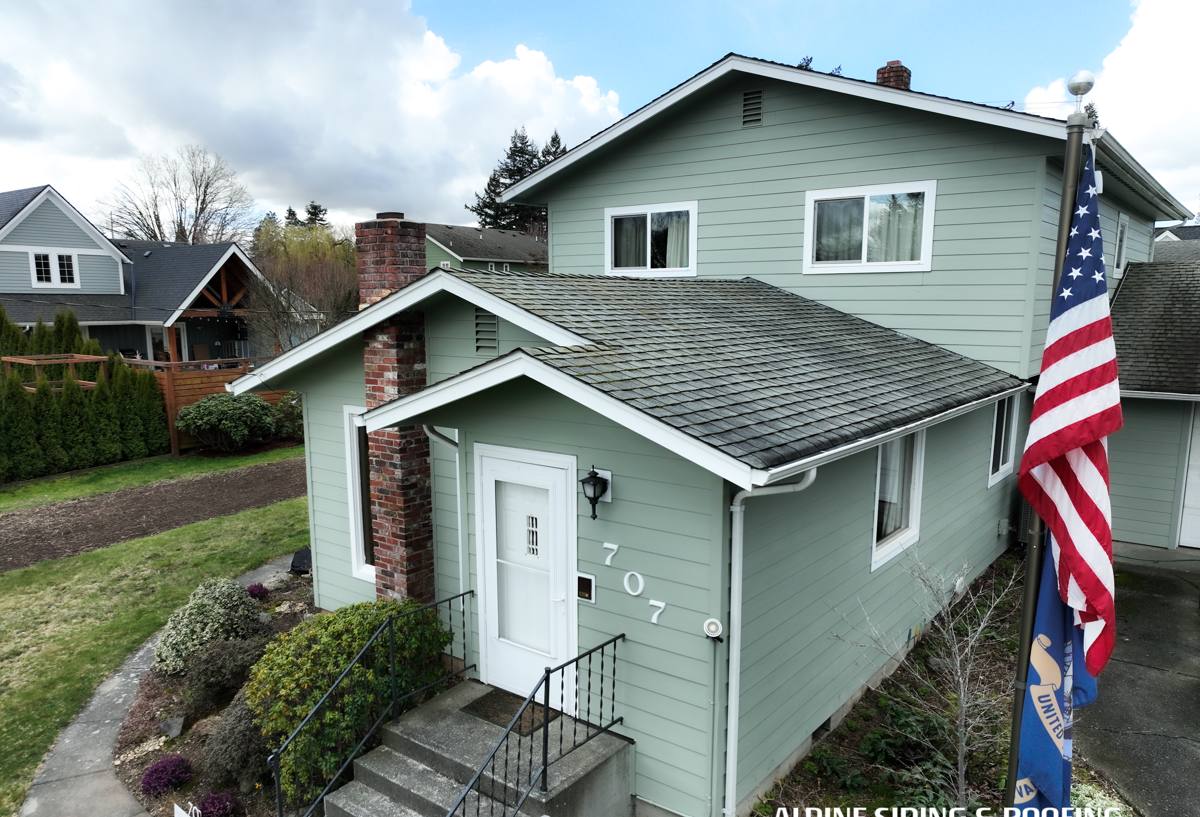
Signs a Cottonwood Beach Roof Needs Replacing, Not Just Repair
Repairs make sense when a problem is isolated — a cracked pipe boot, a handful of wind-lifted shingles, a small flashing leak. Replacement becomes the honest recommendation when the damage is spread across the roof or the underlying materials are past the point where patching buys meaningful time. In a salt-air, high-moss environment, that tipping point tends to arrive earlier than homeowners expect based on the roof's age alone.
- Granule loss visible in gutters or on the ground, especially on slopes facing the water or prevailing wind
- Moss or algae staining that keeps returning within a season or two of cleaning
- Soft spots, sagging, or spongy decking felt underfoot during an inspection
- Rusted or corroded fasteners, flashing, or metal roof-vents
- Daylight visible through the attic or consistent moisture staining on interior ceilings
- Shingles that are curling, cupping, or cracking across multiple slopes rather than one isolated area
- A roof approaching or past the manufacturer's expected service life for this climate, not just its rated lifespan on paper
If even a few of these show up together, a full replacement is usually the more honest and cost-effective path than repeated repair calls on a roof that's already failing broadly.
What a Correct Roof Replacement Involves Here
A roof replacement is only as good as what's underneath the visible layer. In a coastal Whatcom County setting, three things matter more than they would in a drier, inland climate: the underlayment, the ventilation, and the flashing details at every penetration and edge.
Underlayment and Moisture Control
Standard felt underlayment can work in mild climates, but with the volume of driving rain and wind-blown moisture Cottonwood Beach sees, we treat a synthetic or self-adhering underlayment — especially at eaves, valleys, and around penetrations — as the standard, not the upgrade. Wind-driven rain doesn't fall straight down here; it gets pushed sideways under shingle tabs and through gaps that would stay dry in a calmer inland setting. The underlayment is the backup layer that catches what gets past the roofing material itself, and it's the part of the job nobody sees once it's finished — which is exactly why it shouldn't be where corners get cut.
Ventilation Matters as Much as the Shingles
A roof that traps moist air underneath it will grow moss and mildew from the inside out, regardless of what's on top. Balanced intake and exhaust ventilation keeps the attic space closer to outdoor temperature and humidity, which reduces condensation, extends the life of the decking, and slows the conditions that let moss take hold on the underside of sheathing. On a lot of older Cottonwood Beach homes we open up, ventilation was undersized or blocked by insulation — a full replacement is the right time to fix that, since the roof deck is already exposed.
Flashing and Edge Details
Most roof leaks don't happen in the open field of shingles — they happen at transitions: chimneys, skylights, sidewalls, valleys, and roof-to-wall junctions. In a salt-air environment, flashing metal needs to be a corrosion-resistant material and installed with proper laps and sealant, not just reused or patched over from the old roof. We replace flashing as part of every full roof replacement rather than trying to save the old pieces — it's a small material cost against a large risk if it fails.
Roofing Materials: What Holds Up Near the Water
There's no single "best" roofing material for every home — budget, roof pitch, and the style of the house all factor in. But some materials handle salt air and moss exposure more predictably than others, and it's worth understanding the trade-offs before deciding.
| Material | Moss/Algae Resistance | Salt Air Performance | Typical Lifespan (this climate) |
|---|---|---|---|
| Architectural asphalt shingle | Good, especially algae-resistant (AR) rated products | Good with corrosion-resistant fasteners and flashing | 20-25 years |
| 3-tab asphalt shingle | Fair — less algae protection than architectural lines | Fair — thinner profile wears faster in wind-driven rain | 15-18 years |
| Standing seam metal | Very good — moss struggles to grip a smooth metal surface | Very good with a coastal-rated coating and stainless fasteners | 40-50+ years |
| Cedar shake | Poor without diligent, ongoing maintenance | Fair — needs regular treatment near salt air | 20-25 years with upkeep |
We steer most Cottonwood Beach homeowners toward algae-resistant architectural shingles or standing seam metal, not because other materials are inherently bad, but because both hold up with realistically low maintenance in this specific environment. Cedar shake can look great here, but it asks for a level of ongoing care — cleaning, treating, replacing individual shakes — that most homeowners don't want to keep up with once the novelty wears off. We'll walk through the honest maintenance expectations for any material before you commit, rather than just selling the option with the best margin.
Our Roof Replacement Process
The steps themselves aren't unique to Cottonwood Beach, but the attention we put into a few of them is shaped by what this climate does to a roof over time.
- Inspection and assessment — we check the decking, ventilation, flashing, and moss/moisture patterns before quoting anything, so the estimate reflects what your roof actually needs
- Material selection — we walk through the trade-offs for your home's pitch, exposure, and budget rather than defaulting to one product line
- Tear-off and deck inspection — old material comes off completely so we can see the decking underneath and replace any soft or water-damaged sections before anything new goes down
- Underlayment and ice/water protection — installed at eaves, valleys, and penetrations first, since this layer does the real work against wind-driven rain
- Ventilation correction — intake and exhaust vents checked and corrected if the attic isn't breathing properly
- Roofing material installation — installed per manufacturer spec, with attention to fastening patterns that hold up in coastal wind
- Flashing and detail work — new flashing at every penetration, sidewall, and valley, not reused from the old roof
- Final walkthrough — cleanup, magnetic nail sweep, and a walk through the finished roof with you before we consider the job done
Most straightforward roof replacements in this neighborhood take one to three days depending on size, pitch, and material, with weather windows in the Pacific Northwest sometimes adding a day or two of scheduling flexibility.
What Drives the Cost of a Cottonwood Beach Roof Replacement
We won't quote a number without seeing the roof, but the factors that move the price up or down are consistent enough to lay out honestly.
| Cost Factor | Why It Matters |
|---|---|
| Roof size and pitch | More surface area and steeper slopes take more material and labor time |
| Material choice | Standing seam metal costs more upfront than asphalt but lasts far longer |
| Deck condition | Rotted or water-damaged sheathing found during tear-off adds material and labor |
| Number of penetrations | Chimneys, skylights, and vents each need individual flashing work |
| Ventilation corrections | Adding or upgrading intake/exhaust vents where the attic was undersized |
| Access and site conditions | Steep lots, tree cover, or limited driveway access near the water can affect setup time |
The one factor worth flagging specifically for this area: because moss and moisture exposure here are higher than average, we'd rather find and price a deck repair now than have a homeowner discover it two years into a "budget" roof that was installed over compromised sheathing.
Moss, Algae, and Keeping a New Roof Looking Like One
Even a well-installed roof in Cottonwood Beach will see moss activity eventually — the shade, moisture, and mild temperatures along this part of the Whatcom County coastline are close to ideal growing conditions for it. The goal of a good installation isn't to eliminate moss forever; it's to slow it down and make it manageable.
Algae-resistant shingle products, proper attic ventilation, and keeping gutters and valleys clear of debris all reduce how fast moss establishes itself. Zinc or copper strips near the ridge can help on shaded slopes by releasing trace metals that inhibit moss growth as rain washes over them. None of this replaces periodic gentle cleaning, but it stretches the time between cleanings and reduces how aggressively moss needs to be removed when it does show up — aggressive scraping is what damages shingles, not the moss itself.
Permits and Building Considerations Near the Water
Roof replacement projects in Whatcom County typically require a building permit, and homes closer to the shoreline can fall under additional review depending on setback and shoreline regulations. We handle the permit process as part of the job rather than leaving it for the homeowner to sort out, and we flag early if a property's location looks like it may need extra review so there are no surprises mid-project.
Why a Crew That Already Works in Cottonwood Beach Matters
A roofing crew that mostly works inland can still do competent work, but they're often applying a general playbook to a coastal problem. Knowing that a west-facing slope in this neighborhood needs a heavier hand on algae-resistant material, or that fastener corrosion shows up faster here than the manufacturer's general guidance assumes, isn't something you learn from a spec sheet — it's something you learn from doing this work in this specific location, season after season. That's the difference between a roof that looks right on installation day and one that's still performing well ten or fifteen years later, after another decade of salt air and driving rain.
If you're weighing repair against replacement, or just want an honest read on where your roof stands, we're happy to take a look. Reach out for a free, no-pressure estimate — there's a short form below to get started.