 Birch Bay Siding
 Metal Roofing Built for Nooksack's Version of Whatcom County Weather
Homes in and around Nooksack deal with a specific mix of conditions: damp, tree-shaded lots that hold moisture longer than open ground, marine air drifting in off Birch Bay and the Strait, and long gray stretches where a roof rarely gets a full day to dry out. That combination is hard on roofing in general, but it's especially hard on the wrong roofing choice. A roof that works fine in a dry inland climate can struggle here, and a roof that's overbuilt for the coast can be more than a Nooksack property actually needs. Getting the fit right matters more than picking the flashiest material.
Metal roofing has become a common upgrade for exactly this reason. It handles sustained rain without the granule loss and mat saturation issues that wear down asphalt shingles over time, it doesn't feed moss the way a rough shingle surface does, and it shrugs off the salt-laden air that slowly degrades softer materials near the coast. None of that means metal is automatically the right call for every home — it depends on the roof's pitch, the tree cover, the structure underneath, and what the homeowner actually wants to maintain over the next few decades.
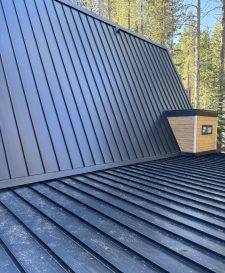
Why Metal Roofing Fits This Area
Rain volume, not just rain frequency
Whatcom County doesn't just get frequent rain — it gets sustained, soaking rain that can sit on a roof surface for days at a stretch during the wetter months. Metal's sealed panel seams and steep water-shedding profile move that volume off the roof fast instead of letting it linger in shingle mat or under moss growth.
Moss pressure on shaded lots
Many Nooksack properties sit on partially wooded lots with a mix of sun and shade across the roof plane. The shaded sections are where moss takes hold first, and once it's established it holds moisture against the roofing material year-round. Metal gives moss far less to grip onto, which doesn't make a roof moss-proof but does slow the problem down considerably compared to a textured shingle surface.
Marine air and material fatigue
Being close enough to Birch Bay and the coastline means salt-carrying air reaches roofs in this area more than homeowners farther inland realize. Over years, that air accelerates the breakdown of some fasteners, coatings, and adhesives. It's a slow process, which is exactly why it's easy to underestimate until a roof starts showing premature wear.
What a Correct Metal Roof Installation Actually Involves
Metal roofing has a reputation as a low-maintenance, long-life product, and that reputation is earned — but only when the installation underneath the panels is done right. A metal roof is only as good as the deck prep, underlayment, and flashing details beneath it. This is where a lot of the problems we get called out to fix originated: not the metal itself, but shortcuts taken putting it on.
- Solid, sound roof decking — any soft or delaminated sheathing gets replaced before a single panel goes down
- A synthetic or self-adhering underlayment rated for the panel type and local moisture exposure
- Ice-and-water shield or equivalent protection at eaves, valleys, and any low-slope transitions
- Proper panel fastening pattern and spacing matched to the manufacturer's wind and expansion specs
- Correctly lapped and sealed flashing at every penetration — vents, chimneys, skylights, and wall transitions
- Ridge and hip caps installed with ventilation in mind, not just appearance
- Compatible fasteners and trim metal so dissimilar metals aren't left to corrode against each other
Skip any one of these steps and the panels themselves — even premium ones — won't perform the way they're rated to. This is also why we walk Nooksack homeowners through exactly what's happening at each stage rather than just showing up and disappearing until it's done.
Metal Roofing Options for Nooksack Homes
Not every metal roof is the same product wearing a different color. The panel type changes how the roof handles water, how it looks, and what it costs. Here's how the common options compare for a wet, tree-covered, coastal-adjacent property like the ones we see in this area.
| Panel Type | Water Performance | Best Fit | Maintenance Notes |
|---|---|---|---|
| Standing seam | Excellent — concealed fasteners, raised seams shed water fast | Steeper roofs, homes prioritizing long-term low maintenance | Very low; seams and fasteners aren't exposed to weather |
| Exposed-fastener panel | Good, if fasteners are maintained | Budget-conscious projects, outbuildings, simpler rooflines | Gaskets under fastener heads should be checked periodically |
| Stone-coated steel | Good — coating adds a textured water-shedding surface | Homeowners wanting a more traditional shingle or shake look | Coating can trap some debris in valleys; needs occasional clearing |
| Aluminum panel | Excellent, especially against salt exposure | Properties closer to the coast with heavier marine air exposure | Won't rust; still needs standard seam and fastener checks |
We don't push one system on every roof. A steep-pitched main house and a lower-slope shop building on the same property might genuinely call for different panel types, and we'll say so rather than installing the same thing everywhere for convenience.
Moss, Moisture, and Salt Air: What Ongoing Care Looks Like
A metal roof cuts down on maintenance, but "low-maintenance" isn't "no-maintenance," especially with this area's moss season stretching across most of the fall through spring. A short annual check catches small issues before they become expensive ones.
What to keep an eye on
- Debris buildup in valleys and against any lower-slope transitions where leaves and needles collect
- Moss or algae starting to establish in shaded areas, particularly under overhanging tree limbs
- Sealant condition at penetrations — vents, flashing, and any roof-mounted equipment
- Fastener heads on exposed-fastener systems, checked for backing out or gasket wear
- Gutter function, since a metal roof can shed water fast enough to overwhelm a clogged or undersized gutter system
None of this requires a specialist visit every few weeks — it's a once- or twice-a-year walk-around, and most homeowners can do a basic visual check themselves between professional inspections.
Our Process for a Nooksack Metal Roofing Project
We keep the process straightforward because roofing projects go wrong most often when communication breaks down, not when the materials fail.
1. On-site assessment
We look at the existing roof, the decking condition, ventilation, and how the property's tree cover and sun exposure will affect long-term performance — not just measure for panels.
2. Honest scope and options
We walk through panel options that actually fit the roof and the budget, including where a mid-range choice is genuinely fine and where it isn't worth cutting corners.
3. Deck prep and correction
Any soft decking, inadequate ventilation, or old flashing issues get addressed before installation — not discovered and patched around afterward.
4. Installation to manufacturer spec
Fastening patterns, underlayment, and flashing details follow the panel manufacturer's specifications so the roof's warranty is actually intact, not voided by a shortcut.
5. Final walkthrough
We go over the finished roof with the homeowner, including what basic upkeep looks like going forward.
Signs a Nooksack Roof Is Due for Replacement
- Granule loss or bald patches showing through on an aging asphalt shingle roof
- Moss established across large sections rather than just a few isolated shaded spots
- Visible sagging along the roofline or soft spots felt underfoot in the attic
- Rust streaking, corroded fasteners, or failing flashing on an older metal or mixed-material roof
- Water stains on interior ceilings, especially near valleys or chimney penetrations
- A roof approaching or past the upper end of its material's expected service life
Any one of these on its own might just need a repair. A few of them together usually means it's time to talk replacement before a small problem becomes a decking or interior repair.
Why a Crew That Already Works Nooksack Matters
Roofing crews that mostly work drier, more open parts of the state don't always account for how much shade, moisture retention, and moss pressure change the math on a property like this. A crew that regularly works Birch Bay and the surrounding Whatcom County area already knows which flashing details tend to fail first in this climate, which panel finishes hold up against the marine air, and where local moss and debris patterns actually cause problems versus where they're cosmetic. That familiarity shows up in the small decisions — where extra underlayment gets added, how ventilation gets planned, which fastener coatings get specified — that a generic install wouldn't necessarily catch.
It also means someone who answers the phone if a question comes up two years after the install, not a crew that was passing through the area for one job.
Get a Straightforward Estimate
If you're weighing a metal roof for a Nooksack-area home, we're happy to take a look, walk the roof, and give you an honest read on what it needs — no pressure, no upsell. Use the form below to request a free estimate and we'll get back to you to schedule a time.