 Birch Bay Siding
 Composite Decking Built for Nooksack's Marine Climate
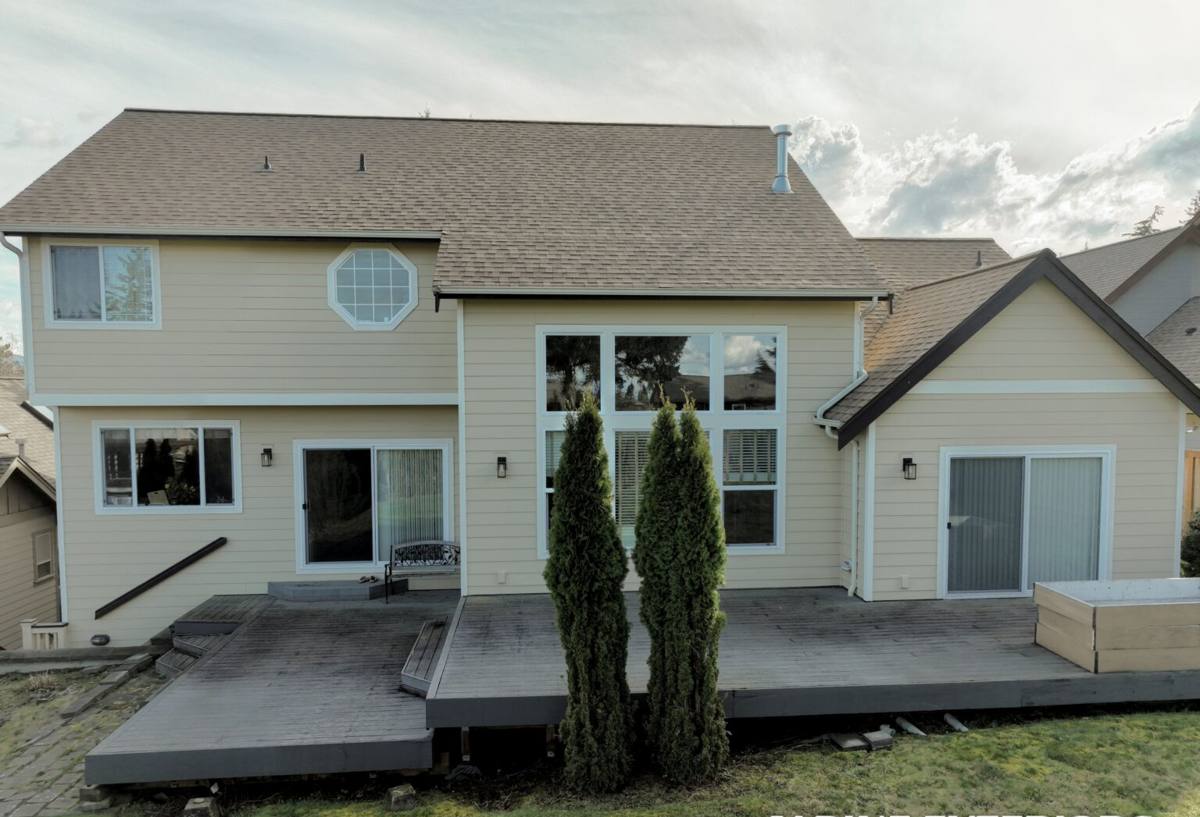
Nooksack sits close enough to Birch Bay and the Salish Sea that homes here deal with a mix most inland decks never see: salty, moisture-laden air blowing off the water, long stretches of driving rain through fall and winter, and a moss season that can run half the year. A deck built for a dry climate, or built with shortcuts that would pass fine somewhere inland, tends to show problems early here — soft spots at the ledger, corroded fasteners, boards that stay slick with algae from October through April. Composite decking, installed correctly for this specific climate, handles all three of those stresses far better than solid wood, but "composite" is not one product with one performance level. What board you choose, how it's fastened, and how the structure underneath is built matter as much as the material itself.
What Salt Air, Rain, and Moss Actually Do to a Deck
Salt Air and Hardware
Airborne salt accelerates corrosion on anything metal — screws, joist hangers, post bases, railing brackets. On a lot of decks we're called to inspect, the boards themselves still look fine while the fasteners underneath are rusting and losing grip. Once a fastener corrodes, it stops holding the board tight, and that's when you get squeaks, movement, and eventually a board that lifts at the edge.
Driving Rain and Hidden Moisture
Wind-driven rain doesn't just fall on a deck, it gets pushed sideways into gaps, under railing posts, and behind ledger boards where the deck attaches to the house. If that connection point isn't flashed and sealed properly, water tracks behind the siding and into the rim joist — a slow, hidden problem that can go unnoticed for years because the surface of the deck looks totally normal.
The Long Moss Season
This region's damp, mild winters are ideal growing conditions for moss and algae, and a deck that stays shaded or doesn't drain well becomes a host surface fast. Beyond the cosmetic issue, wet moss on a walking surface is genuinely slippery, and moss that's allowed to sit holds moisture against the board longer than the board would otherwise experience on its own.
None of these three stresses act alone. Salt speeds up hardware failure, rain finds every gap that hardware failure creates, and moss thrives in whatever moisture is left sitting around. A deck built for Nooksack has to answer all three at once, not just pick the most obvious one.
Composite vs. Wood vs. PVC: What Holds Up Here
There's no single "best" decking material for every situation, but for this climate specifically, here's how the common options compare on the factors that actually matter locally.
| Factor | Pressure-Treated Wood | Composite (Capped) | PVC / Vinyl |
|---|---|---|---|
| Moisture resistance | Absorbs water; prone to swelling, cupping, rot at fastener points | Very low absorption; core resists rot even with heavy rain exposure | Essentially waterproof |
| Moss & algae resistance | Porous surface holds moisture, feeds growth | Capped surface sheds moisture, easier to clean, resists staining | Smooth, non-porous surface; easy to clean |
| Maintenance | Annual sealing/staining recommended | Periodic wash, no sealing or staining needed | Occasional wash only |
| Typical lifespan (this climate) | 10-15 years before major repair or replacement | 25-30 years with proper installation | 25-30+ years |
| Upfront cost | Lowest | Mid-range | Highest |
| Feel underfoot / appearance | Natural wood grain, warms and cools with weather | Wood-look, consistent color, some heat retention in direct sun | Uniform look, lighter underfoot |
We install and recommend capped composite for most Nooksack projects because it lands at the sweet spot between upfront cost, long-term maintenance, and how well it actually performs against salt air and constant moisture. Wood isn't a bad material — it just asks for more upkeep than most owners realistically keep up with here, and that gap shows up as rot within a decade. PVC performs well too and is worth discussing for specific situations, but it costs more and some homeowners don't love the look. It's also worth noting the framing underneath is usually still wood regardless of which decking material sits on top, which is exactly why the flashing and moisture-barrier details at the structure matter as much as the board choice.
What a Correctly Built Composite Deck Includes
The composite boards get the attention, but most of the failures we see trace back to what's underneath and around them, not the decking material itself. A deck built right for this climate includes:
- Footings sized and set to local frost depth and soil conditions, not just poured to minimum code
- Joist spacing tightened to the manufacturer's coastal/high-moisture spec, which is often closer than standard spacing
- Stainless steel or coated corrosion-resistant fasteners and hardware throughout, not just at visible points
- Ledger board flashing and a proper water-resistant barrier where the deck ties into the house
- Joist tape over the top of every joist to keep moisture out of the wood framing under the composite
- Board spacing and end gaps set correctly for composite's expansion and contraction with temperature
- Drainage planned underneath the deck so water doesn't pool against posts or footings
Skip any one of these and the composite boards can still look great on top while the structure underneath is degrading — which is exactly the kind of problem that's expensive to fix later and cheap to build right the first time.
Our Installation Process
We keep this straightforward and honest about what's involved:
- On-site assessment. We look at your existing deck or build site, check drainage, sun/shade exposure, and how the structure will tie into your house.
- Product and layout conversation. We walk through board options, color, and layout based on your home, budget, and how you actually use the space.
- Permitting. Most deck work in this area requires a permit, especially for elevated structures or anything tied to the house. We handle that process.
- Structural prep. Footings, framing, ledger flashing, and joist tape go in before a single composite board is installed.
- Composite installation. Boards go down with hidden or coated fasteners per manufacturer spec, with correct spacing for drainage and expansion.
- Railings and final details. Railings, fascia, stairs, and any trim are installed and checked for code compliance.
- Walkthrough. We go over the finished deck with you, including basic care so it holds up through the wet season ahead.
Picking the Right Board and Fastening System
Not all composite decking is built the same. We steer Nooksack homeowners toward fully capped composite boards — meaning the core is wrapped on all sides with a protective shell — rather than older uncapped composite, which can still absorb moisture at cut ends and is more prone to staining and mold in a wet, shaded climate. Capping matters more here than it would in a dry inland climate, because our boards spend so much of the year damp.
How the boards are fastened matters too. Hidden fastener clip systems leave far less metal hardware exposed to salt air and standing moisture than traditional face-screwing, which reduces the corrosion problem described earlier and gives a cleaner surface with no screw heads to catch water or debris. We use hidden fastener systems wherever the board profile supports it.
Color is worth thinking through too. Darker boards show less algae staining but retain more heat in direct summer sun; lighter and mid-tone colors show dirt and moss growth more visibly but stay cooler underfoot. Streaked or multi-tonal color patterns, which most composite manufacturers offer, do a good job of hiding both dirt and the early stages of moss growth between cleanings — a real practical advantage in a climate where moss is a fact of life, not an occasional nuisance.
Keeping a Composite Deck Clean Through Moss Season
Composite decking is genuinely low-maintenance compared to wood, but "low-maintenance" doesn't mean "no maintenance," especially with a moss season this long. A little regular care keeps a composite deck looking and performing the way it should for decades:
- Sweep debris (leaves, needles, seed pods) off the deck regularly — trapped organic material is what feeds moss and mold
- Rinse with a garden hose every few weeks through fall and winter to keep spores from taking hold
- Use a soft-bristle brush and a composite-safe cleaner for visible moss or algae — avoid pressure washers on the highest settings, which can damage the capped surface
- Keep gutters and downspouts clear so roof runoff isn't dumping extra water onto or near the deck
- Trim back overhanging branches or shrubs that keep sections of the deck shaded and damp
- Check railings and stair connections once a year for movement, even though the boards themselves need little attention
Permits, Railings, and Code Considerations
Whatcom County and most local jurisdictions require a permit for new deck construction, particularly anything over a certain height or attached to the home's structure. Railing height, baluster spacing, and stair rise/run are all governed by code, not preference, and they're the details inspectors check first. We build to code as standard practice, not as an afterthought, and we handle the permit process so you're not stuck figuring out the requirements on your own.
Why a Crew That Already Works Nooksack Matters
A lot of deck problems we get called to fix started with a contractor who does great work somewhere drier, without adjusting for what this climate actually demands — standard fastener spacing instead of tightened, uncapped boards instead of fully capped, no joist tape, minimal ledger flashing. None of those shortcuts show up on installation day. They show up two or three winters later, after enough driving rain and moss season cycles have found every weak point.
Working in and around Birch Bay and greater Whatcom County means we're building to this climate by default, not adjusting for it after something fails. We know what fastener corrosion looks like a few years in, how much moss growth a given exposure and shade combination will produce, and where water actually goes on a deck once the rain starts driving sideways. That's the difference between a deck that needs real attention in ten years and one that's still solid in twenty-five.
If you're planning a new composite deck or replacing one that's not holding up to the weather here, we're happy to take a look and put together a straightforward, no-pressure estimate. Use the form below to get started.