 Birch Bay Siding
 Why Sandy Point Homes Take a Different Kind of Beating
Sandy Point sits close enough to the water that homes here deal with a different climate load than a house a few miles inland in Whatcom County. Salt-laden air moves off the water and settles on exterior surfaces daily, not just during storms. Combine that with the driving rain that comes through Birch Bay in the fall and winter, plus a moss and mildew season that can stretch for months in the shaded, damp conditions typical of this part of the Pacific Northwest, and you get siding conditions that punish anything not built and installed for the job.
Salt air is corrosive to exposed metal fasteners and trim, and it accelerates the breakdown of coatings that aren't formulated to resist it. Driving rain doesn't just fall straight down — wind pushes it sideways and up under laps, seams, and trim edges, which means water management details matter more here than they would on a sheltered inland lot. And moss doesn't just grow on roofs; it takes hold on siding surfaces that stay damp and shaded, especially on north-facing walls and under tree cover, feeding on organic material in the substrate and holding moisture against the wall long after a storm has passed.
None of this means siding is a lost cause in Sandy Point. It means the material choice and the installation details have to be right for this specific environment, not just "good enough" for a typical suburban lot.
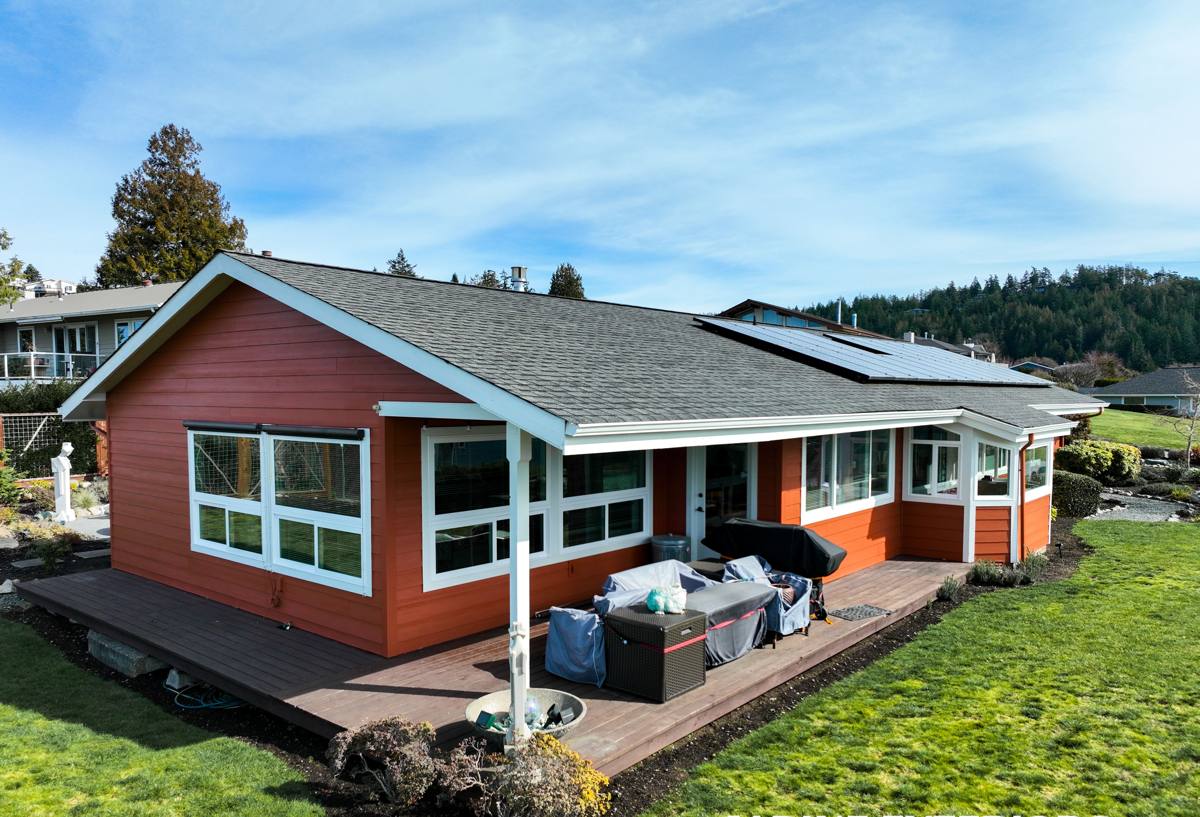
What Sandy Point Siding Actually Needs to Hold Up
Moisture Management First
The single biggest factor in how long siding lasts near the water isn't the paint color or the profile — it's how well the assembly manages moisture. That means a properly lapped weather-resistive barrier behind the siding, correctly integrated flashing at every window, door, and penetration, and enough of a gap and drainage path for water that does get behind the cladding to find its way back out instead of sitting against the wall sheathing.
Material That Won't Absorb and Swell
Wood-based and wood-derived siding products absorb moisture at cut edges and fastener points. In a climate with this much sustained dampness, that absorption cycle — swell, dry, swell again — is what eventually causes delamination, soft spots, and paint failure. A material that resists water absorption at its core removes that failure mode entirely.
Finish That Resists Salt and UV Together
A factory-cured finish holds up differently than a field-applied coat of paint, particularly where salt air and UV exposure are both present. Field-painted surfaces are more prone to chalking and fading in this combination, which is one of the reasons we don't rely on site-applied paint as the primary defense on the homes we side.
Why We Install James Hardie Fiber Cement — and Nothing Else
We standardized on James Hardie fiber cement siding for every home we side, including the waterfront and near-waterfront properties around Sandy Point. We don't install vinyl, LP SmartSide, primed spruce, cedar, or other fiber cement brands. That's a deliberate professional standard, not a sales pitch — it comes down to how these materials actually perform in a salt-air, high-moisture environment over the long run.
Fiber cement is non-combustible and dimensionally stable, meaning it doesn't expand, contract, warp, or absorb water the way wood-based products can. James Hardie's ColorPlus finish is baked on and cured at the factory rather than applied on site, which gives it better, more consistent resistance to fading and chalking in coastal UV and salt exposure than a field-applied coat typically achieves. Hardie also engineers region-specific product lines — including HZ5 formulations built for climates with more moisture exposure — which matters in a spot like Sandy Point where the siding is dealing with salt air and sustained dampness for a meaningful part of the year. Backed by a strong transferable warranty when installed to spec, it's the product we're willing to put our name behind on homes in this area.
How Correct Installation Works Here
1. Assessment and Water Path Planning
Before any siding goes up, we walk the exterior and map out how water currently moves across the walls — where wind-driven rain hits hardest, where shade keeps surfaces damp longer, and where the existing trim, flashing, or sheathing may already be compromised.
2. Substrate and Weather Barrier Prep
Any damaged sheathing gets addressed before it's covered. We install a continuous weather-resistive barrier, properly lapped shingle-style so gravity moves water down and out rather than into seams.
3. Flashing and Penetration Detailing
Every window, door, vent, and penetration gets flashed and integrated with the weather barrier so water is directed out and away rather than trapped behind the cladding — this is the step that matters most for driving-rain performance.
4. Fastening and Clearances to Manufacturer Spec
Hardie siding has to be fastened and gapped according to manufacturer specifications — correct nailing patterns, proper clearance from grade, roof lines, and decks, and the right gaps at butt joints for expansion. Skipping these details is one of the most common ways an otherwise good product underperforms.
5. Trim, Caulking, and Final Detail Work
Corners, trim boards, and joints get sealed with products suited to the coastal environment, and we check that no detail creates a shelf where water or organic debris can collect and feed moss growth.
Material Comparison for a Waterfront Whatcom County Climate
| Material | Moisture Behavior | Salt Air / UV Finish Durability | Maintenance Burden |
|---|---|---|---|
| James Hardie Fiber Cement | Dimensionally stable, does not absorb and swell | Factory-cured ColorPlus finish resists fading and chalking | Low — periodic rinsing and inspection |
| Vinyl Siding | Doesn't absorb water, but can warp or become brittle with temperature swings | Color is molded-in, can fade and become chalky over years of UV exposure | Low, but seams and panels can loosen over time |
| Wood / Primed Spruce / Cedar | Absorbs moisture at joints and cut edges, prone to swelling and rot | Field-applied finishes need more frequent recoating in coastal conditions | High — regular painting, sealing, and moss/mildew treatment |
| LP SmartSide / Other Fiber Cement | Varies by product engineering and installation quality | Depends on finish system and manufacturer climate-specific formulation | Varies — worth comparing warranty and finish specifics directly |
What Drives the Cost of a Sandy Point Siding Job
| Factor | Why It Matters Here |
|---|---|
| Home size and wall complexity | More corners, gables, and trim details mean more flashing and cutting time |
| Substrate condition | Homes with existing moisture damage from years of salt air exposure may need sheathing repair before siding goes on |
| Siding profile and accessories | Lap width, trim style, and corner details affect material cost and install time |
| Access and site conditions | Waterfront lots with limited access or steep grades can affect staging and labor time |
| Existing siding removal | Tear-off of failing wood or vinyl siding adds labor beyond a straightforward re-side |
Because every one of these varies by property, we give firm numbers only after walking the specific home — broad ranges quoted without seeing the house rarely hold up once the details are known.
Checklist: Choosing a Siding Contractor for a Sandy Point Home
- Do they have experience specifically with waterfront or near-waterfront homes in Birch Bay and Whatcom County, not just general siding work?
- Do they explain their flashing and weather-barrier approach in detail, not just the finished appearance?
- Do they install to the manufacturer's published fastening and clearance specifications, and can they explain what those are?
- Do they carry a transferable manufacturer warranty, and do they know what voids it?
- Do they talk honestly about moss, mildew, and moisture as an ongoing reality of this location, not a one-time fix?
- Are they willing to walk your specific home before quoting, rather than pricing from a phone call?
Living With Siding in a Moss-Prone, Salt-Air Location
Even the right material installed correctly benefits from a little homeowner attention in this climate. Periodic rinsing to clear salt residue and organic buildup, keeping gutters clear so water isn't overflowing down the wall, and trimming back vegetation that keeps a wall shaded and damp all extend the life of any siding system. Fiber cement doesn't need the recoating and sealing schedule that wood does, but it's not maintenance-free either — it's simply a much smaller and more predictable list of upkeep than wood or aging vinyl demand in a spot like Sandy Point.
Get a Straight Answer for Your Home
If you're planning a siding project for a Sandy Point home, we're glad to walk the property, look at what the salt air and moisture have already done to the current siding, and give you a clear, no-pressure estimate for a proper James Hardie installation. There's no obligation — just a straight look at what your home needs. Use the form below to get started.