 Birch Bay Siding
 Cottonwood Beach Roofs Take a Different Kind of Beating
Cottonwood Beach sits right up against the water on the Birch Bay shoreline, and that location shapes everything about how a roof ages here. Homes a few miles inland in Whatcom County deal with rain and wind like anywhere else in the Pacific Northwest. Homes on Cottonwood Beach deal with all of that plus a steady dose of salt-laden air blowing straight off the bay. That combination is why roofs here often show wear years before a similar roof would inland, and why storm damage that looks minor from the driveway can be hiding real problems underneath.
Three things do most of the work: salt air that corrodes exposed metal and slowly breaks down asphalt granules, driving rain that gets pushed sideways into laps and seams that were only ever designed to shed water falling straight down, and a moss season that runs long on this coast because the roof rarely gets a real dry-out stretch. None of these are exotic problems. They're just constant, and a roof that's constantly stressed fails differently than one that gets damaged once and then has time to recover.
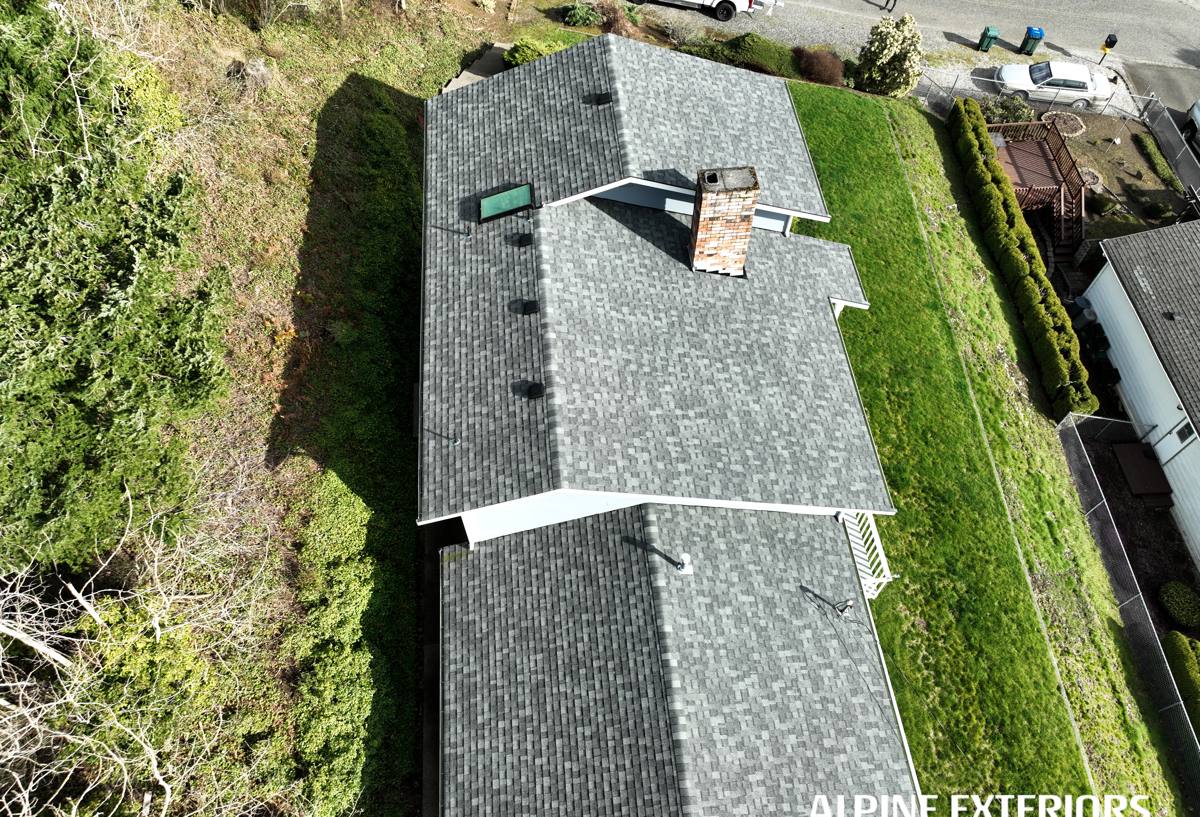
What Storm Damage Actually Looks Like on This Stretch of Coast
Wind-Driven Rain Intrusion
When wind pushes rain sideways off the bay, water finds its way under shingle tabs, around flashing laps, and into any gap that was cut a little too tight during the original install. This kind of intrusion rarely shows up as an obvious leak right away. It shows up months later as a stain on a ceiling, a soft spot in the sheathing, or mold smell in an attic that nobody's checked in a while.
Granule Loss and Salt Exposure
Asphalt shingles are protected by a layer of mineral granules. Salt air accelerates the breakdown of the asphalt binding those granules in place, so a Cottonwood Beach roof can show bald patches and granule loss in the gutters well before its rated lifespan is up. That thinning layer means less UV and moisture protection right when the roof needs it most.
Fastener and Flashing Corrosion
Exposed nail heads, metal flashing, and vent boots take the worst of the salt exposure. Corroded fasteners back out slightly over time, which loosens the shingles around them, and pitted flashing develops pinholes that let water through long before it looks obviously "broken" from the ground.
Moss and Trapped Moisture
North-facing slopes and shaded valleys near Cottonwood Beach rarely dry out fully between rain events. Moss takes hold in the shingle laps, lifts them slightly, and holds moisture against the roof deck. A storm that wouldn't damage a dry, moss-free roof can push water straight through one that's already been compromised by months of moss growth.
What a Correct Storm Damage Repair Actually Involves
A lot of storm repair work in this area gets done as a patch job — a few shingles swapped, a bead of sealant run around a flashing edge, done. That approach can hold for a season, but it doesn't address why the damage happened in the first place, which matters a lot more on a bay-front roof than an inland one. A repair done right starts with figuring out how water got in, not just where it's currently showing.
- Full inspection of the storm-affected slope, not just the visibly damaged section, since wind-driven rain damage often extends past what's obvious from the ground
- Check of the roof deck underneath removed shingles for soft spots, staining, or rot before anything new goes down
- Replacement of corroded fasteners and flashing in the repair area, not just the shingles around them
- Correct shingle lap and nailing pattern re-established, since improperly reset laps are a common source of repeat leaks after a rushed repair
- Self-adhering underlayment in vulnerable spots like valleys, eaves, and around penetrations where wind-driven rain is most likely to get pushed uphill under the shingle
- Moss and debris cleared from the surrounding area so the repair isn't immediately undermined by the same moisture problem that contributed to the damage
Our Process for Cottonwood Beach Storm Calls
1. Fast Assessment
After a storm, the priority is figuring out whether the roof is actively letting water in and how urgent the repair is. We look at the whole affected area, not just the spot the homeowner noticed, since salt-air-weakened shingles nearby are often close to failing too.
2. Temporary Protection When Needed
If there's active leaking or exposed decking, we get it covered to stop further water intrusion before the permanent repair is scheduled. This matters more here than inland — a bay-front roof left exposed through even one more rain event can see damage spread fast.
3. Documentation for Insurance
We photograph and document the damage clearly, which makes the insurance claims process smoother if the homeowner is filing one. We're not an insurance company and don't promise claim outcomes, but a well-documented repair estimate is something adjusters can work with.
4. The Repair
We match materials to what's already on the roof where possible, address the underlying cause of the damage, and don't leave corroded fasteners or degraded flashing in place just because they weren't the exact spot that failed.
5. Follow-Up Check
Given how much moss and moisture cycling affects roofs on this stretch of coast, we're straightforward with homeowners about whether the repair is a durable fix or whether it's buying a few more years on a roof that's approaching the end of its service life.
Repair or Replace? What Actually Drives That Decision
Not every storm-damaged roof needs to be replaced, and not every roof that "just needs a patch" should be repaired instead of replaced. The honest answer depends on a handful of factors that matter more on a salt-air, wind-exposed property than they would elsewhere.
| Factor | Leans Toward Repair | Leans Toward Replacement |
|---|---|---|
| Age of roof | Under 12-15 years, asphalt shingle | Approaching or past typical lifespan for salt-air exposure |
| Extent of damage | Localized to one slope or section | Spread across multiple slopes or repeat leak history |
| Deck condition | Sheathing solid, no rot found | Soft spots or rot found during tear-back |
| Granule loss | Isolated to the storm-damaged area | Widespread thinning across the roof |
| Flashing and fasteners | Corrosion limited to the repair zone | Corrosion visible broadly, especially at valleys and vents |
We'll tell a homeowner directly when a repair is the right call and directly when it isn't — a roof that's fighting salt air and moss on every slope usually isn't a good candidate for another round of spot repairs.
Materials That Hold Up to Bay-Front Conditions
Not every roofing product performs the same way a hundred yards from saltwater. We favor corrosion-resistant fasteners and flashing over standard-grade hardware in this area, since the cost difference is small relative to how much longer it holds up against salt exposure. For underlayment, self-adhering membrane in eaves, valleys, and around penetrations gives real protection against wind-driven rain that a standard felt underlayment won't match on its own. We're upfront that this adds a modest amount to a repair — it's a tradeoff worth explaining rather than skipping.
We're also honest about products we steer away from for this specific environment. Some lower-cost flashing and fastener options simply aren't built for constant salt-air exposure, and using them here means a homeowner is likely back on the phone with us — or someone else — in a few years for a problem that better materials would have avoided. That's a maintenance-burden and longevity conversation, not a knock on any brand; it's just about matching materials to the site conditions.
What to Check After a Storm — A Homeowner's Quick List
- Look for granules collecting in gutters or at downspout outlets — a sign of accelerated shingle wear
- Check the attic (if accessible) for new staining, damp insulation, or daylight coming through the deck
- Note any shingles that look lifted, curled, or missing after high wind, especially on the bay-facing slope
- Check flashing around chimneys, vents, and skylights for visible gaps or rust streaks
- Watch for moss buildup in valleys and north-facing sections, since it holds moisture against the deck
- Photograph anything unusual right after the storm — it helps both the contractor and, if needed, the insurance claim
Why a Crew That Already Works Cottonwood Beach Matters
Storm damage repair isn't just about swapping shingles — it's about understanding why a roof failed in this specific spot. A crew that regularly works Cottonwood Beach and the rest of Birch Bay already knows which slopes take the worst of the wind-driven rain, how fast moss builds back in the shaded valleys here, and which fastener and flashing choices hold up against the salt air instead of corroding out again in a couple of years. That local pattern recognition is the difference between a repair that solves the actual problem and one that just covers up the symptom until the next storm off the bay finds the same weak point.
We also know the practical side of working this neighborhood — narrow access points near the shoreline, weather windows that can close fast when a system rolls in off the water, and the value of getting temporary protection up quickly rather than waiting days for a full repair to be scheduled.
Let's Take a Look
If a recent storm has left shingles missing, flashing lifted, or a leak you can't quite pin down, we're happy to come take a straightforward look and tell you what we find — no pressure, no upsell. Fill out the form below for a free estimate on your Cottonwood Beach storm damage repair.