 Birch Bay Siding
 Windows in Custer Face a Different Set of Problems
Custer sits close enough to the water that homes here deal with a steady diet of salt-laden air, wind-driven rain, and the long gray stretch of moss season that Whatcom County is known for. That combination is hard on window assemblies in ways that inland installations never have to account for. Salt air accelerates corrosion on hardware and fasteners. Wind-driven rain doesn't just fall on a window, it gets pushed sideways and upward into gaps that would stay dry almost anywhere else. And months of damp, shaded conditions give moss, algae, and mildew plenty of time to work into any seam that wasn't sealed correctly the first time.
None of this means Custer homes need exotic products. It means the installation itself has to be more careful than a generic job, particularly around flashing, drainage paths, and the materials used at the sill and jamb. A window that's a perfectly good product can still fail early if it goes in without those details handled for this specific climate.
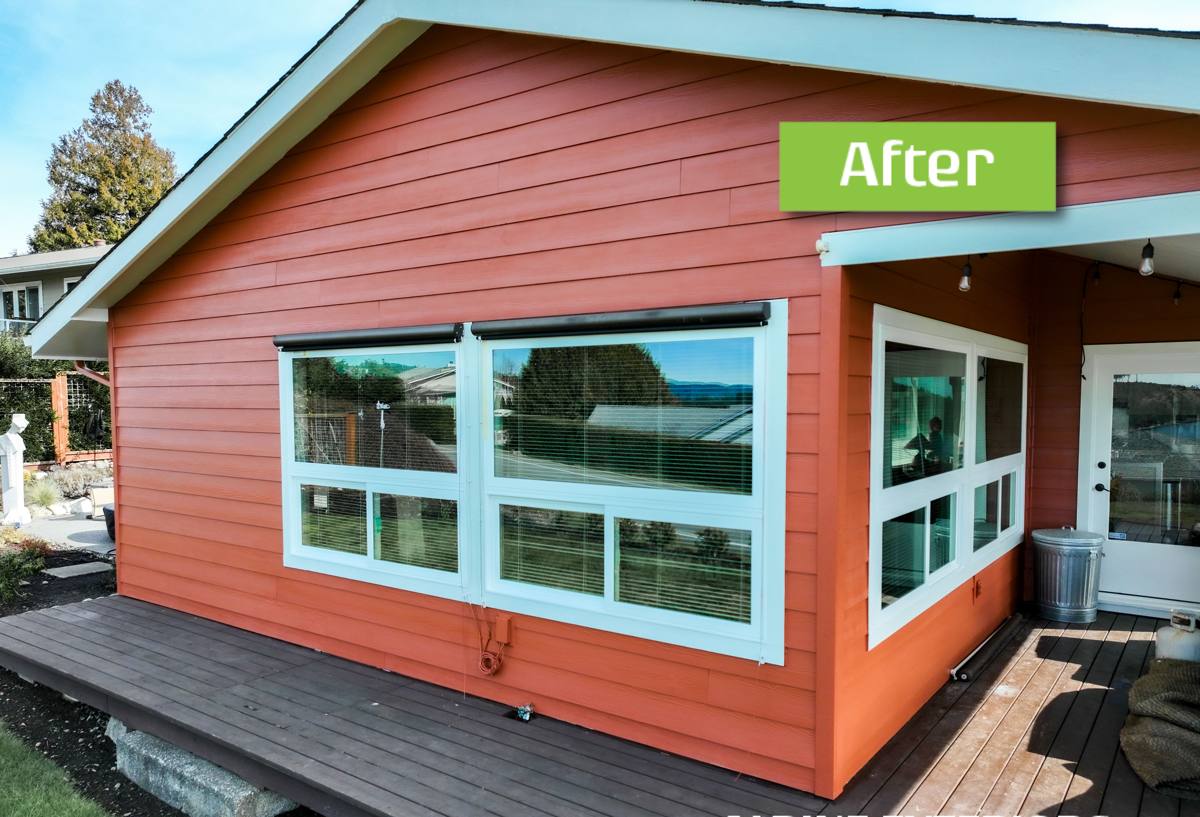
What a Correct Window Installation Actually Involves
A window installation is judged on what you can't see once the trim is back on. The visible frame and glass matter, but the water management behind them is what determines whether the window is still performing well in ten or fifteen years.
Sill Pan and Flashing
Every window opening needs a sloped sill pan that directs any water that gets past the window back outside, not into the wall cavity. Flashing tape needs to integrate correctly with the weather-resistant barrier already on the wall, shingled so water always flows down and over the layer below it, never up underneath it. In a driving-rain environment like Custer, this step is not optional trim work — it's the difference between a window that sheds water and one that slowly feeds it into the framing.
Shimming and Square
A window that isn't shimmed plumb, level, and square will bind, won't lock tightly, and will develop gaps at the corners over time. Uneven pressure on the frame also stresses the seals around the glass itself, which is often where "failed" windows actually start fogging.
Insulation and Air Sealing
The gap between the window frame and the rough opening needs to be filled with a low-expansion foam or backer rod and sealant designed for that purpose — not packed tight with standard can foam, which can bow the frame, and not left open, which lets in both air and moisture.
Exterior Sealant and Trim
The final sealant bead at the exterior trim is the last line of defense. It has to be applied to clean, dry surfaces with a sealant rated for exterior use and UV exposure, because in this climate it will be tested by rain within days of the job finishing, not months.
Signs Your Current Windows Are Losing the Battle
Homeowners in Custer usually don't notice a window problem until it's already been developing for a while. Common signs worth acting on:
- Fogging or a milky haze between the panes of a double- or triple-pane window — this means the seal has failed and the insulating gas has escaped
- Soft or discolored wood at the sill or the interior trim below the window
- A noticeable draft near the frame on windy days, even with the window fully latched
- Windows that are difficult to open, close, or lock — often a sign the frame has shifted out of square
- Visible moss, algae, or black staining building up in the corners of the exterior trim
- Condensation forming on the interior glass or frame during cold, damp mornings
Any one of these on its own might just mean a caulking touch-up. Several together, especially on a window that's original to an older home, usually means it's time to talk about replacement rather than another round of patching.
Choosing the Right Window for a Coastal Whatcom County Property
There's no single "best" window for every home, but there are trade-offs worth understanding before you decide. Our standard is to steer homeowners toward frame materials and glazing that hold up with minimal upkeep in salt air and constant moisture, and to be upfront about what each option asks of you over time.
| Frame Material | How It Handles This Climate | Maintenance Burden |
|---|---|---|
| Vinyl | Doesn't corrode or absorb moisture; performs consistently in salt air | Low — occasional cleaning, no painting or sealing needed |
| Fiberglass | Very stable in temperature swings and moisture; strong long-term option | Low to moderate — durable but a higher upfront cost |
| Aluminum | Conducts cold and can be prone to condensation; hardware needs monitoring for corrosion near salt air | Moderate — watch fasteners and seals over time |
| Wood / Wood-Clad | Handsome, but exposed wood is the most vulnerable to the moisture and moss cycle here | High — regular refinishing and sealant inspection required |
We're honest with clients that a wood-clad window can still be the right visual choice for certain homes, but it comes with an ongoing maintenance commitment that a lot of people underestimate until they've lived with it through a few wet winters. Glazing matters too — a good low-E, dual- or triple-pane unit cuts down on the interior condensation that's common in this climate during cold, damp stretches.
Our Process, Start to Finish
Estimate and Walkthrough
We look at each window opening individually rather than quoting a flat per-window rate sight unseen. Rot, out-of-square openings, and old flashing that needs correcting all change the scope, and we'd rather flag that upfront than run into it mid-job.
Removal and Opening Inspection
Once the old window is out, we inspect the framing and sheathing before anything new goes in. This is the point where hidden water damage from a prior installation typically shows up, and it needs to be addressed before a new window can be installed correctly.
Flashing and Sill Pan Installation
We build the drainage path first — sill pan, then flashing tape integrated with the existing weather-resistant barrier — before the window ever gets set in the opening.
Setting, Shimming, and Fastening
The window gets shimmed plumb, level, and square, fastened per the manufacturer's schedule, and checked for smooth operation before we move to insulation and sealing.
Insulation, Sealing, and Trim
Low-expansion foam or backer rod fills the gap around the frame, and exterior trim goes back with a fresh, properly applied sealant bead rated for our weather.
Cleanup and Walkthrough
We clear debris and old materials from the site and walk the finished windows with the homeowner before calling the job done.
Why It Matters to Hire a Crew That Already Works in Custer
A window installer who mostly works drier, inland areas can still do competent work in general, but they haven't necessarily built the habit of treating flashing and drainage detail as non-negotiable on every single job, because their local conditions don't punish shortcuts the way ours do. A crew that regularly works Custer and the surrounding Birch Bay area already knows how exposed a given property is likely to be to wind-driven rain off the water, understands how moss and algae behave on this side of the county through the wet months, and doesn't need to relearn those lessons on your home.
There's also a practical side to local experience: knowing what typical framing and siding conditions look like in homes built in this area over different decades, and having a realistic sense of what a job should cost and how long it should take here, rather than applying assumptions from a different climate or market.
What Drives Window Installation Costs
Costs vary based on several factors that are worth discussing honestly before you commit to a number:
| Factor | Why It Affects Cost |
|---|---|
| Window count and size | More openings and larger units mean more material and labor time |
| Frame material chosen | Vinyl, fiberglass, and wood-clad options carry different material costs |
| Condition of the existing opening | Rot repair or reframing adds time beyond a straightforward swap |
| Story and access | Second-story or hard-to-reach windows take longer and may need staging |
| Trim and finish work | Matching existing interior trim or exterior siding detail adds labor |
We'd rather walk a property and give a real number than throw out a broad estimate that doesn't hold up once we're on-site. Every home in this area has its own quirks, and a fair quote reflects that.
Keeping New Windows Performing After Installation
Even a correctly installed window benefits from a little seasonal attention, especially given how long our wet season runs:
- Rinse frames and sills periodically to keep salt residue and grime from building up
- Check exterior sealant beads once a year for cracking or separation, particularly after a hard winter
- Clear debris from window wells and sills so water has somewhere to drain rather than pooling
- Keep an eye out for early moss or algae growth in corners and address it before it spreads
- Operate each window a few times a season so hardware doesn't seize up from disuse
None of this is a heavy lift, but skipping it is how a well-installed window ends up looking neglected well before its time in a climate like ours.
If you're dealing with drafty, foggy, or hard-to-operate windows in Custer, or you're planning ahead for a remodel, we're happy to walk the property and give you a straight answer on what it would take. Reach out below for a free, no-pressure estimate.