 Birch Bay Siding
 Deck Building in Sumas: Built for the Weather That's Actually Here
A deck in Sumas doesn't fail because of one bad storm. It fails a little at a time — a fastener that rusts, a board that cups, a ledger board that traps moisture against the house for months without anyone noticing. Whatcom County's marine climate is patient that way. From the salt-tinged air moving in off Birch Bay's shoreline to the damp, shaded stretches further inland near Sumas, the moisture load on an outdoor structure here is constant for most of the year. A deck built with generic, one-size-fits-all methods might look fine for a season or two. Whether it's still solid in year eight depends almost entirely on decisions made before the first board goes down.
This page is about that one job — deck building — for that one area. Not a general contracting pitch, not a catalog. What local conditions demand, what a correctly built deck actually involves, and what our process looks like when we build one in Sumas.
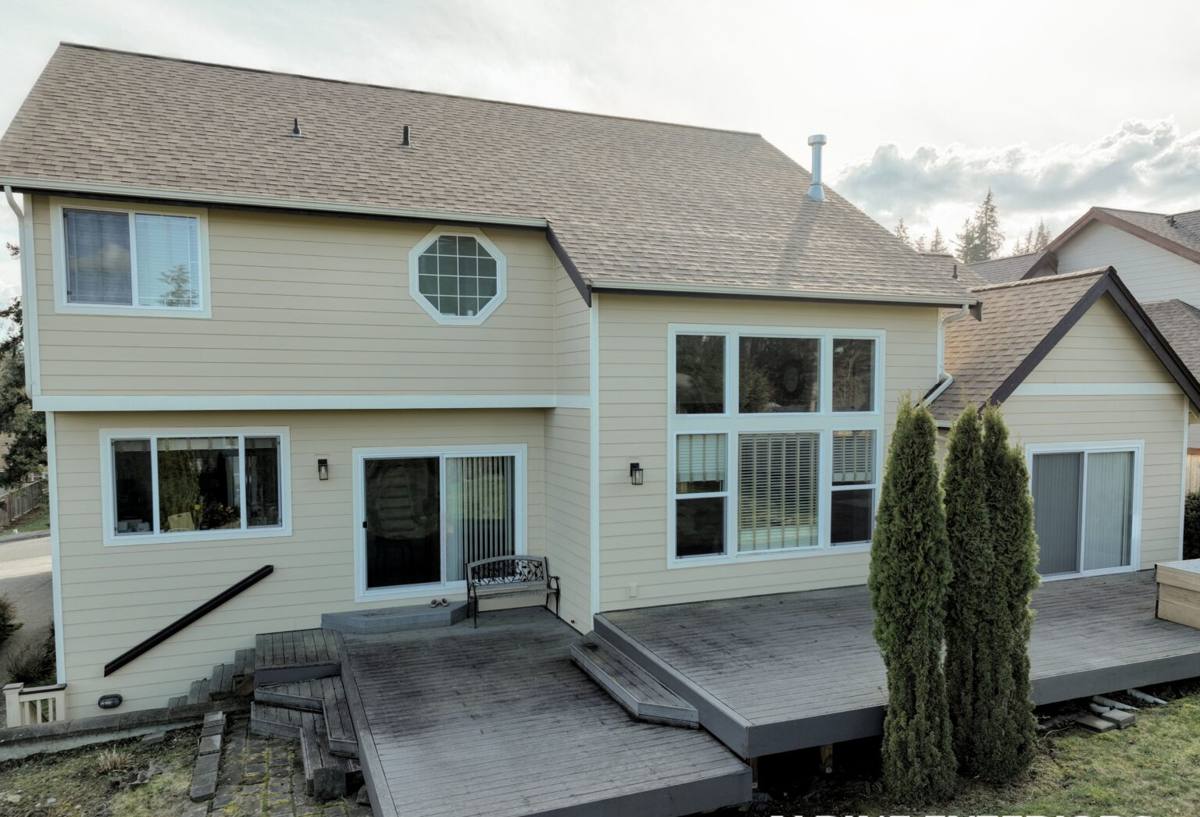
What Sumas's Climate Does to an Outdoor Deck
Whatcom County gets long stretches of low-intensity rain rather than short violent downpours, and that pattern is worse for wood and fasteners than people expect. Water doesn't just fall on a deck — it sits on it, soaks into end grain, and gets trapped underneath in the framing where the sun rarely reaches. Add the region's driving rain events, where wind pushes moisture sideways into ledger connections and rail posts, and you get a structure that's wet from multiple directions, not just from above.
Then there's moss. Whatcom County's moss season isn't a few weeks — it's close to half the year in shaded or north-facing spots. Moss holds water against decking boards and fasteners long after the surrounding air has dried out, which accelerates rot in wood decking and can dull or stain composite surfaces if it's never cleaned off. A deck design that ignores drainage and airflow underneath the boards is signing up for a moss problem from day one.
None of this means a deck in Sumas can't last decades. It means the build has to account for water that lingers, not just water that falls.
The Three Failure Points We See Most
- Ledger board attachment — where the deck meets the house is the single most common source of hidden rot, because flashing is often skipped or installed poorly.
- Fastener corrosion — mismatched screws and hangers (wrong coating for the wood or composite in use) rust or react with treated lumber chemicals over time.
- Poor under-deck drainage — joists and beams sitting in standing water or moss buildup because there was no airflow or drainage plan built into the framing.
What a Correctly Built Deck Actually Involves
A deck is really three separate systems working together: the structure below (footings, posts, beams, joists), the surface on top (decking boards, fasteners), and the connections between the deck and the house or ground. Getting one right and shortcutting another is how decks end up needing major repair well before they should.
Footings and Framing
Footings need to go below the frost line and bear on undisturbed, well-draining soil — something worth confirming rather than assuming, given how variable soil drainage is across different lots. Posts and beams should be sized for the actual span and load, not just "what's always been done," and pressure-treated lumber rated for ground contact belongs anywhere wood is within a few inches of soil or sits in a location that stays damp.
Ledger Flashing
Where a deck attaches to the house, proper flashing — installed in the correct order relative to the house's own weather barrier — is what keeps water from working its way behind the siding and into the wall framing. This is the detail most likely to be rushed on a fast job, and it's also the one most likely to cause expensive hidden damage if it's wrong.
Fasteners and Hardware
Hot-dip galvanized or stainless hardware, matched to whether the lumber is standard pressure-treated or a different chemical formulation, prevents the slow corrosion that loosens joist hangers over years of exposure. This is a small material cost with a large consequence if it's skipped.
Decking Material
Wood, composite, and PVC decking all behave differently under sustained moisture and moss exposure. None of them is automatically "the right answer" — the right choice depends on budget, maintenance appetite, and how shaded or exposed the specific site is.
Choosing a Decking Material for This Climate
| Material | Moisture Behavior | Moss/Mold Resistance | Maintenance |
|---|---|---|---|
| Pressure-treated wood | Absorbs water, dries slower in shaded areas | Needs regular cleaning to prevent moss growth | Periodic staining/sealing every few years |
| Cedar | Naturally moisture-resistant but still needs sealing | Better than treated pine, still needs upkeep | Sealing and cleaning, higher upfront cost |
| Composite | Doesn't absorb water into the board itself | Surface moss/algae still forms and needs washing | Occasional washing, no staining or sealing |
| PVC/capped composite | Fully moisture-resistant surface | Least prone to surface growth, still benefits from cleaning | Lowest ongoing maintenance, highest material cost |
We don't push one material as universally "best." A shaded, low-airflow site near tree cover in Sumas is a very different problem than an open, sun-exposed deck, and the honest answer changes with the site. What we won't do is install a decking system in a location where its moisture and airflow needs clearly won't be met — that's a warranty problem and a homeowner headache waiting to happen, not a good use of anyone's money.
Our Process for a Sumas Deck Build
- On-site assessment — we look at drainage, sun exposure, soil condition, and how the deck will tie into the house before recommending anything.
- Design and material selection — sizing, layout, and material chosen against your budget and the site's actual exposure to rain, shade, and moss.
- Permitting — most deck builds in Whatcom County require a permit; we handle that process so the structure is documented and inspected correctly.
- Footings and framing — footings set below frost line, framing built to span and load requirements, hardware matched to the lumber.
- Flashing and waterproofing — ledger connections and any deck-to-house transitions sealed and flashed before decking goes down.
- Decking installation — boards, fastening pattern, and gapping set for the specific material's expansion and drainage needs.
- Final walkthrough — railings, stairs, and fastener checks, plus a plain-language explanation of what maintenance the deck will actually need.
Why Local Experience on This Specific Job Matters
A crew that mostly builds decks in drier climates will make different — and wrong — assumptions here. They may under-flash a ledger board because it's rarely a problem where they usually work, or specify a fastener that's fine in a dry climate but corrodes within a few years in Whatcom County's damp air. Building decks regularly in this region means already knowing which details can't be shortcut, because we've seen what happens when they are.
It also means knowing the practical side: what typically triggers a permit review locally, how to sequence work around the region's wetter months, and how to talk through material trade-offs honestly rather than upselling whatever has the best margin.
Maintenance: What Actually Keeps a Deck Sound Here
Even a well-built deck needs some ongoing attention in this climate. This isn't about obsessive upkeep — it's a short list of things that make the difference between a deck that lasts and one that doesn't.
- Sweep off standing leaves and debris regularly, especially in fall — trapped organic matter holds moisture against boards.
- Wash off moss and algae buildup at least once a year, more often on shaded sections.
- Check for gaps or separation in flashing where the deck meets the house every year or two.
- Re-stain or reseal wood decking on the manufacturer's recommended schedule — don't wait until it visibly needs it.
- Look underneath the deck occasionally for standing water, sagging joists, or corrosion on hardware.
- Trim back overhanging trees or shrubs that keep sections of the deck shaded and damp longer than the rest.
What Drives the Cost of a Deck Build
| Factor | Why It Matters |
|---|---|
| Size and footprint | More square footage means more footings, framing, and decking material |
| Height off the ground | Taller decks need stairs, additional railing, and stronger structural support |
| Material choice | Wood, composite, and PVC decking span a wide cost range and affect long-term maintenance spend |
| Site access and soil | Difficult access or poor drainage can add labor and footing requirements |
| Site conditions | Shaded, low-airflow areas may need extra drainage or spacing considerations |
| Permitting requirements | Structural review and inspection scheduling can affect timeline and scope |
We give straightforward, itemized estimates rather than vague lump-sum numbers, so you can see what you're actually paying for and where there's room to adjust scope if needed.
Get an Honest Look at Your Deck Project
If you're planning a new deck in Sumas or evaluating whether an existing one is holding up the way it should, we're happy to take a look and give you a straight answer — not a sales pitch. Reach out for a free, no-pressure estimate using the form below.